
What should I do if my stairlift suddenly stops working or stalls partway through its travel?
If your stairlift stops or stalls partway, remain seated, apply the safety belt and avoid forcing the controls or trying to climb off on the stairs. Switch it off if safe to do so, check for an obvious obstruction, and contact Independent Stairlifts for advice and professional assistance.
If your stairlift suddenly stops or stalls partway through its travel, remain seated, keep the safety belt fastened and do not try to climb off on the stairs. Release the control, switch the stairlift off if you can do so safely, check for an obvious obstruction and contact Independent Stairlifts for advice. Do not force the controls, repeatedly restart the lift or attempt a repair while you are on the staircase.
Take these immediate steps:
- Stay seated and secure yourself. Keep both hands and feet inside the stairlift, apply the safety belt and ask anyone nearby to keep clear of the stairs.
- Release the joystick, paddle or control. A control that is held in the travel position can sometimes prevent the lift from resetting correctly. Do not push it harder than normal.
- Check the emergency stop control. If it has been pressed accidentally, release or reset it only if you can do this from your seated position and according to your stairlift instructions.
- Look for a visible obstruction. Check the carriage, footrest and track area for an item of clothing, pet, toy or other object. Do not lean out or reach into moving parts. Only remove an obstruction if it is clearly within reach and can be taken away without changing your position on the stairs.
- Check the key and power position. If your model has a removable key or on/off switch, make sure it has not been moved accidentally. Do not stand up to reach a switch or attempt to access the mains supply from the staircase.
- Try one controlled reset only if advised. Some stairlifts can be reset by switching the power off and on, but the correct procedure varies by model. If the lift does not respond immediately, stop trying and call for professional assistance.
Do not leave the seat on the stairs unless there is no safer alternative. Getting off partway through the journey creates a risk of falling, particularly for anyone with reduced balance, strength or vision. If the lift has stopped close to a landing and you can transfer safely without stepping onto the staircase, wait for advice before moving. If you feel unwell, are injured or cannot remain safely seated, call the emergency services and explain that you are on a staircase using a stalled stairlift.
A stairlift may stall because of a low battery, a loss of mains power, a tripped supply, an activated safety edge or sensor, an obstruction, a control fault or a mechanical problem affecting the carriage or track. A lift may also stop when its safety circuits detect an unsafe condition. The reason cannot always be identified from the symptoms alone, so avoid removing covers or bypassing a safety switch.
If the stairlift stops at the same point each time, makes a grinding, clicking or scraping sound, moves unevenly, stops after starting, or shows a warning light or tone, tell us when you call. Also provide the stairlift make and model if known, its position on the staircase, whether it has power and whether anyone is currently on the seat. This information helps the engineer assess the situation and bring appropriate parts or equipment.
Arrange professional assistance promptly if:
- the stairlift will not move after the basic checks;
- it stops repeatedly or only travels in one direction;
- the batteries do not appear to charge or the power indicator is abnormal;
- there is a burning smell, smoke, heat, sparking or visible damage;
- the safety belt, armrests, swivel seat, footrest or sensors are damaged;
- the lift has become loose, tilted or misaligned; or
- the fault follows unusual noises, vibration, impact or water exposure.
Until the stairlift has been checked, leave it switched off if safe to do so and keep the staircase clear. Do not use a separate handset to send the lift away while somebody is seated, and do not allow another person to push or pull the carriage. A qualified stairlift engineer should diagnose the fault, test the safety features and confirm that the lift is safe before it is returned to service.
Contact Independent Stairlifts as soon as possible for guidance and repair support. We can help establish whether the problem is likely to be a simple power or control issue or whether an engineer needs to attend. If the lift has stopped with you on board, say this when you call so the situation can be treated as a priority and you can be given safe instructions for your particular model.
If your stairlift stalls partway through its journey, remain seated with the safety belt fastened and keep your hands and feet inside the lift. Release the control, ask others to keep clear of the stairs and do not try to climb off, push the carriage or force the controls.
From your seated position, check for an obvious obstruction around the footrest, carriage or track, but do not lean out or reach into moving parts. If there is no safe, obvious cause, stop troubleshooting and contact Independent Stairlifts. Tell us where the lift has stopped, whether anyone is on board, whether there is power and whether you noticed warning sounds, unusual movement or damage.
Leave the stairlift switched off if this can be done safely. A qualified engineer should identify whether the cause is a power, control, sensor, battery or mechanical fault, then test the safety features before the stairlift is used again.
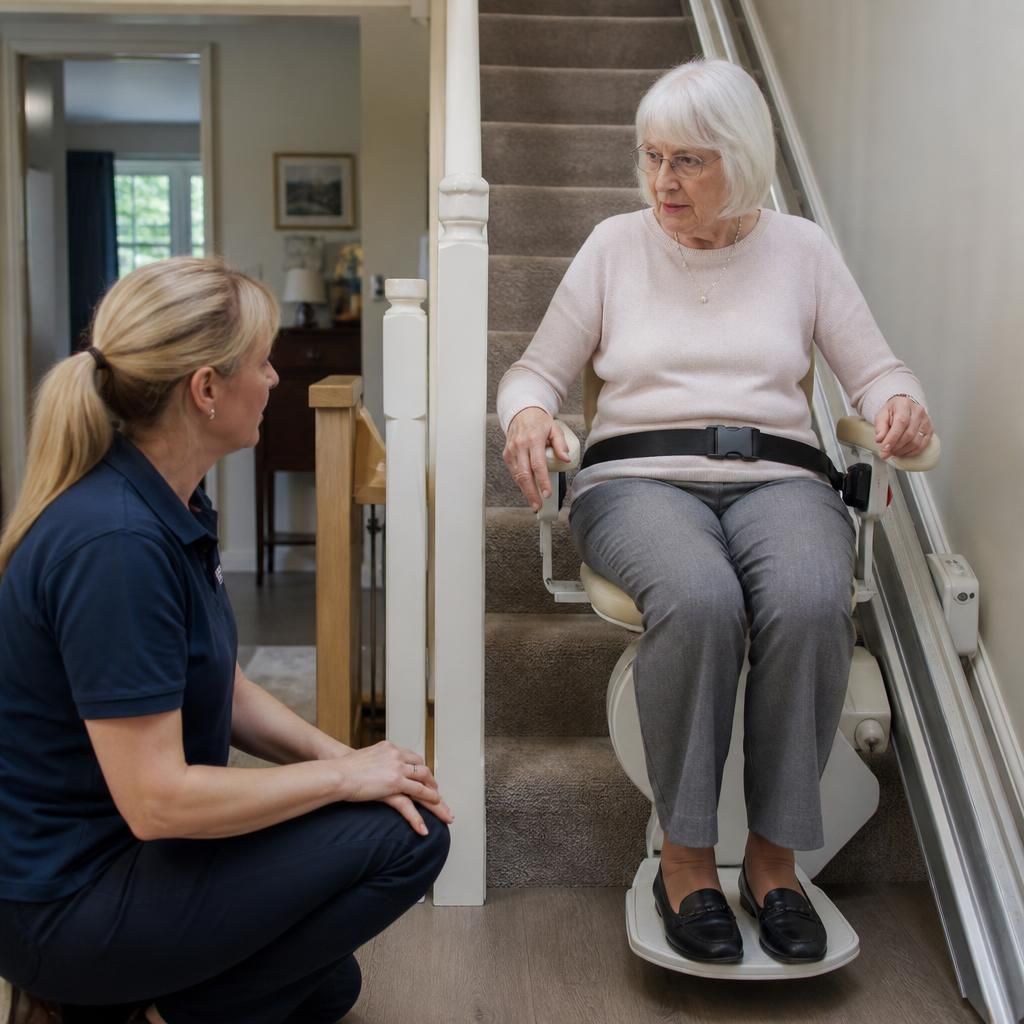
Get Help with a Stalled Stairlift
If your stairlift has stalled or stopped working, contact Independent Stairlifts for practical guidance and professional repair support. Tell us whether anyone is on board and where the lift has stopped so we can advise on the safest next step.