
How should I handle a stairlift that stops responding altogether?
If your stairlift stops responding altogether, check that it is switched on, securely parked on its charging point and that the key, seat and armrest controls are correctly positioned. Do not force the controls or attempt a repair; if it still does not respond, keep the stairlift where it is and contact Independent Stairlifts for professional assistance.
If your stairlift stops responding altogether, stop using it and carry out only the safe checks available to you: confirm that the power supply and key switch are on, the stairlift is correctly parked on its charging point, and the seat, armrests and controls are in their normal operating positions. Do not force the joystick, repeatedly operate the controls or attempt to remove covers. If it remains unresponsive, leave it where it is and contact Independent Stairlifts for professional assistance.
If someone is on the stairs or in the stairlift
- If you are seated in the stairlift, remain seated with the seat belt fastened if one is fitted. Do not try to climb off on the stairs unless there is an immediate danger and you have suitable assistance.
- If the stairlift has stopped at a landing, wait for assistance rather than attempting to move it manually.
- If there is a medical emergency, a fall risk, smoke, a fire or another immediate danger, call the emergency services and follow their instructions.
Safe checks to make before calling
- Check the mains supply. Confirm that the nearby socket or fused supply is switched on and that there has not been a power cut. Do not remove electrical covers or handle internal wiring.
- Check the stairlift’s isolation switch and key switch, if fitted. Both must normally be in the operating position. The location and markings vary between models.
- Park the lift fully on its charging point. A stairlift may not operate if its batteries are low or if it has not made proper contact with the charging contacts. If it can be moved safely using the normal controls, return it to the designated charging position; do not push or pull it along the rail.
- Check that the seat is fully locked in its travelling position, the armrests are lowered if required, and any swivel seat or folding mechanism is correctly secured. Safety switches can prevent movement when a component is not in its expected position.
- Look for an obvious obstruction on the stairs or rail, such as an object, clothing or a pet. Keep clear of the lift and do not reach beneath the carriage or attempt to free anything while the power is connected.
- Check the hand control or remote only if it is safe to do so. Make sure its switch is on, its batteries have not become loose and it is set to control the correct stairlift. If the main controls work but the remote does not, stop using the remote and report the fault.
- Note any warning light, display message, alarm sound or unusual smell. These details can help the service engineer identify whether the issue relates to power, charging, a safety circuit or a mechanical fault.
Some models have a reset or emergency stop procedure, but the correct method is model-specific. Use it only as described in your handbook or by an Independent Stairlifts adviser. Do not repeatedly reset the lift, bridge a safety switch, replace a fuse with a different type or use an external power source. These actions can create a safety hazard and may hide the cause of the fault.
What complete unresponsiveness may indicate
A stairlift with no lights, sounds or response may have lost its mains supply, have depleted or failed batteries, or have a fault in its control or safety circuit. If the lift powers up but will not travel, the cause may instead be a seat or armrest interlock, charging contact issue, obstruction, control fault or mechanical problem. These symptoms cannot reliably identify the failed component without testing, so avoid dismantling the stairlift.
When you contact Independent Stairlifts, provide the stairlift make and model if known, its position on the stairs, whether anyone is using it, whether any lights or alarms are present and what checks you have already made. If the lift is under a service agreement or warranty, use the relevant support route and do not arrange unauthorised repairs before checking the terms.
Until the fault has been assessed, keep the stairlift out of use and make sure other people know not to operate it. A qualified engineer can test the supply, charging system, batteries, controls, safety devices and drive components, then advise whether a repair, replacement part or further assessment is required.
A stairlift that stops responding altogether should be treated as an out-of-service appliance, not as a fault to overcome by force. Keep it stationary and carry out only simple external checks, such as confirming the power supply and key switch are on, the seat and armrests are correctly positioned, and the lift is properly parked on its charging point.
Do not push the stairlift along the rail, remove covers, bridge a safety switch or repeatedly press the controls. If someone is seated on the lift, they should remain seated with the belt fastened if fitted and wait for suitable assistance. If the lift remains unresponsive, contact Independent Stairlifts and provide its position, any warning lights or alarms, and the checks already completed. An engineer can safely test the charging system, batteries, controls, safety circuits and drive components.
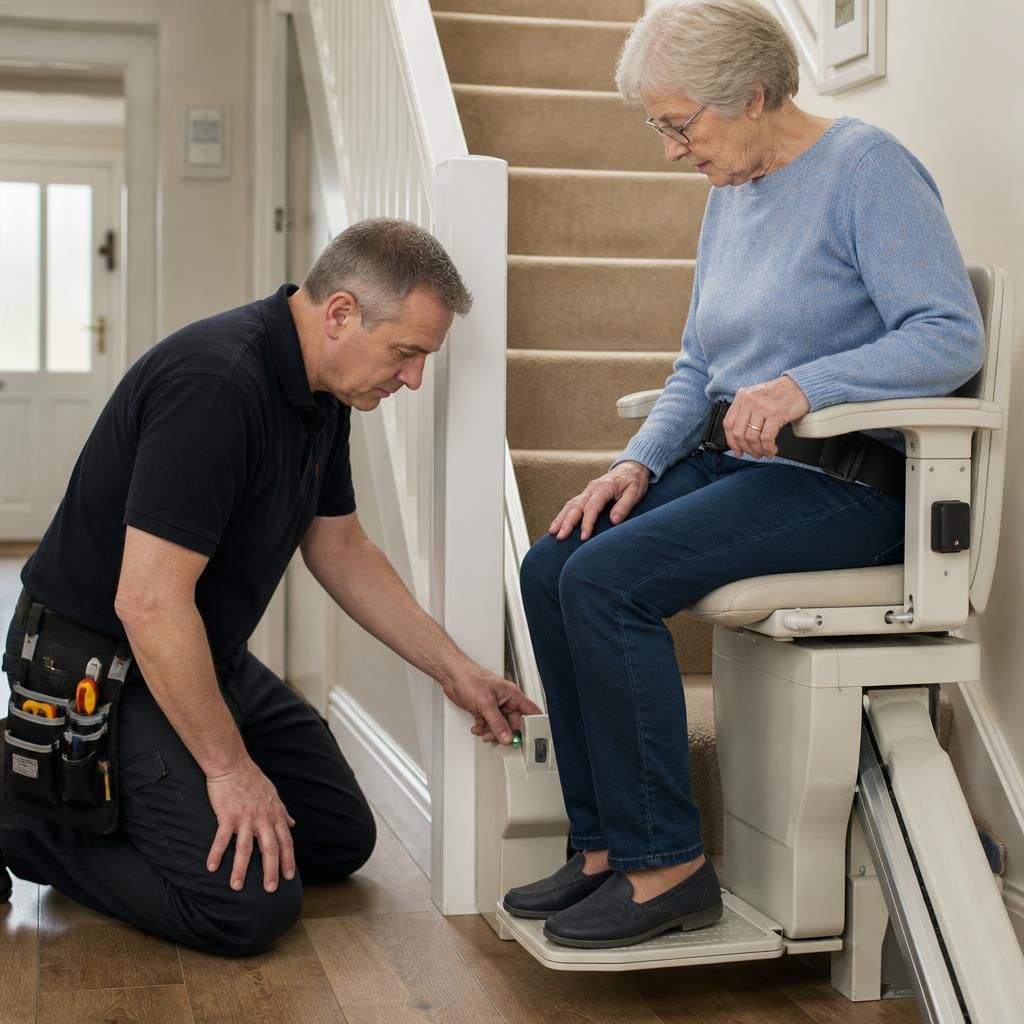
Need Help With a Stairlift That Won’t Respond?
If your stairlift remains completely unresponsive after these safe checks, keep it out of use and contact Independent Stairlifts for a professional repair assessment. Tell us its position, make and model if known, and any warning lights or alarms.