
What can I expect during the stairlift installation process?
During stairlift installation, a trained fitter checks the staircase and surrounding space, positions and secures the track, connects the stairlift, and tests its operation and safety features. They then explain how to use the lift safely, answer your questions and confirm that it is working correctly before completing the installation.
During a stairlift installation, a trained fitter checks the staircase and surrounding areas, positions and secures the rail, fits the stairlift and connects its power supply, then tests the equipment and explains how to use it. The exact work depends on whether your staircase is straight, curved or external, but the installation should be planned around the structure of your home, the user’s needs and safe access at every stage.
Before the installation begins
Your survey information will normally be reviewed before the fitter arrives. This includes the shape and dimensions of the stairs, the position of doors and landings, available clearance, the location of the top and bottom of the rail, and any features that could affect installation. For a curved stairlift, the rail is made or configured to follow the individual staircase. A straight stairlift generally uses a simpler rail, but the fitter still needs to consider the approach to the stairs and how the seat will be used at each end.
If anything has changed since the survey, tell the installation team before work starts. This could include new flooring, alterations to a doorway, furniture being moved, a change in the intended user, or a change in mobility. These details can affect the position of the lift or the way it is accessed. If the proposed installation requires an electrical socket, a hinged rail, a different seat configuration or another adaptation, this should be confirmed with you in advance wherever possible.
Preparing the area
You should make the staircase and the areas at the top and bottom as clear as reasonably possible. Remove loose objects, ornaments and items stored on the stairs, and make sure the fitter can reach the staircase and any required electrical points. It is also helpful to keep pets and other household members away from the work area while tools and materials are being used.
There is usually no need to remove every item of furniture from your home. However, furniture near the stairs may need to be moved temporarily so that the fitter can work safely and check that the stairlift can park correctly. If you need help preparing the area, discuss this beforehand rather than attempting to move heavy items yourself.
Positioning and securing the rail
The rail is normally fixed to the stair treads or another suitable structural surface, rather than relying solely on the wall. The fitter positions it to provide a safe travel path while retaining practical access to the staircase. On a curved staircase, the rail is aligned with each bend, landing and change in gradient. On an outdoor installation, the materials and fixing method must also be suitable for the external location and expected weather exposure.
The fitter will check clearances around handrails, doorways, radiators and other obstructions. The final position may need to balance several requirements: allowing the user to sit down and stand up safely, keeping the stairway as usable as possible for other people, and ensuring the stairlift can park without blocking a landing or doorway. If the planned position cannot be used safely because of an unforeseen feature, the fitter should explain the issue and agree any suitable alternative with you before proceeding.
Fitting the stairlift
Once the rail is secure, the carriage, seat and other components are fitted. Depending on the model, this may include armrests, a footrest, a swivel seat, a safety belt, sensors, controls and charging contacts. The stairlift is connected to its battery and charging system, and the fitter checks that cables and connections are protected and positioned safely.
Some installations include features designed for the particular staircase or user. These might include a powered swivel seat to help with transfers, a hinged rail where a doorway or walkway is close to the bottom of the stairs, or a different control arrangement for someone with limited hand movement. Not every feature is suitable for every home, so the fitter should demonstrate the equipment that has been installed and explain its purpose.
Testing and safety checks
The stairlift should be tested through its full operating route, including starting, stopping, parking and charging. The fitter checks that the lift travels smoothly, responds correctly to the controls and stops when it reaches the intended points. Safety edges and obstruction sensors are checked so that the stairlift does not continue travelling if it detects an object in its path. The seat, armrests, footrest, belt and swivel mechanism are also checked where fitted.
Testing may include confirming that the lift operates from its controls and any remote controls supplied, that it charges correctly at its parking positions, and that the user can reach the controls comfortably. The fitter should also check that the rail and fixings are secure and that the stairlift does not interfere with doors, landings or normal movement around the staircase.
Demonstration and handover
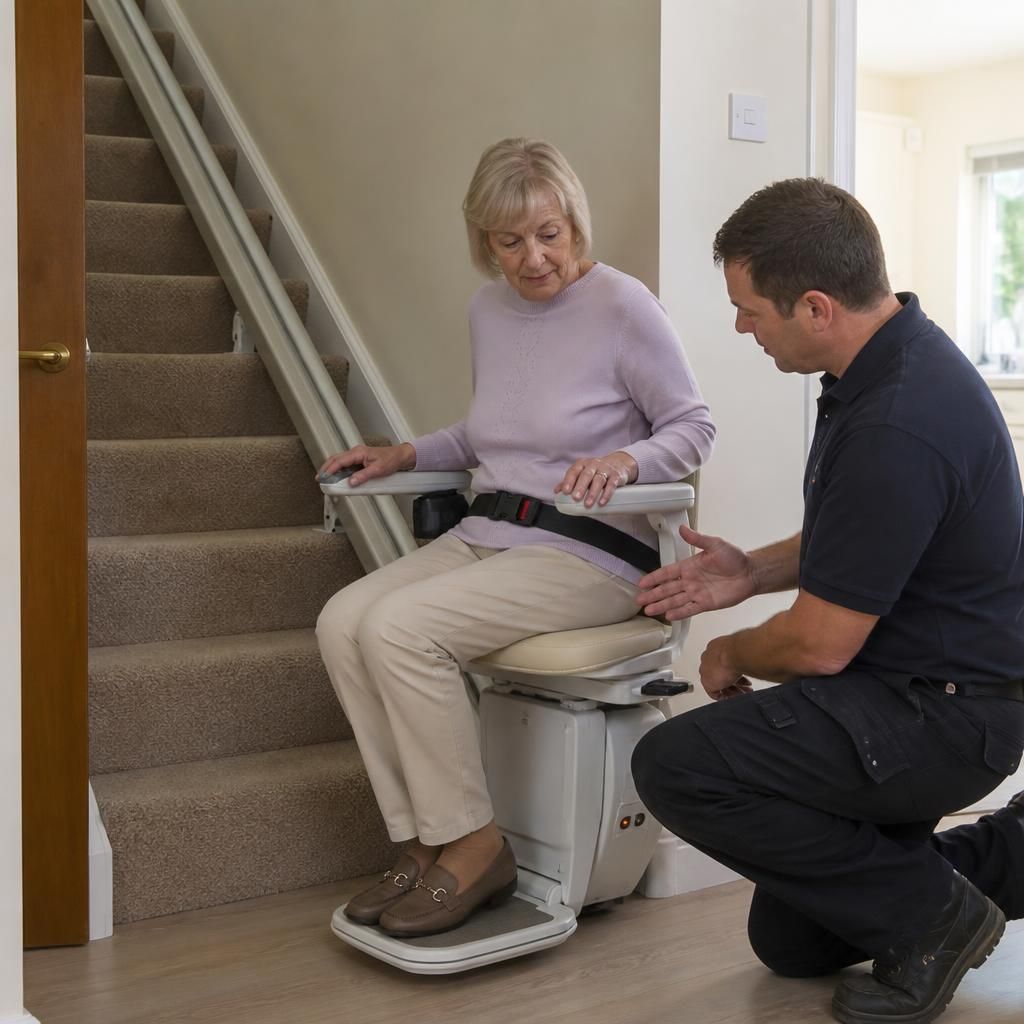
After testing, your fitter should show you how to use the stairlift safely. This normally covers:
- calling or sending the stairlift using the controls or remote control;
- approaching the seat, using the swivel function if fitted, fastening and releasing the safety belt, and sitting with your feet correctly positioned;
- starting and stopping the lift, and using the controls without leaning or reaching unnecessarily;
- parking the stairlift and leaving it on charge as instructed;
- using the emergency stop or other safety controls;
- what to do if the stairlift stops, sounds an alert or loses power; and
- basic cleaning, routine care and how to contact the service team if assistance is needed.
You should have an opportunity to operate the stairlift yourself rather than only watching a demonstration. Ask the fitter to repeat any part of the explanation that is unclear, particularly if the user has difficulty with balance, vision, hearing, memory or hand strength. If a family member or carer will operate the lift or help with transfers, they should be included in the handover.
After the installation
The fitter should leave the staircase and surrounding work area tidy, remove installation waste and confirm that the stairlift is ready for use. You should receive the relevant operating information, safety guidance and details of who to contact for servicing or repairs. Keep these details somewhere accessible, and make sure everyone who may use the stairlift understands the safety instructions.
Installation work can create some noise and temporary disruption, particularly while fixings are being made. The length of the visit varies according to the type of stairlift, the staircase and any adaptations required. Your fitter should tell you about any expected disruption and identify anything that needs further attention before completing the work. If you notice unusual movement, repeated warning sounds, damage or a change in performance after installation, stop using the stairlift if it is unsafe to do so and contact the service team for advice.
The final testing and handover are essential parts of the stairlift installation process. Before the fitter leaves, the stairlift should be operated along its full route and checked for smooth travel, secure fixings, correct stopping, reliable charging and effective safety sensors.
Your fitter should then demonstrate how to approach the seat, use the swivel function if fitted, fasten the safety belt, operate the controls and park the stairlift correctly. You should have the opportunity to use it yourself and ask questions. If a family member or carer will provide assistance, they should also take part in the handover.
Make sure you understand what to do if the stairlift stops, sounds an alert or loses power, and keep the operating and service information somewhere accessible. Any unusual movement, repeated warning sound or change in performance should be reported to the service team before continued use.
Speak to our team about your stairlift installation
If you have questions about your stairlift installation, speak to our team for practical advice about the fitting, preparation or handover.