
What are the primary safety features to look for in a stairlift installation to ensure user confidence and security?
Key stairlift safety features include a secure seat and seat belt, powered swivel and braking controls, obstruction sensors, dependable battery backup, and safety edges that stop the lift if it meets an obstacle. During installation, these features should be correctly adjusted and tested for the user, staircase and access points so the stairlift operates securely and confidently at home.
The primary safety features to check in a stairlift installation are a correctly fitted seat and seat belt, secure swivel and braking controls, obstruction sensors, safety edges, reliable battery backup and accessible user controls. These features must be adjusted and tested for the individual, the staircase and the access points at the top and bottom, rather than treated as standard add-ons.
Secure seating and restraint are the starting point. The seat should provide stable support while the lift is moving, with armrests that help the user maintain a secure position. A properly adjusted seat belt should be easy for the user to fasten and release, while remaining secure during travel. The installer should check that the belt sits correctly across the user and is not obstructed by clothing, armrests or the seat swivel mechanism. Where a user has particular postural or balance needs, the seating arrangement should be discussed during the assessment.
A powered swivel seat and locking mechanism help the user get on and off the stairlift safely. At the top landing, the seat should turn far enough away from the staircase to provide a stable exit position, where the design allows. The lift should not travel unless the seat and swivel are correctly locked in place. The installer should confirm that the swivel release is not operated accidentally while the lift is moving and that the landing provides enough space for the user to stand or transfer safely.
Safety edges and obstruction sensors are essential for detecting objects on or beside the track. If the footrest, carriage or another protected part of the stairlift meets an obstruction, the system should stop the lift rather than continue against it. During installation, the staircase should be checked for items such as rugs, loose flooring, furniture, doorways, pets’ access and changes in wall clearance that could interfere with movement. Sensors should be tested in both directions where appropriate, and the user should be shown what to do if the lift stops because an obstruction has been detected.
Reliable braking and controlled movement prevent the stairlift from rolling freely or stopping abruptly. The carriage should start and stop smoothly, remain stable on the rail and hold its position when the controls are released. A correctly installed system should also prevent travel when essential safety conditions are not met, such as an unlocked seat or an incorrectly positioned swivel. Testing should include the full staircase, not only a short section near the installation point.
Battery backup and charging are important because most stairlifts are designed to operate during a mains power interruption. The charging points should be positioned so that the lift can charge when parked, without creating a trip hazard or blocking a landing. The installer should check that the batteries charge correctly, explain warning tones or indicators and confirm the procedure for using the lift if the power supply fails. Batteries are consumable components, so future replacement and routine checks should be included in the aftercare guidance.
Simple, well-positioned controls reduce the risk of unintended operation. The armrest control should be easy for the user to operate without stretching or changing position. Remote controls can be useful where the stairlift needs to be called to a different level, but they should be kept where they are accessible without encouraging the user to stand on the stairs. Controls should include clear indications of direction and status, and the user should understand how to stop the lift safely.
An accessible emergency stop and alarm function can provide additional protection if the user becomes unwell or the lift develops a fault. The location and operation of these controls should be demonstrated during handover. The user, and anyone likely to assist them, should also know how to report a fault and what not to do if the stairlift stops between floors. For a user who may be alone for periods, the installation assessment should consider access to a telephone or other means of calling for assistance.
A correctly designed and secured rail is a safety feature in its own right. The rail must follow the staircase accurately, remain clear of steps and landings, and be firmly fixed without weakening or obstructing the surrounding structure. On a curved staircase, the design should account for bends, changes in pitch, intermediate landings and available clearance. On a straight staircase, the installer should still check the rail position at the top and bottom, including any effect on doors, hallways and escape routes. Outdoor installations require suitable protection against the local weather and surface conditions.
Footrest protection and safe transfers should also be checked. The footrest should support the user’s feet without creating an unnecessary obstruction on the stairs. Safety sensors around the footrest can stop the lift if it contacts an object. The distance between the seat, footrest, steps, walls and handrails should be reviewed for the user’s leg length and posture. At both ends of the staircase, the installer should confirm that the user can approach, sit down, stand up and move away without twisting into an unsafe position.
Installation checks should cover more than the stairlift itself. The fitter should inspect the staircase, landings, flooring, lighting, handrails and nearby doors, then identify anything that could affect safe use. If a handrail needs to be moved, a door requires adjustment or a landing is unusually restricted, the implications should be explained before work is completed. The finished installation should not create a new trip hazard or prevent normal use of the staircase by other household members.
Before the installation is signed off, ask for a practical demonstration covering:
- fastening and releasing the seat belt;
- using the armrest control and remote controls;
- swivelling and locking the seat at the landing;
- recognising and clearing an obstruction safely;
- parking the lift so that it charges;
- responding to a power interruption, warning tone or fault indication;
- using the emergency stop or alarm controls; and
- contacting the installation and aftercare team when assistance is needed.
The installer should allow the intended user to operate the stairlift, not simply watch a demonstration. Any difficulty with reaching the controls, fastening the belt, judging the landing position or transferring from the seat should be addressed before the fitter leaves. Written operating and maintenance information should be retained, and everyone who may use or assist with the stairlift should understand the basic safety procedure.
Finally, safe operation depends on ongoing maintenance as well as the original fit. Keep the rail and charging areas clear, do not carry loads that interfere with the controls or seat belt, and report unusual noises, jolting, repeated stops, battery warnings or changes in movement promptly. Never bypass a sensor or attempt an electrical or mechanical repair yourself. A properly assessed, installed, tested and maintained stairlift gives the user clear control over each journey while ensuring that the main risks are managed by the equipment.
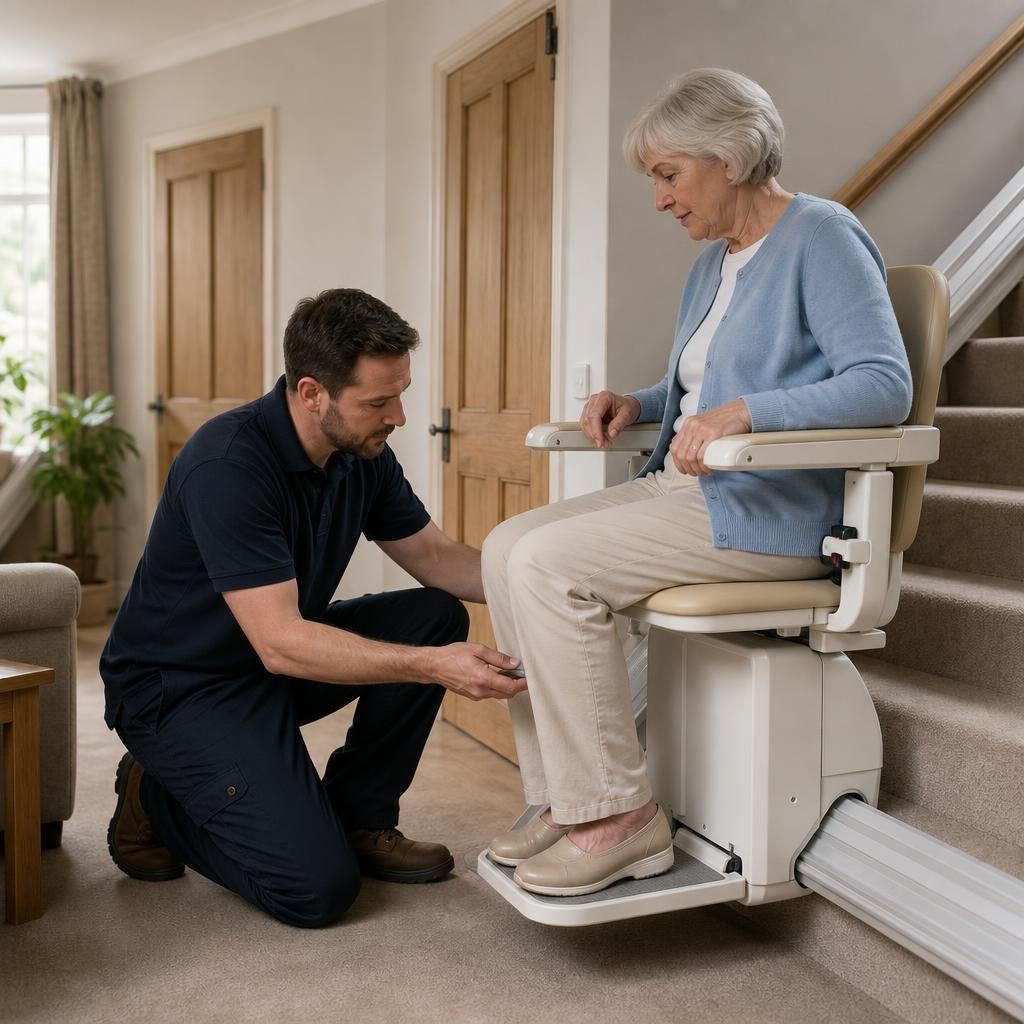
A practical handover check confirms that the stairlift’s safety features work for the individual user, not just in theory. The installer should demonstrate the seat belt, swivel seat, armrest controls, obstruction sensors, emergency stop and battery warnings, then allow the user to operate each function themselves.
Pay particular attention to transfers at the top and bottom of the stairs. The seat should swivel and lock securely, the user should have enough space to stand safely, and the controls should be reachable without leaning or stretching. The installer should also explain what to do if the stairlift stops, encounters an obstruction or loses mains power. Any difficulty with posture, balance, fastening the belt or understanding the controls should be resolved before the installation is signed off.
Arrange Your Stairlift Safety Check
Arrange a stairlift safety check with our team to confirm that the seat, controls, sensors, battery charging and access points are working safely for the user and staircase.