
What should I expect during a stairlift site survey at my home?
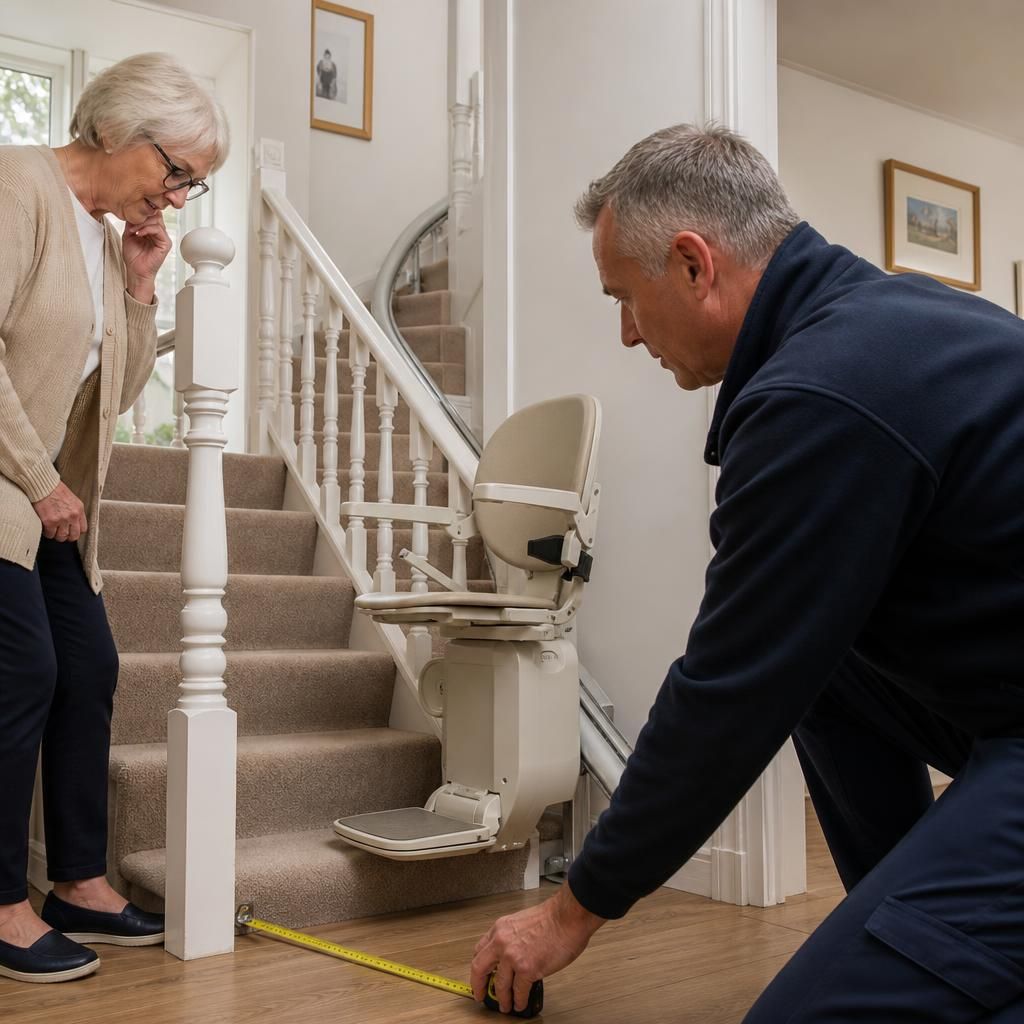
During a stairlift site survey at your home, a specialist will assess your staircase, available space, access points and individual mobility requirements to determine the most suitable solution. They will take detailed measurements, discuss suitable stairlift options, explain the installation process and provide clear, personalised advice and a no-obligation quote.
A stairlift site survey is an in-home assessment carried out by a qualified adviser to establish whether a stairlift can be installed safely, which configuration is suitable and how it will work for the person using it. The survey normally covers the staircase, surrounding space, access to the property, the user’s mobility requirements and any practical installation considerations. It is also your opportunity to ask questions before receiving clear, personalised advice and a no-obligation quotation.
During the visit, the surveyor will usually:
- Inspect the full staircase, including the top and bottom landing areas.
- Take detailed measurements and assess the available clearance around steps, doorways, radiators, furniture and other obstructions.
- Check the position of the bannister, walls, skirting boards, architraves and any changes in direction or gradient.
- Consider how the stairlift will start and finish, including whether a standard, hinged, folding or other rail arrangement is appropriate.
- Discuss your mobility, balance, transfer ability, comfort, weight requirements and how you expect to use the lift.
- Assess access to the home and the route needed to bring equipment inside without unnecessary disruption.
- Identify any electrical, structural or access issues that could affect the proposed installation.
Measurements are particularly important on a curved or unusually shaped staircase. The surveyor may assess multiple sections, intermediate landings, tight turns, narrow areas and the position of doors or other fixtures. On a straight staircase, the assessment is generally more straightforward, but the available space at the top and bottom still needs to be checked carefully. Outdoor staircases require additional consideration of weather exposure, surface conditions, drainage, power and the protection of equipment.
The surveyor will also look beyond the staircase itself. A stairlift needs to leave sufficient room for the user to get on and off safely, and the final position should not obstruct a doorway, hallway or important route through the home. If there is limited landing space, the surveyor can explain possible arrangements, such as a different seat position, a folding rail or a configuration that parks the lift in a more suitable location. Any proposed solution should take account of how other household members use the stairs.
Your individual requirements form an important part of the assessment. You may be asked about difficulty with walking, standing, bending, transferring between a chair and the stairlift, or using controls. The surveyor can discuss features such as powered swivel seats, adjustable footrests, alternative control positions, seat belts, easy-to-use controls and weight capacity. If more than one person may use the stairlift, mention this during the visit because it may affect the model or settings selected.
It is helpful to explain any changes you expect in the user’s mobility, but the surveyor should not make assumptions based only on the staircase. Comfort, confidence and safe operation matter just as much as physical fit. If the user has particular difficulties, such as reduced grip, limited knee movement or trouble turning at the top of the stairs, describe these as specifically as possible. This helps Independent Stairlifts recommend a solution that is practical for everyday use rather than simply one that fits the rail route.
The surveyor will explain where the stairlift is likely to be installed and how it will operate. They can outline the expected route of the rail, parking position, charging arrangements and the way the seat and controls are used. If there are alternative layouts or models, you should be told how they differ in terms of space, comfort, operation and installation requirements. Ask for clarification if you are unsure about any feature or if the proposed arrangement does not seem convenient for the user.
Most stairlifts are fixed to the stairs rather than the wall, so extensive structural work is not normally required. However, the survey may identify matters that need attention before installation, such as damaged steps, unsuitable surfaces, restricted access, a required electrical supply or a fixture that must be moved. These points should be explained clearly, including whether they are essential, who is responsible for them and whether they affect the quotation.
After completing the assessment, Independent Stairlifts will use the information gathered to determine the most suitable stairlift and installation approach. The quotation should reflect the staircase layout, selected features and any additional work identified during the survey. Before accepting it, check that it describes the proposed equipment, installation arrangements, price, any assumptions and what happens next. A site survey is intended to prevent avoidable surprises by identifying practical issues before installation begins.
You do not normally need to make special changes before the visit, but the surveyor will need access to the entire staircase and nearby landings. If possible:
- Clear loose items, shoes and storage from the stairs and landing areas.
- Make sure doors, cupboards and rooms near the staircase can be accessed.
- Have details available about the user’s mobility needs, height, weight requirements and any relevant medical or practical considerations.
- Tell the surveyor about pets, children, other residents or routines that could affect how the stairlift is used.
- Raise concerns about privacy, noise, access, cleaning or disruption so they can be considered in the installation plan.
The survey is also the right time to discuss installation day. Ask how the installers will protect flooring and walls, how long the work is expected to take, whether the staircase will remain usable during the work and how the finished stairlift will be demonstrated. Independent Stairlifts should also explain the relevant safety checks, handover information, servicing guidance and what to do if you need assistance after installation.
At the end of the visit, you should understand whether a stairlift is suitable for the staircase, which model or configuration is being recommended, what adaptations may be needed and what the next steps are. If the surveyor cannot confirm a detail immediately, ask for it to be included in the written quotation or follow-up information. Taking notes and involving the main user, or a family member who helps with their care, can make it easier to compare the advice with your day-to-day needs.
A stairlift site survey assesses how the proposed lift will work for the individual user, not just whether it will fit the staircase. The surveyor will discuss balance, transferring onto the seat, bending, grip, control use and any difficulty turning at the top or bottom of the stairs.
Explain these practical needs as clearly as possible, including any expected changes in mobility. This helps Independent Stairlifts recommend suitable features, such as a powered swivel seat, alternative control position, adjustable footrest or appropriate weight capacity, so the finished installation is safe and comfortable to use every day.
Arrange Your Stairlift Site Survey
Arrange your stairlift site survey with Independent Stairlifts to assess your staircase, discuss your requirements and receive personalised advice with a clear, no-obligation quote.