
How does a stairlift site survey help in selecting the appropriate stairlift model for diverse user needs, such as weight capacity or specific mobility challenges?
A stairlift site survey assesses your staircase, available space and individual mobility needs—including weight capacity, posture, transfer ability and control access—to identify the most suitable model. It also confirms whether a straight, curved, outdoor or reconditioned stairlift can be installed safely and comfortably in your home.
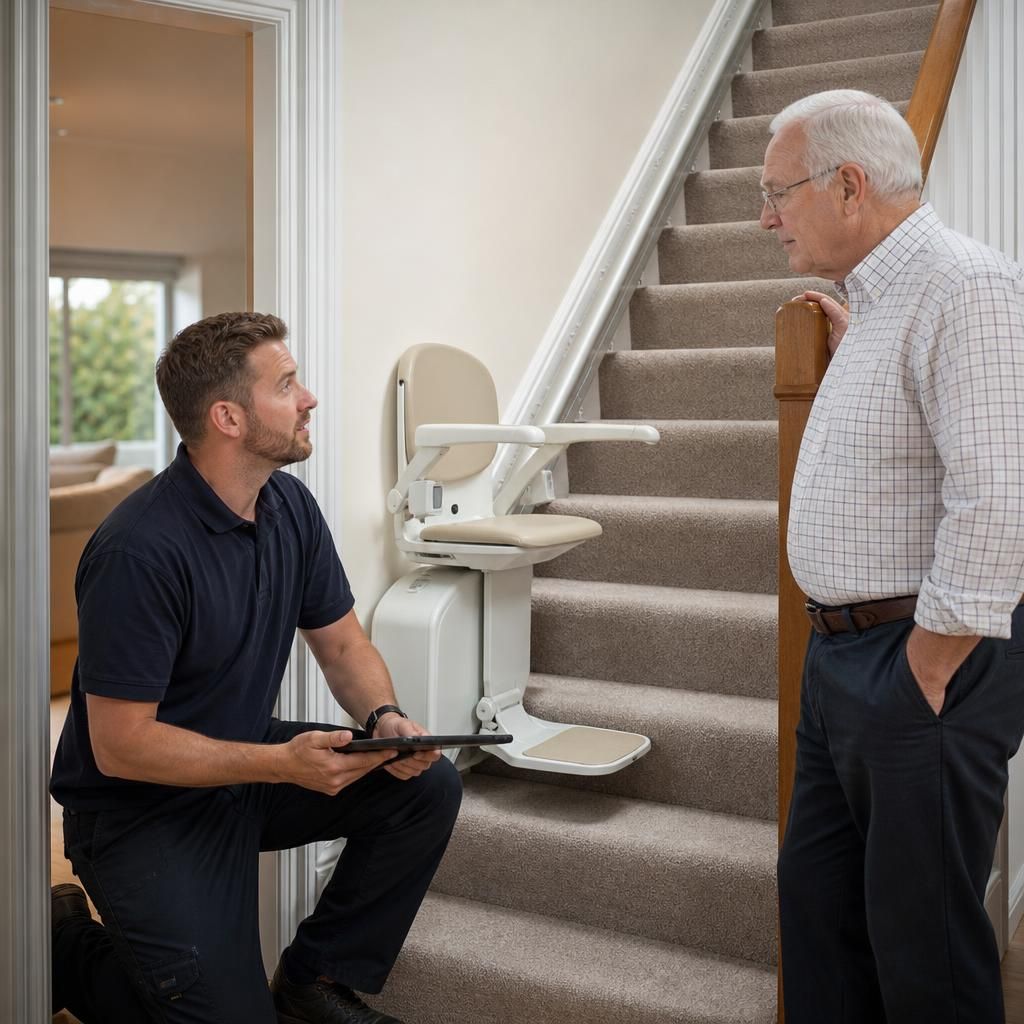
A stairlift site survey identifies the model and configuration that can safely support the user, suit their mobility needs and fit the staircase and surrounding space. It considers more than whether the stairlift can travel from one floor to another: the assessment also covers weight capacity, posture, transfer ability, control access, comfort, staircase geometry and the way the user will approach and leave the seat.
The survey helps distinguish between a standard straight stairlift, a curved stairlift made to follow one or more bends, an outdoor model or a suitable reconditioned option. It also allows the adviser to recommend features and seating arrangements that address the user’s particular difficulties, rather than selecting a model from measurements alone.
Weight capacity and seating requirements
The user’s weight is discussed confidentially and matched with the stairlift’s approved load capacity. This is essential for safe operation and may affect the model, seat size, armrest design and available features. Where more than one person may use the stairlift, the assessment considers the needs of each user so that the recommended equipment is appropriate for everyone who will operate it.
Seat width, back support, armrest position and footrest dimensions are also relevant. A person with limited hip or knee movement may need more room to sit comfortably, while someone who is unsteady when standing may benefit from a supportive seat and a swivel mechanism that helps them turn towards the landing before getting off. The survey confirms that the chosen arrangement does not leave the user obstructing the stairs or struggling to reach a safe standing position.
Specific mobility challenges
The adviser will consider how the user moves on and off the stairlift, as well as how they sit during the journey. Important points may include:
- Reduced strength in the legs or difficulty bending the knees
- Pain, stiffness or restricted movement in the hips, knees, back or ankles
- Balance problems or a risk of falling when standing
- Difficulty transferring from a wheelchair, walking frame, bed or chair
- Limited grip, dexterity or reach when using controls
- Difficulty maintaining an upright posture or keeping the feet positioned safely
- Visual, hearing or cognitive difficulties that may affect operation
- Fatigue or other conditions that make a slow, stable transfer particularly important
This information influences practical recommendations. For example, easy-to-use controls may be positioned to suit the user’s stronger hand, and a powered swivel seat or other supportive seating option may be considered where turning at the top or bottom of the stairs is difficult. A safety belt, suitable armrests and a correctly positioned footrest can also help the user remain secure and comfortable, subject to the requirements of the selected model.
The survey is not a medical assessment, and it does not replace advice from a healthcare professional or occupational therapist. However, it provides an opportunity to explain everyday difficulties accurately and ensures that the installation team understands how the stairlift will need to work in practice.
Staircase shape and available space
The staircase is assessed alongside the user’s needs. A straight stairlift may be suitable where the flight is uninterrupted and there is sufficient room at both ends. A curved stairlift may be required for bends, intermediate landings, multiple flights or changes in direction. The survey checks the full route, including the stair width, the position of walls and doors, the landing areas and any changes in floor level.
Clearance is particularly important for users with larger frames, limited movement or mobility equipment. The adviser checks whether the seat, armrests and footrest can pass safely without interfering with walls, doors, radiators, furniture or other household features. They also consider whether the user can approach the stairlift, sit down and dismount without being forced into an awkward position.
Where space is restricted, the recommended model may include a compact folded profile, a suitable seat arrangement or a parking position that keeps access routes usable. These choices must still provide adequate room for safe transfers. A stairlift should not be selected solely because it occupies the least space if that makes getting on or off harder for the user.
Controls and day-to-day operation
The survey considers where controls need to be located and how they will be used. Controls on the armrest, remote controls and call or send units may be relevant if the stairlift will be used by more than one person or if the user cannot comfortably reach a particular control position. The adviser can also discuss the user’s ability to operate switches, hold a control steadily and understand the operating sequence.
Practical questions include whether the user will be able to see the controls, whether they have sufficient hand strength, and whether a carer or family member may need to send the stairlift between floors. The final recommendation should make normal use straightforward while incorporating the manufacturer’s safety features and operating requirements.
Indoor, outdoor and reconditioned options
The environment helps determine which type of stairlift is appropriate. An outdoor staircase requires equipment designed for exposure to weather and for the conditions around that particular entrance or access route. The survey considers the surface, drainage, shelter, electrical supply and the effect of weather on safe use and maintenance.
A reconditioned stairlift may be considered where its specification, condition and available configuration meet the user’s needs and the staircase allows an appropriate installation. It is not suitable simply because it is available. Weight capacity, seat dimensions, controls, safety features, route compatibility and the condition of the equipment must all be checked before it is recommended.
How the survey leads to a recommendation
- The adviser discusses the user’s mobility, transfer method, comfort requirements and expected pattern of use.
- The staircase, landings, access points and surrounding obstructions are inspected and measured.
- Potential risks are identified, including insufficient clearance, difficult transfers, unsuitable parking positions or obstacles affecting the route.
- Available models and configurations are compared against the user’s weight, posture, dexterity, balance and space requirements.
- The adviser explains the suitable options, relevant features, installation conditions and any limitations in clear terms.
The result is a recommendation based on the interaction between the person and their home. If the user’s condition, confidence or transfer ability changes, this should be mentioned during the survey, as it may affect the preferred seating, controls or level of support. It is also useful to explain who else may use the stairlift and whether a walking aid, wheelchair or carer needs to be accommodated at either end.
A thorough site survey therefore reduces the risk of choosing a stairlift that technically fits but is uncomfortable or difficult to use. It confirms the safe route, checks that the equipment can be installed without avoidable obstruction and matches the model’s capacity and features to the user’s actual abilities. The survey findings can then be used to agree a practical solution for the staircase and the way the home is used.
A stairlift site survey matches the equipment to the person using it, not just to the shape of the staircase. The adviser considers weight capacity, seating position, balance, leg movement, transfer ability and hand control before recommending a suitable model and configuration.
For example, someone who finds standing or turning difficult may need a supportive seat with a swivel function, while a user with limited grip may require controls that are easy to operate with their stronger hand. Seat width, armrest position, footrest support and the available clearance are also checked together, so the stairlift is comfortable to use and allows a safe transfer at the top and bottom of the stairs.
Book Your Personalised Stairlift Site Survey
Book a personalised stairlift site survey with Independent Stairlifts to assess your staircase, mobility needs, weight capacity and preferred features. Our adviser will explain the suitable options and confirm the safest configuration for your home.