
What types of stairlifts are available for different home configurations?
The main stairlift options are straight, curved, outdoor and reconditioned models, with the right choice depending on your staircase layout, available space and whether the lift will be exposed to the weather. A site survey identifies the safest and most practical solution for your home, including options for narrow, split-level or more complex staircases.
The main stairlift types for different home configurations are straight, curved, outdoor and reconditioned models. The appropriate option depends on the shape and length of the staircase, the available space at the top and bottom, whether the stairs are indoors or outside, and the user’s mobility requirements. A professional site survey confirms which design can be installed safely and whether any additional features are needed.
Straight stairlifts
A straight stairlift is designed for a staircase that runs in one continuous line without bends, intermediate landings or changes of angle. The rail is fitted to the stair treads rather than the wall, so it can usually be installed without major structural alterations. Straight models are often suitable for standard staircases in houses, flats and bungalows where the user needs help travelling between two floors.
Available space at the top and bottom must still be checked. The lift needs a safe area for boarding and getting off, and the stairlift may need to park in a particular position when not in use. Folding seats, arms, footplates and rails can help preserve access to the stairs for other household members, particularly on narrower staircases.
Curved stairlifts
Curved stairlifts are made for staircases with bends, landings, multiple flights or changes in direction. Their rail is measured and manufactured to follow the individual route of the stairs. This makes them suitable for configurations such as L-shaped, U-shaped and split-level staircases, where a standard straight model would not travel continuously from one floor to another.
A curved system may use one continuous rail or a design that incorporates separate sections, depending on the layout and the proposed parking positions. The survey considers the width of each flight, the shape of landings, headroom, doorways and whether the stairlift can stop without obstructing circulation. In some homes, the best solution is for the user to remain seated while the stairlift travels around a landing; in others, parking or transfer arrangements may need careful planning.
Stairlifts for narrow staircases
Narrow stairs do not automatically rule out a stairlift. Compact models may have a slimmer folded profile, while folding seats, arms and footplates can reduce the space occupied when the lift is parked. However, the available width must be assessed with the user seated, the stairlift moving and other people using the staircase.
The survey should also check obstructions such as handrails, radiators, dado rails, doorways and low ceilings. A narrow staircase may require a particular seat position, a different parking location or a hinged section of rail at the bottom. These details help prevent the stairlift from blocking a passageway or creating a trip hazard.
Stairlifts for split-level and multi-flight layouts
Where a home has a landing between flights, the stairlift may be designed to follow the complete route or, where appropriate, separate lifts may be considered for different flights. The choice depends on the landing size, the direction of travel, the user’s ability to transfer safely and the need to keep the landing accessible.
For more complex layouts, the rail may include tight bends, changes in gradient or a parking point away from the main staircase. A detailed measurement is particularly important because a seemingly small obstruction can affect the turning space, the position of the seat and the clearance from walls or doors.
Outdoor stairlifts
Outdoor stairlifts are designed for external steps, such as a front path, garden staircase or access route to a raised entrance. They use weather-resistant components and protective covers, but they still need a suitable power supply and a location that allows the user to board and leave the lift safely.
The installation must take account of rain, frost, direct sunlight, drainage, surface condition and the risk of slippery steps. Outdoor models should be parked and covered as recommended, and the rail and seat should be kept clear of leaves, ice and other debris. If the staircase is exposed or has uneven paving, improvements to the surrounding access may be needed in addition to the stairlift.
Reconditioned stairlifts
Reconditioned stairlifts can be suitable where the configuration is straightforward and a compatible model is available. They are restored and checked before being offered for reuse, but the rail and fittings still need to match the staircase and the user’s requirements. A reconditioned straight stairlift may be practical for a standard flight, while a curved installation generally requires a rail made for the particular staircase.
Before choosing a reconditioned model, confirm what inspection, servicing and warranty cover are included, whether the batteries and safety controls have been tested, and whether the installation is appropriate for the intended user. The lowest initial cost is not the only consideration; reliable operation, correct fitting and future servicing are also important.
Features that can adapt the stairlift to the home
The stairlift type is only part of the solution. The following features may help accommodate the staircase and the user:
- Swivel seats: help the user turn towards the landing before standing, reducing the need to twist on the stairs.
- Powered swivel or folding functions: can make operation easier for someone with limited strength or dexterity.
- Hinged rails: allow the rail to fold away from a doorway, corridor or bottom step where a fixed rail would obstruct access.
- Different seat and track positions: may improve comfort or clearance on a narrow staircase.
- Perch or standing seats: may be considered where bending the knees is difficult, subject to an assessment of balance and safe use.
- Remote controls: allow the lift to be called to another floor, provided the user can operate the controls safely.
- Folding components: reduce the stairlift’s footprint when other people need to use the stairs.
How the right type is identified
A site survey should assess the complete route rather than simply measure the stair width. The fitter will normally consider the staircase shape, tread depth, landings, headroom, doorways, radiators, bannisters, electrical supply, parking positions and the condition of the stairs. The user’s height, weight, leg movement, balance, ability to transfer and preferred operating position are also relevant.
Discuss how the staircase is used at different times of day, whether other household members need to pass the lift, and whether the user expects their mobility to change. This helps identify practical details such as a powered swivel seat, a rail that folds away from an entrance or a control layout that is easy to reach. Where the layout is unusual, the proposed route and parking points should be explained before installation.
In summary, straight staircases usually suit straight stairlifts, while bends, landings and multiple flights generally require a bespoke curved solution. Outdoor steps need weather-resistant equipment and careful consideration of the surrounding access, and reconditioned models may be appropriate when a compatible, properly checked system is available. A professional assessment is essential for confirming the safest option, protecting access around the home and ensuring the stairlift suits the person who will use it.
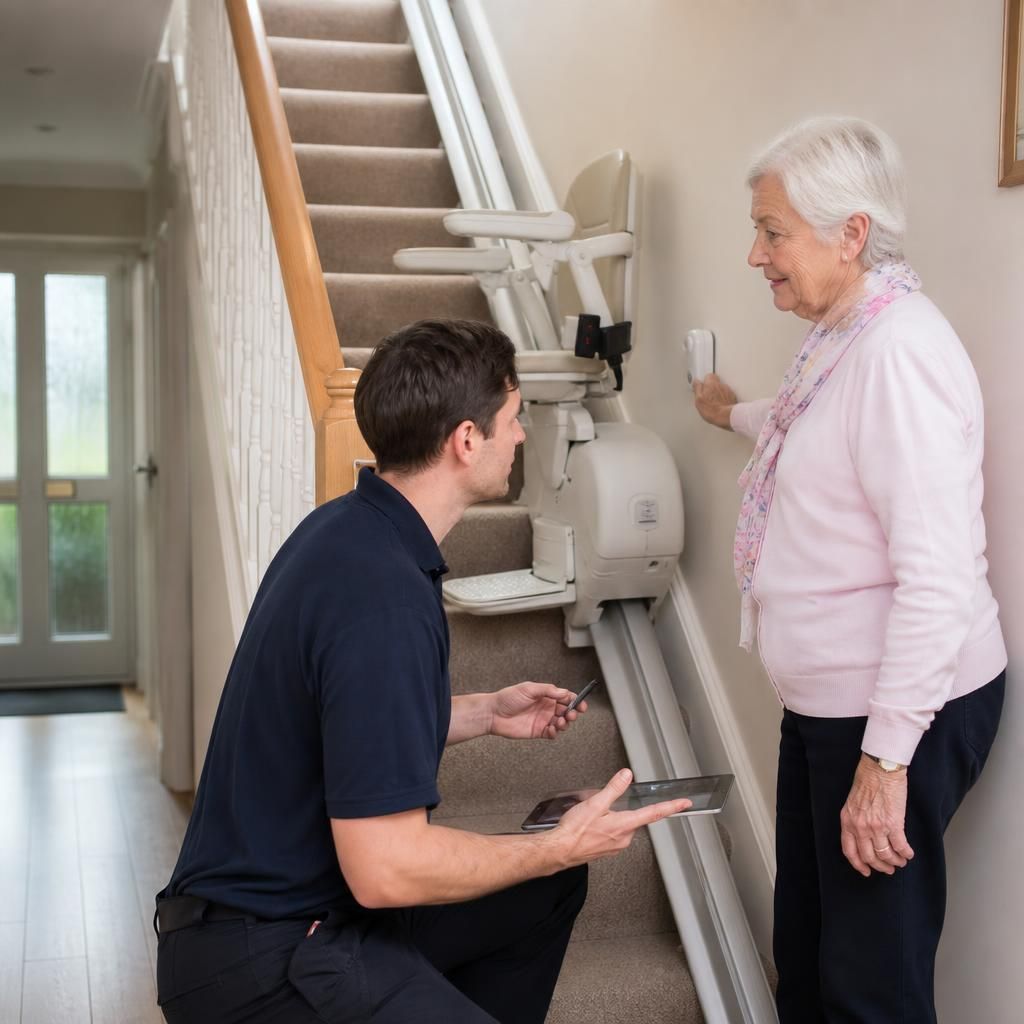
A professional site survey identifies which stairlift design is suitable for your staircase, including the space available for boarding, travelling and parking. The assessment covers the full route rather than relying on the stair width alone.
The survey will check bends, landings, headroom, doorways, handrails, radiators and access at the top and bottom of the stairs. It also considers how the user transfers on and off the seat, whether other people need to use the staircase and whether the lift could obstruct a corridor or entrance. This helps distinguish between a straight model, a bespoke curved system, a compact option for narrow stairs or a weather-resistant outdoor stairlift.
Where the layout is unusual, the proposed rail route and parking position should be discussed before installation. Features such as a swivel seat, folding components or a hinged rail may then be selected to improve clearance and make the stairlift practical for everyday use.
Book a Stairlift Site Survey
Arrange a professional stairlift site survey to identify the most suitable solution for your staircase, whether you need a straight, curved, narrow-staircase or outdoor model.
Contact Independent Stairlifts to discuss your home configuration and book an assessment.