
What should I consider when choosing a local stairlift fitter?
When choosing a local stairlift fitter, check their installation experience, ability to recommend a suitable lift for your staircase, and the quality of their site survey, workmanship and aftercare. A reliable fitter should provide clear advice, transparent costs, appropriate safety checks and ongoing support from assessment through to installation and servicing.
When choosing a local stairlift fitter, look beyond the headline price. The most important considerations are the fitter’s experience with your type of staircase, the quality of the site survey, the suitability of the recommended stairlift, the standard of installation and the support available after fitting.
A stairlift is not a one-size-fits-all product. The right installation should take account of the staircase layout, the user’s mobility, the position of doorways and landings, available space and the way the stairs are used by other members of the household. A local fitter should be able to explain the options clearly and recommend a practical solution rather than simply offering the first available model.
Check relevant installation experience
Ask how much experience the fitter has with stairlifts similar to the one you need. Straight staircases are generally more straightforward, while curved, narrow, split-level, steep or unusually shaped staircases require more detailed planning. Outdoor installations also involve additional considerations, including exposure to weather, suitable power supplies and protection of the equipment.
Experience should include both new and reconditioned stairlifts if you are considering either option. A competent fitter should be able to explain the differences in condition, availability, features, warranty cover and future servicing, without presenting one type as suitable for every household.
Expect a proper site survey
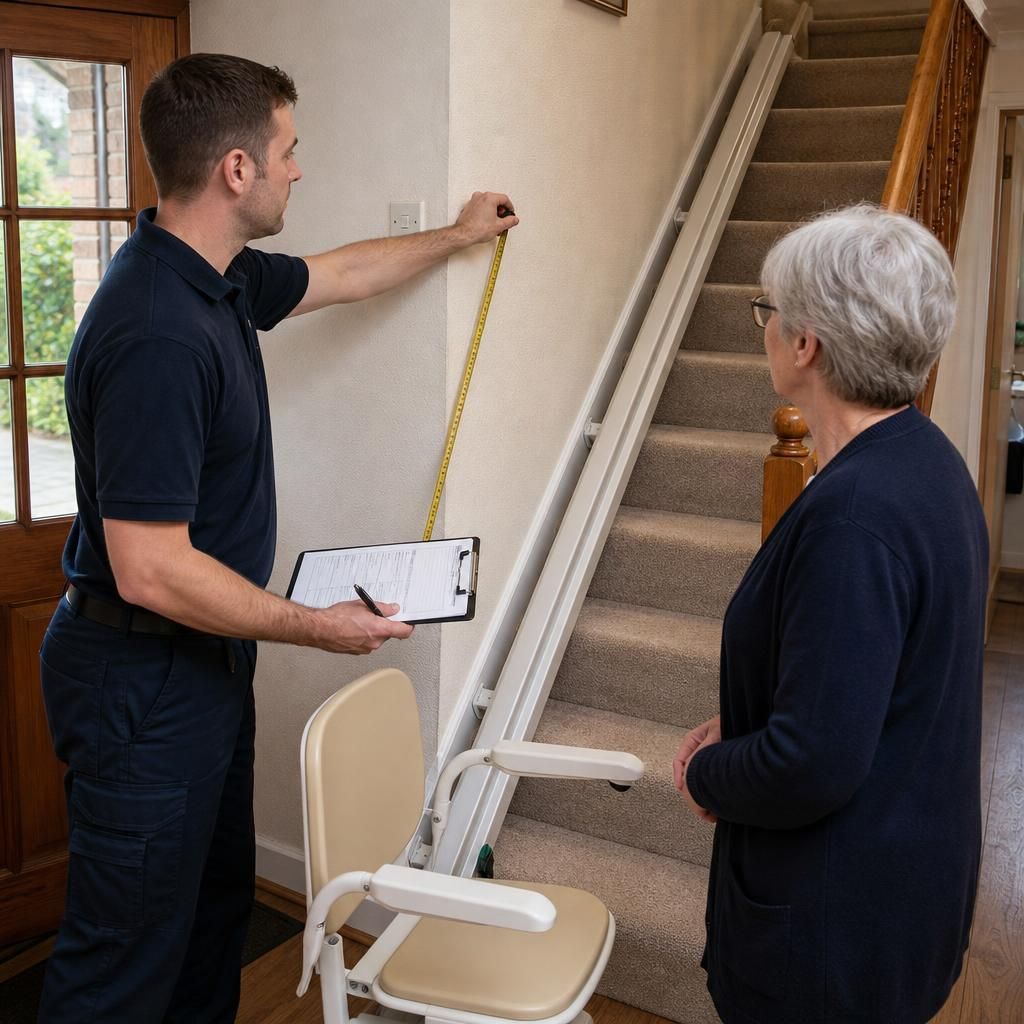
A site survey is essential because it allows the fitter to assess the staircase and identify practical or safety issues before installation. The survey should cover the stairway’s shape and dimensions, the position of the lift at the top and bottom, access to charging points, obstructions such as doors or radiators, and whether there is enough room for safe transfers.
The survey should also consider the user. Factors such as height, weight, balance, leg strength, ability to transfer on and off the seat, and whether the lift will be used independently can affect the choice of seat, controls, rail position and additional features. If another person uses the stairs, the proposed installation should allow them to pass safely where possible.
Be cautious if a firm gives a firm recommendation and price without inspecting the staircase or discussing the user’s needs. A remote discussion can be useful as an initial enquiry, but it does not replace an assessment of the actual installation environment.
Compare the advice, not just the quote
A written quotation should identify the stairlift being offered, the work included, any adaptations required and the total cost. Check whether the price includes delivery, fitting, removal of an existing lift, electrical work, demonstrations and disposal of packaging. If the quotation includes optional features, ask which are genuinely useful for the intended user.
The cheapest quote may not represent the best value if it is based on an unsuitable model, excludes necessary work or provides limited aftercare. Equally, a higher price should be supported by a clear explanation of the equipment and service included. Ask the fitter to explain any differences between quotations in plain language.
Ask about safety and workmanship
The fitter should follow the manufacturer’s installation instructions and applicable UK safety requirements. Ask how the stairlift will be secured, how the electrical supply will be dealt with and what checks will be completed before handover. A professional installation should include testing of the controls, safety sensors, seat or carriage movement, charging system and any swivel or powered features.
Good workmanship also means protecting the property. The fitter should plan how equipment will be brought into the home, take reasonable care around walls, floors and bannisters, and leave the area clean and usable. Fixings should be appropriate for the staircase and installation should not obstruct doors, walkways or essential household controls.
Confirm the fitter’s qualifications and responsibilities
Ask who will carry out the installation and whether the work is completed by the company’s own trained engineers or by subcontractors. This is particularly useful when you need a clear point of contact for adjustments or servicing. The installer should be able to describe their training and experience and should not be reluctant to explain who is responsible for the work.
Where electrical work is required, check that it will be completed by someone competent to carry out that work safely. You can also ask whether the company has appropriate public liability insurance and procedures for dealing with installation issues, although these do not replace checking the quality of the actual advice and workmanship.
Look carefully at warranty and aftercare
Find out what the warranty covers, how long it lasts and whether it applies to parts, labour or both. Ask about exclusions, call-out arrangements and what happens if the lift develops a fault outside normal working hours. If you are buying a reconditioned stairlift, check whether the warranty differs from that offered with a new installation.
Reliable aftercare should include an explanation of how to use the lift, basic charging and cleaning guidance, and advice on what to do if a warning light or fault occurs. You should also know how to arrange servicing, repairs or adjustments. A local fitter may be able to provide convenient ongoing support, but confirm the actual service area and response arrangements rather than assuming that proximity guarantees availability.
Make sure the process is clear and pressure-free
A suitable fitter should give you time to consider the recommendation and should explain alternatives where they exist. You should receive clear information about cancellation rights, payment terms, installation dates and any changes that could affect the quoted price. Avoid committing to work that is presented as urgent without a specific safety reason or a proper explanation.
For customers working with Independent Stairlifts, these are the same points to raise during your assessment: describe how the stairs are used, mention any difficulties with transfers or balance, and ask for the reasons behind the proposed equipment. This helps the fitter match the installation to the home and the person using it, rather than treating the staircase in isolation.
In practical terms, the best local stairlift fitter is one that combines relevant installation experience with a detailed survey, transparent advice, careful workmanship and dependable aftercare. Checking all four areas before agreeing to the installation gives you a better basis for choosing a safe, usable and maintainable stairlift.
A proper site survey is one of the most important checks when choosing a local stairlift fitter. It allows the installer to assess the staircase, available space, access points and the user’s mobility before recommending suitable equipment.
The survey should consider the position of doors, radiators and landings, where the stairlift will park, how the user will transfer on and off the seat, and whether other household members can use the stairs safely. Ask the fitter to explain how these details affect the proposed model, rail position and optional features.
A clear survey also helps identify any electrical work, access difficulties or property protection measures needed before installation. Be cautious about accepting a firm recommendation based only on photographs or a telephone conversation, as these cannot replace an assessment of the actual staircase and the person who will use the lift.
Book Your Stairlift Assessment
Book a stairlift assessment with Independent Stairlifts to discuss your staircase, mobility needs and suitable installation options. Our adviser can explain the recommendation, quotation and aftercare before you decide.