
What qualifications or experience should I look for in a stairlift fitter to ensure a quality installation?
Look for a stairlift fitter with demonstrable experience installing the type of lift and staircase involved, relevant manufacturer training, and a clear understanding of safe working practices and building requirements. They should carry out a thorough site survey, explain the proposed installation clearly, provide written warranty details, and be able to show evidence of suitable insurance, competence and aftercare arrangements.
A quality stairlift installation depends on a fitter having relevant practical experience, current manufacturer training and a sound understanding of safe working practices. Look for evidence that they regularly install the type of stairlift you need, can assess the particular features of your staircase, and will provide a properly documented survey, installation and aftercare service.
There is no single statutory qualification that every stairlift fitter must hold in the UK. Competence is usually demonstrated through a combination of manufacturer-specific training, hands-on experience, technical understanding and appropriate safety procedures. A reputable installer should be willing to explain how their fitters are trained and how that training is kept up to date.
Relevant manufacturer training
Stairlifts differ considerably between manufacturers and models. A fitter should be trained to install, adjust, test and maintain the equipment being supplied, rather than relying only on general experience with mobility products. Ask whether the fitter has current training for:
- the specific stairlift model proposed for your home;
- straight, curved or outdoor systems, where applicable;
- track measuring, joining and alignment procedures;
- battery, charging and electrical safety checks;
- the manufacturer’s commissioning and handover requirements; and
- fault diagnosis and routine servicing.
Manufacturer training is particularly important for curved stairlifts, because the rail is designed around the staircase and must be measured, positioned and adjusted accurately. Outdoor installations also require appropriate knowledge of weather protection, drainage, corrosion prevention and safe access.
Experience with your type of staircase
Ask how much experience the fitter has with the configuration in your home, not simply how long they have worked in the industry. Relevant experience may include narrow or steep stairs, split-level layouts, half-landings, multiple turns, limited headroom, doorways near the stairs and staircases with unusual banisters or radiators. A fitter who understands these conditions can identify access, parking, fixing and clearance issues before installation begins.
For a curved stairlift, the company should be able to explain how the proposed rail will follow the staircase and where the seat will stop at the top and bottom. For a straight stairlift, the fitter should still check available landing space, obstruction risks, seat height and whether the lift can be parked without restricting a doorway or escape route. Experience should be supported by a proper site survey, rather than by assumptions based on photographs alone.
Knowledge of safe installation practice
A competent fitter should carry out a risk assessment and follow a controlled installation method. This includes checking the condition and strength of the stairs, identifying suitable fixing points, protecting people from tools and materials, managing cables safely and testing the completed lift. They should understand the relevant manufacturer instructions and applicable technical and safety requirements for stairlift equipment.
Where electrical work is required beyond connecting the stairlift to its intended power supply, the person carrying it out should have appropriate electrical competence. The fitter should also be able to identify when another suitably qualified professional or additional advice is needed, rather than proceeding with an unsafe or unsuitable arrangement.
Evidence of insurance and professional procedures
Before work starts, check that the installer has suitable public liability insurance and ask what cover applies if accidental damage occurs during fitting. It is also reasonable to ask whether the business has documented health and safety procedures, risk assessments and a process for recording the installation and final tests.
Membership of a trade association or participation in an accreditation scheme can provide useful reassurance, but it should not be treated as a substitute for checking the fitter’s actual experience. Ask what the accreditation covers, whether it applies to the individual installer or the company, and whether it is current.
A thorough site survey is essential
The surveyor or fitter should inspect the full staircase and surrounding areas before recommending equipment. They should discuss your mobility needs, preferred seat position, transfer points, likely users, controls and any risks associated with pets, children or other household traffic. The survey should consider the structure of the stairs, clearances, landing space, power supply, parking positions and any access restrictions.
A good fitter will explain the proposed installation in plain language and identify any limitations. They should not promise that every stairlift can fit without checking measurements, or recommend a model solely because it is readily available. You should receive clear information about what will be fixed to the stairs or walls, whether any existing fittings need to be moved, and what preparation is required before the installation date.
Testing, handover and documentation
After fitting, the installer should test the lift through its operating range and check the controls, safety edges, seat, swivel or lift-up mechanisms, charging system and any safety belt. They should demonstrate normal operation and explain what to do if the stairlift stops, displays a fault or needs to be isolated.
Ask for written confirmation of the equipment supplied, installation details, warranty terms, servicing arrangements and emergency contact process. The handover should include user instructions and information about charging, cleaning, safe use and reporting faults. Keep these documents, particularly if the stairlift may later be serviced, moved or removed.
Questions to ask before appointing a fitter
- Are your fitters trained on the stairlift model being proposed?
- How much experience do they have with staircases similar to mine?
- Who will carry out the site survey and installation?
- What checks are made on the stairs, fixings, clearances and electrical supply?
- What insurance and safety procedures does the business have?
- How will the lift be tested and demonstrated after fitting?
- What written warranty and aftercare information will I receive?
- Who should I contact for an urgent fault or service visit?
Be cautious if a fitter is unwilling to discuss their training, skips the site survey, gives only verbal warranty information or cannot explain how the installation will work around your staircase. The strongest indication of competence is a consistent process: an accurate assessment, a suitable recommendation, careful fitting, documented testing and accessible aftercare. Independent Stairlifts can use this process to match the installer and stairlift arrangement to the specific conditions of your home.
A competent stairlift fitter should have current training for the equipment being installed, practical experience with similar staircases and a clear, documented installation process. In the UK, there is no single statutory qualification that every stairlift fitter must hold, so competence should be assessed through training, experience, safety procedures and aftercare arrangements.
Before installation, ask the fitter to explain:
- Whether they are trained on the proposed stairlift model and its installation requirements.
- How they will assess the staircase, fixings, clearances, landings and power supply during the site survey.
- How the completed lift will be tested, commissioned and demonstrated.
- What insurance, warranty documentation and fault-support arrangements are provided.
For curved or outdoor stairlifts, look for specific experience with accurate rail fitting, weather protection and the additional clearance or access issues these installations can involve.
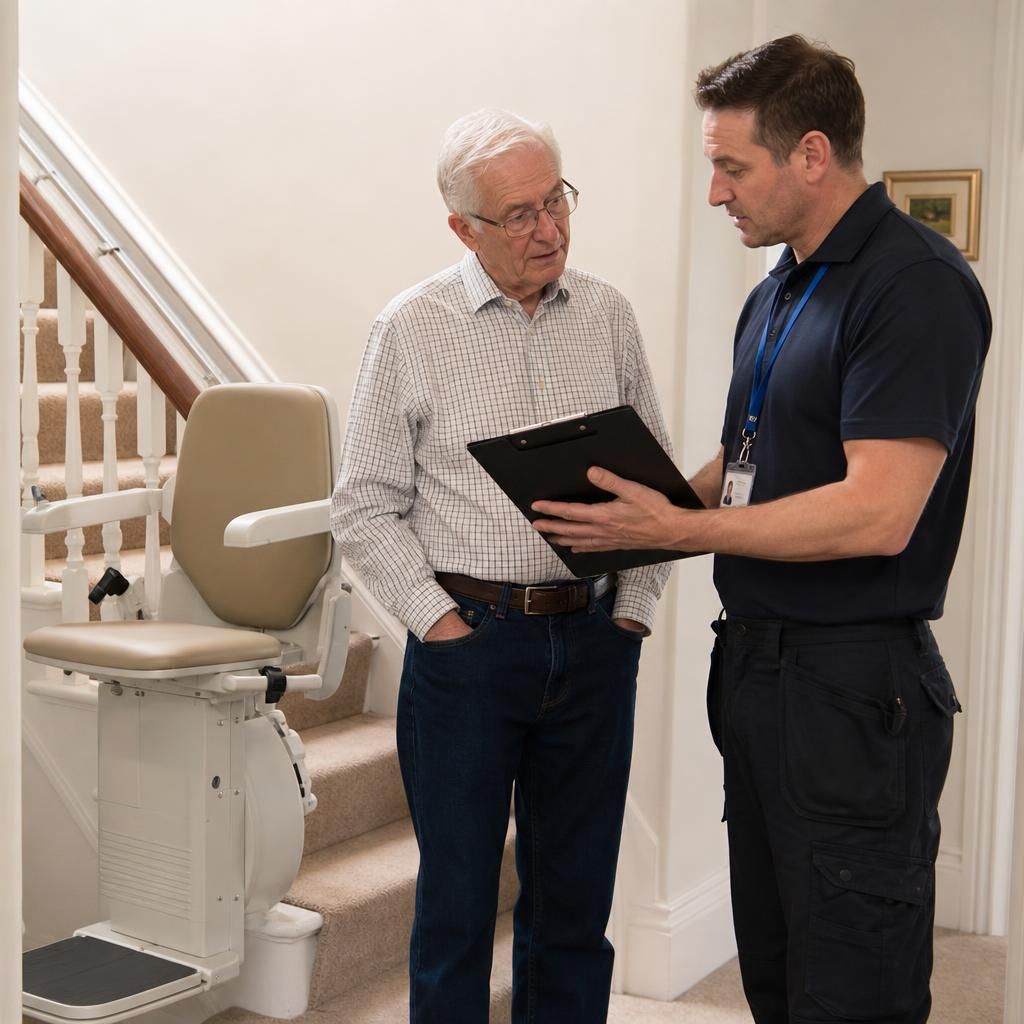
Discuss your stairlift installation with our qualified team
Discuss your stairlift installation with our qualified team. We can help assess your staircase, explain the fitting process and answer questions about training, safety checks, warranties and aftercare.