
What are the common misconceptions about stairlift installation that I should be aware of?
Common misconceptions about stairlift installation include the belief that fitting is highly disruptive, requires major structural alterations, or is only suitable for straight staircases. In practice, a professional site survey can identify a suitable solution for your staircase, protect your home’s existing features and provide a clear explanation of the installation, costs and aftercare involved.
Most misconceptions about stairlift installation concern disruption, structural alterations, suitability and cost. In practice, a professional assessment determines whether a stairlift can be fitted safely, how it will attach to the staircase, what preparation is needed and what the total cost includes. A properly planned installation is usually designed around the existing home rather than requiring major changes to it.
1. “A stairlift is only suitable for a straight staircase.”
Stairlifts are available for many different domestic layouts, including straight, curved, split-level and outdoor staircases. A curved stairlift is made to follow the shape of an individual staircase, including bends, intermediate landings and changes in direction. Outdoor models are designed for suitable external steps and must take account of weather exposure, drainage and the available fixing surfaces.
Not every staircase will be suitable for every model. Stair width, headroom, landing space, the position of doors and the condition of the steps all need to be considered. This is why a site survey is more reliable than judging suitability from photographs alone.
2. “Installation requires major building work.”
In most homes, the stairlift rail is secured to the stair treads or appropriate structural surfaces rather than fixed to the wall. This normally avoids removing the banister, opening up walls or making extensive alterations to the staircase. The fitting team should explain precisely where fixings will be placed and identify any unusual structural considerations before work begins.
Some preparation may still be necessary. For example, furniture or objects near the stairs may need to be moved, and a power supply may need to be positioned safely. If a landing is particularly tight, the installer may discuss options such as a folding rail, a powered swivel seat or a different parking position. These are design decisions, not automatically signs that major building work is required.
3. “The installation will cause significant damage or disruption to my home.”
A stairlift installation involves bringing equipment into the property, assembling the rail and seat, securing the system and testing its operation. It is not normally comparable with a building or refurbishment project. The installer should use suitable care when accessing the staircase, protect nearby surfaces where appropriate and keep the working area as orderly as possible.
There may be some unavoidable noise and temporary restriction of access while the lift is being fitted. You should be told in advance how long the work is expected to take, which areas need to remain clear and whether an alternative route is required. Removing fragile ornaments, pictures or loose items near the stairs before the appointment can also help reduce risk.
Protecting existing decoration and structure is part of competent installation. If you have concerns about flooring, paintwork, skirting boards or a particular feature of the staircase, raise them during the survey so they can be considered in the installation plan.
4. “The cheapest quoted price tells me everything I need to know.”
The headline price is only useful when you know what it covers. A meaningful quotation should reflect the type and length of rail, the seat and control options, installation, testing, user instruction and the available aftercare. A curved stairlift, for example, is designed for an individual staircase and may involve more detailed surveying and manufacturing than a standard straight model.
Ask whether the quotation includes any necessary electrical work, removal of an existing lift, delivery, VAT where applicable and future servicing arrangements. You should also understand whether the quoted equipment is new or reconditioned, what condition reconditioned equipment is in and what warranty or guarantee applies. Comparing like with like is more useful than choosing solely on the lowest initial figure.
5. “A stairlift can be installed without a proper survey.”
A site survey is essential because the installer needs to assess the staircase and the way the lift will be used. This includes checking measurements, landings, turns, obstructions, doors, power arrangements, fixing points and safe transfer areas at the top and bottom. The survey should also consider the user’s mobility, height, weight, balance, ability to operate controls and whether they can sit and stand safely.
For a curved staircase, the survey records the shape and dimensions needed to produce a suitable rail. For an outdoor installation, the surrounding ground, exposure and access conditions are also relevant. A remote discussion may provide useful initial guidance, but it should not replace an appropriate in-person assessment where one is needed to confirm safe fitting.
6. “Installation is always quick, or it will take several days.”
There is no single installation time that applies to every property. A straight stairlift may be fitted during a planned appointment, while a curved model generally requires a rail made for the individual staircase before installation can be arranged. The condition of the staircase, access to the property, electrical requirements and any existing stairlift can also affect the timetable.
During the survey and quotation process, ask for a realistic explanation of the stages: assessment, manufacture or preparation, delivery, fitting, testing and handover. The fitting team should not rush safety checks to meet an assumed timescale. Before leaving, they should demonstrate the controls, charging procedure, safety features and manual release or emergency arrangements relevant to the model.
7. “Once the stairlift is fitted, no further checks or support are needed.”
Installation is the start of using the equipment safely, not the end of the process. The user and anyone who regularly assists them should understand how to operate the lift, use the seat belt, position the footrest and respond to basic alerts. The stairlift should be tested through its full travel, including its charging position and any swivel, folding or powered features.
Keep the operating instructions and contact details for support in an accessible place. Do not continue using the lift if it behaves unusually, makes an unfamiliar noise, fails to charge or shows a fault indication. Contact the appropriate service team for advice rather than attempting to adjust the rail or electrical components yourself. Routine care, such as keeping the rail and charging points clear and reporting changes promptly, helps maintain reliable operation.
What to check before the installation goes ahead
- Confirm that the proposed model is suitable for the staircase, user and intended parking positions.
- Ask what will be fixed to the stairs and whether any alterations or electrical work are required.
- Request a written quotation that explains equipment, installation, warranty or guarantee and aftercare.
- Discuss access arrangements, protection for nearby decor and any furniture that needs to be moved.
- Agree how the stairlift will be demonstrated and who to contact if a problem occurs after fitting.
Reliable stairlift installation depends on accurate assessment, suitable equipment and careful commissioning. If any part of the proposed work is unclear, ask for it to be explained before you approve the installation. Clear advice at the survey stage helps prevent unexpected work and ensures the finished stairlift is matched to both the staircase and the person using it.
A proper stairlift site survey is the most reliable way to confirm whether installation is safe and suitable for your home. It allows the fitter to assess the staircase, landings, doors, access points, fixing surfaces and the user’s ability to transfer on and off the seat.
The survey also helps prevent unexpected disruption or costs. The installer can explain where the rail will be fixed, whether furniture needs moving, how the stairlift will park and whether features such as a powered swivel seat or folding rail may be useful. For curved or outdoor staircases, the measurements and surrounding conditions are particularly important because the lift must be designed or selected for that specific setting.
Photographs and telephone discussions can provide initial guidance, but they cannot replace an appropriate in-person assessment where measurements and safety checks are required. Ask for any concerns about décor, access, electrical work or future use to be recorded before you approve the proposed installation.
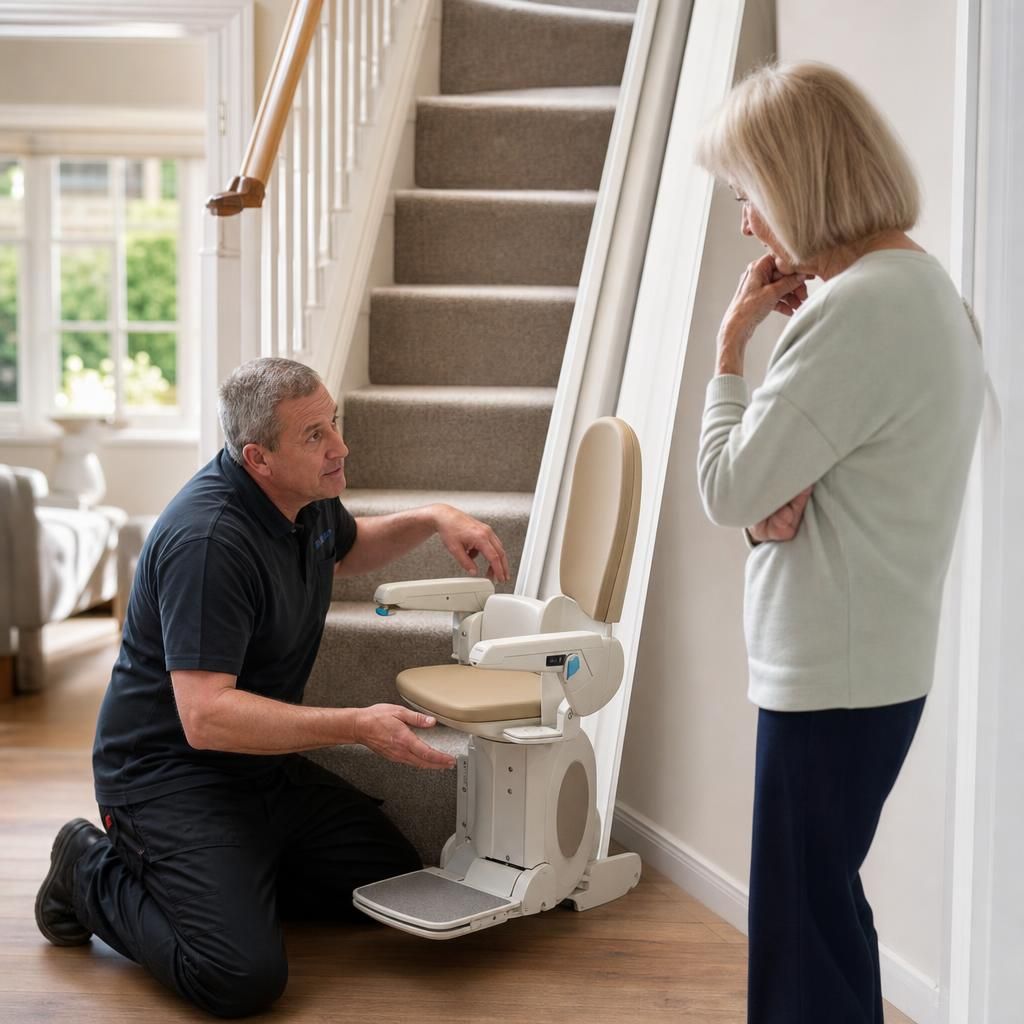
Arrange a stairlift assessment
Arrange a stairlift assessment with Independent Stairlifts to confirm the most suitable solution for your staircase, home and mobility needs. Our assessment will also clarify the installation process, likely preparation and any available aftercare before you proceed.