
How is a stairlift installed to ensure it fits different types of staircases?
A stairlift is installed after a site survey measures the staircase, checks clearances and identifies suitable fixing points. Straight staircases usually take a standard rail, while curved, narrow, split-level or outdoor staircases require a made-to-measure rail and carefully planned fixings to provide a secure, comfortable fit.
A stairlift is fitted to the shape and structure of the staircase rather than installed as a one-size-fits-all appliance. The process begins with a detailed site survey to measure the stairs, assess available clearance, identify safe fixing points and understand how the lift will be used. These findings determine the rail design, seat configuration, parking position and installation method.
The site survey comes first
An experienced surveyor examines the complete route from the bottom to the top of the stairs. This includes the width and gradient of each section, the position of landings, the height of the ceiling, doorways and nearby furniture, and the space available for getting on and off the lift safely. The survey also considers the user’s height, weight, mobility and ability to transfer into the seat.
The surveyor checks the condition of the staircase and identifies suitable points for attaching the rail. Most domestic stairlifts are secured to the stair treads or stair structure, rather than relying on the wall. The exact fixing arrangement depends on the staircase construction, the rail design and the need to preserve safe clearance from walls, banisters and doorways.
How straight staircases are fitted
A straight stairlift normally uses a standard straight rail, which is measured and cut to suit the staircase. The rail is installed alongside the stairs with brackets fixed at suitable intervals to the treads or supporting structure. The installer positions it so that the seat can travel smoothly while leaving enough room for the user’s knees, feet and arms.
At the top and bottom, the installer checks that the lift can stop in a convenient position and that the user can transfer safely. Where space permits, the rail may finish beyond the top or bottom step, or incorporate a parking arrangement that keeps the seat clear of a doorway or circulation area. A hinged or sliding rail can be considered where the rail would otherwise obstruct a door, hallway or walkway.
How curved staircases are fitted
A curved stairlift requires a made-to-measure rail. The survey records the direction and radius of each bend, changes in gradient, intermediate landings and the required stopping points. The rail is then manufactured to follow the exact route of the staircase, rather than forcing the lift to travel along a straight line.
On a staircase with one or more bends, the rail is carefully aligned so the carriage transitions smoothly between straight sections, curves and landings. The design may include different parking positions to keep the lift out of the way when it is not being used. In some homes, the rail can be designed to serve more than one flight, subject to the available space and the user’s requirements.
Because a curved installation is individually designed, the installer pays particular attention to clearances around bends. The seat may swivel or adjust at the landing so the user can leave the lift facing a safe direction. The final position must allow the user to reach the landing without twisting or stepping into an obstruction.
Fitting narrow, steep or unusually shaped stairs
Narrow staircases require careful consideration of the lift’s folded width, seat position, armrests and footrest. The rail is positioned to retain as much usable stair width as possible while maintaining safe clearance. A compact design, folding components or a suitable seat configuration may help where space is restricted, but the installation must still provide a stable and comfortable seating position.
For steep stairs, the survey assesses the angle of travel and the user’s ability to get on and off at each end. The stairlift is set up so the seat remains level during travel, while the footrest and safety controls are positioned within comfortable reach. Steepness alone does not determine suitability; the staircase structure, available landings and safe transfer space also matter.
Stairs that change width, have winders, include a half landing or run alongside a wall may need a specially shaped rail and carefully selected fixing brackets. The installer plans around radiators, skirting boards, handrails, doors and other features instead of assuming that the rail can follow the most obvious line.
Split-level and multi-flight staircases
Where two or more flights are connected by a landing, the installation is planned as one route or as separate sections, depending on the layout and the most practical way for the user to travel. A continuous curved rail may follow the full route, or separate stairlifts may be considered where the landing arrangement, available turning space or user needs make that more appropriate.
The survey includes the landing itself because it must provide enough room for a safe approach, transfer and parking position. The installer also checks whether the lift could restrict access to rooms, doors or other parts of the home. Any change in direction is designed into the rail and tested at slow speed before the installation is completed.
Outdoor and exposed staircases
An outdoor stairlift is selected and installed for the conditions it will face, including rain, damp, temperature changes and possible exposure to dirt. The rail, seat, controls, charging arrangement and electrical connections must be suitable for the location. The installer checks the condition of the outdoor steps, the availability of secure fixing points and the route of any power supply.
Outdoor installations also need a practical parking position that does not obstruct paths, gates or entrances. Weather protection, drainage and the user’s ability to transfer safely on potentially wet surfaces are considered as part of the installation plan. The equipment should be used and maintained in accordance with its instructions, particularly where it is exposed to severe weather.
Adapting the installation to the home
A stairlift does not have to be positioned in exactly the same way in every property. The installer may adjust the rail height, bracket arrangement, seat options or parking position to work around architectural features. These decisions must balance convenience with the manufacturer’s installation requirements and safe operating clearances.
- Doorways and hallways are checked to make sure the parked lift does not block normal access.
- Banisters, handrails, radiators and skirting boards are considered when setting the rail position.
- Uneven or unusually deep treads are assessed before fixings are selected.
- Landing space is planned around the direction in which the user needs to leave the seat.
- Charging points are positioned so the lift can charge reliably when parked.
- Controls and call points are placed where the user can operate them without stretching.
Where a staircase has unusual construction, the installer may need to discuss suitable structural fixing methods before work begins. A competent fitting team should not proceed with a fixing arrangement that cannot safely support the equipment and its intended load.
Testing after the rail is installed
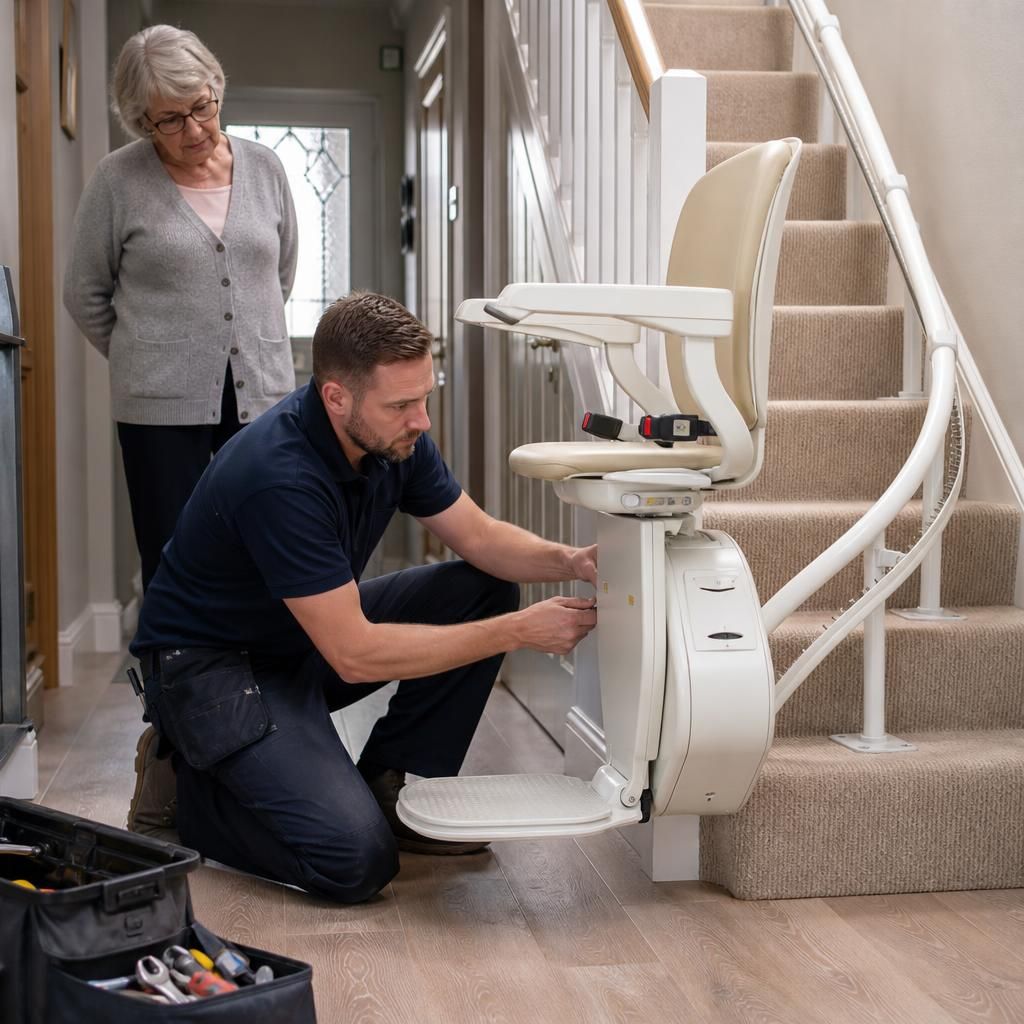
Once the rail, carriage, seat and safety components are fitted, the installer tests the complete route. This includes checking smooth travel, stopping positions, charging, controls, seat swivelling, the safety belt, footrest sensors and any obstruction or safety edges fitted to the lift. The lift is run through bends, joins and landings to confirm that it follows the designed path without contacting walls, doors or other features.
The installer also checks that the stairs and surrounding areas remain safe to use when the stairlift is parked or folded. Any adjustment needed to improve clearance, transfer space or operation should be completed before handover.
What happens at handover
After testing, the installer explains how to use the stairlift, including the controls, seat swivel, belt, charging position, call controls and manual lowering or emergency procedures where applicable. You should be shown how to park the lift and how to keep the rail and surrounding steps clear. It is sensible to ask questions at this stage and to have the user practise getting on and off under supervision.
The final fit is therefore the result of surveying, design, secure fixing, careful alignment and practical testing. Whether the staircase is straight, curved, narrow, split-level or outdoors, the installation should be tailored to its physical layout and to the person who will use the stairlift. If your home or mobility needs change later, seek advice before altering the staircase, moving furniture near the route or changing the electrical supply, as these changes can affect safe operation.
A stairlift is fitted to the staircase’s dimensions, shape and structure, so the rail follows the safest practical route rather than using a standard position in every home. A site survey identifies bends, changes in gradient, narrow sections, landings, doorways and suitable fixing points before the equipment is ordered or installed.
On a straight staircase, the rail is usually measured and cut to length. Curved, split-level or unusually shaped stairs require a made-to-measure rail, with brackets positioned to maintain clearance from walls, banisters and other features. The installer also checks the space available at the top and bottom so the user can transfer safely, while the seat, controls and parking position are selected around their mobility and the layout of the home.
Arrange Your Stairlift Site Survey
Arrange your stairlift site survey so we can assess your staircase, available clearances and suitable fixing points before recommending the right installation approach.