
What should I know about maintaining my stairlift after installation?
After installation, keep your stairlift charged, clean the seat, track and controls, and check regularly for unusual noises, movement or warning lights. Arrange servicing in line with the manufacturer’s guidance, and contact Independent Stairlifts or a qualified engineer rather than attempting repairs yourself.
Maintaining a stairlift after installation mainly involves keeping it charged, clean and free from obstructions, carrying out simple safety checks, and arranging professional servicing in line with the manufacturer’s guidance. Regular care helps preserve reliable operation, identifies developing faults early and supports the terms of your warranty.
Keep the stairlift charged
Most modern stairlifts use rechargeable batteries and should be left on their charging point whenever they are not in use. Depending on the model, charging contacts may be located at the top or bottom of the staircase, or at both ends. If the lift is regularly left away from a charging point, the batteries may become depleted and the stairlift may eventually stop operating.
- Check that the power supply is switched on and that any charging indicator is showing normally.
- Park the stairlift on its designated charging point after each journey.
- If the stairlift will not be used for an extended period, follow the manufacturer’s instructions rather than disconnecting it without advice.
- Do not replace batteries with an unsuitable type. Battery replacement should be carried out by a qualified engineer.
Rechargeable batteries gradually lose capacity as they age. A stairlift that travels more slowly, gives a low-battery warning despite being charged, or stops before completing the journey may require a battery check. These symptoms can also indicate a charging or electrical fault, so arrange an inspection rather than assuming the batteries are the only cause.
Keep the track and lift clean
Dust, pet hair and other debris can collect on the track, particularly around the bends or at the edges of steps. Wipe accessible surfaces with a soft, dry or slightly damp cloth, following the cleaning advice supplied with your stairlift. Keep liquids away from the motor, controls, charging points and electrical connections.
Do not apply household oil, grease or other lubricant to the track unless the manufacturer specifically requires it. Many stairlifts use materials and drive systems that do not need user-applied lubrication. The wrong product can attract dirt, affect movement or damage components. An engineer should carry out any lubrication or adjustment that is specified as part of servicing.
Keep the stairlift’s seat, armrests, footrest and controls clean and dry. Avoid placing bags, coats or other items on the seat or footrest, as they could interfere with the controls or become caught during travel.
Carry out simple safety checks
Before using the stairlift, check that the staircase and track are clear. The seat should be correctly positioned, the footrest should be unobstructed, and any swivel seat or safety mechanism should be fully returned to its travelling position before the lift moves.
Pay attention to changes in performance, including:
- unusual grinding, clicking or squeaking noises;
- jerky starts, stops or changes in speed;
- movement that appears slower than usual;
- warning lights, error messages or repeated beeps;
- difficulty lowering or raising the armrests, seat or footrest;
- the safety belt, swivel lock or sensors not operating correctly; or
- the lift stopping unexpectedly or failing to complete its journey.
Stop using the stairlift if a safety feature is not working, if it is visibly damaged, or if its operation has changed significantly. Keep the lift stationary in a safe position where possible and contact Independent Stairlifts or a suitably qualified stairlift engineer. Do not continue using it simply because it still moves.
Arrange professional servicing
Servicing should follow the schedule in your user manual, warranty documents or service agreement. A service normally includes checks of the batteries and charging system, drive mechanism, track, safety sensors, switches, seat, belt and other operating components. The engineer may also test the stairlift under load and confirm that it is travelling and stopping correctly.
Professional servicing is different from cleaning and visual checks. It can identify wear that is not obvious to a user and allows adjustments or replacement of worn parts before they cause a breakdown. Keep a record of service visits, repairs and replaced components. This can make it easier to explain a recurring problem and may be useful when checking warranty or service-contract requirements.
Warranty conditions can require the stairlift to be maintained in accordance with the manufacturer’s instructions. Check your paperwork for details of what is covered, whether servicing is included, and which repairs must be authorised in advance. Using an unqualified person or fitting non-approved parts may affect cover, so ask before arranging work independently.
Take extra care with outdoor or little-used stairlifts
Outdoor stairlifts need protection from conditions such as rain, frost, dust and direct sunlight. Use the supplied cover where appropriate, keep drainage areas clear and follow the cleaning and storage guidance for the model. Do not allow water to collect around electrical components or charging contacts.
A stairlift in a holiday home, spare accommodation or another area that is rarely used still needs to remain charged and checked. If the property is left unoccupied, ask an engineer or the person responsible for the property to confirm that the stairlift remains connected and safe to use before anyone travels on it.
What to do if something goes wrong
If the stairlift stops, check the straightforward points first: confirm that the mains power is on, the lift is not in an emergency stop condition, the seat and armrests are correctly positioned, and the track is clear. Consult the user manual for model-specific reset instructions. Only carry out a reset if the manual permits it.
Never remove covers, work on wiring, bypass a safety sensor or attempt to repair the motor or batteries yourself. Stairlifts contain electrical and mechanical components that can cause injury if handled incorrectly. If the lift is stopped on the stairs and the user cannot safely leave it, follow the emergency procedure provided at installation and contact the appropriate support service.
Good aftercare does not require complex technical work. Keeping the stairlift charged and unobstructed, cleaning it appropriately, monitoring changes in operation and arranging qualified servicing will help maintain safe, dependable use. If you are unsure whether a noise, warning or performance change is normal, contact Independent Stairlifts for advice before the issue develops further.
Professional servicing is the most reliable way to check the parts of your stairlift that are not covered by routine cleaning and visual checks. An engineer can inspect the batteries, charging system, drive mechanism, track, safety sensors, switches, seat and safety belt, then test that the lift starts, travels and stops correctly.
Arrange servicing in line with the manufacturer’s guidance and keep a record of visits, repairs and replaced parts. Check your warranty or service agreement before authorising work, as it may specify who can carry out repairs, which parts may be used and whether servicing is required to maintain cover. Do not remove covers, adjust mechanical components or attempt electrical repairs yourself; contact Independent Stairlifts or a suitably qualified engineer if you notice a fault or change in performance.
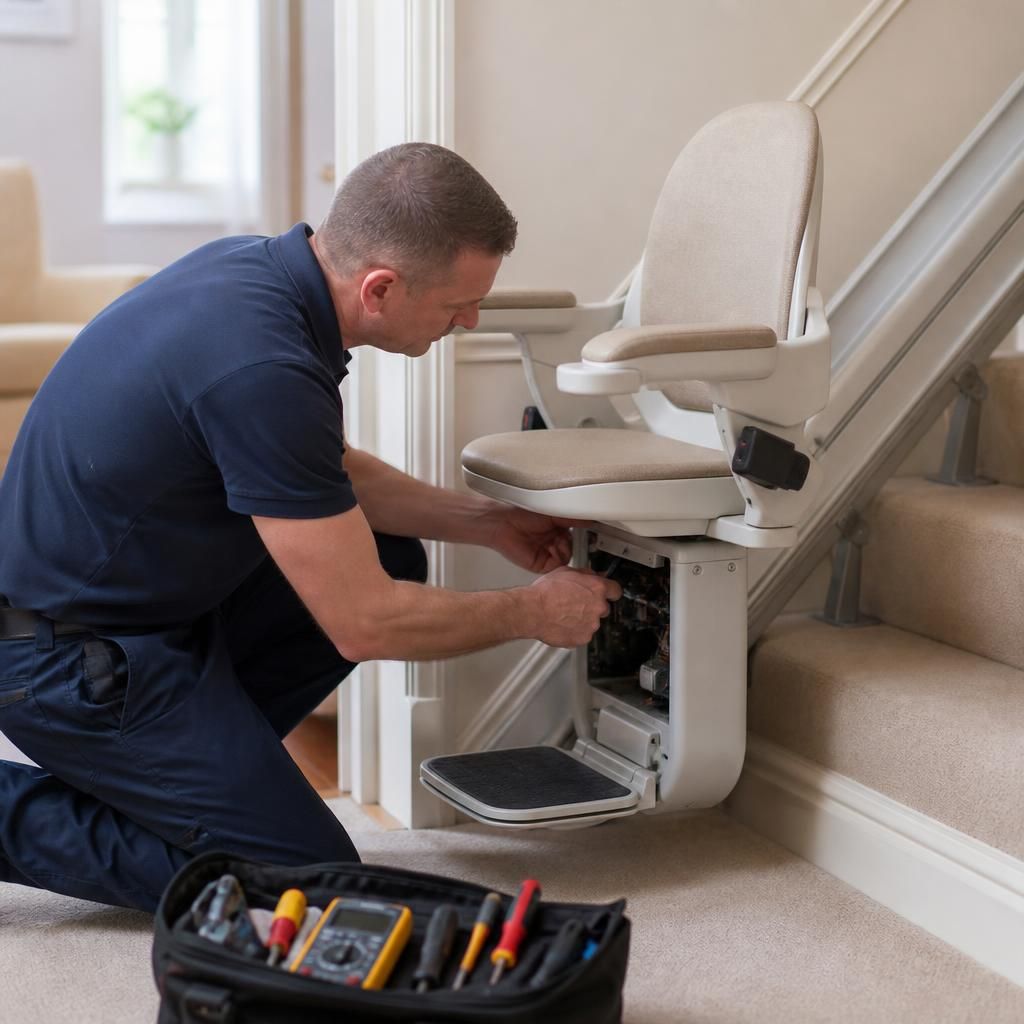
Need help maintaining your stairlift?
If you need help maintaining your stairlift or notice a change in its operation, contact Independent Stairlifts for advice or to arrange a qualified engineer visit.