
What should I do if my stairlift breaks down unexpectedly?
If your stairlift breaks down unexpectedly, stop using it, remain safely seated or move to a safe position, and contact Independent Stairlifts for advice and repair support. Check that the power supply is switched on and the lift is correctly parked, but do not attempt to repair or bypass any safety feature yourself.
If your stairlift breaks down unexpectedly, stop using it, stay seated if you are in a safe position, and contact Independent Stairlifts for advice and repair support. Do not try to force the lift to move, bypass a safety feature, or remove covers. A stairlift that stops can often be assessed safely with a few basic checks, but repairs and electrical work should be carried out by a qualified engineer.
If you are on the stairs
- Stay calm and keep your hands, feet and clothing clear of the moving parts.
- If the lift has stopped at a landing and you can safely stand and move away, do so carefully. Use your walking aid or ask someone to assist if necessary.
- If you are in an unsafe position, cannot leave the seat safely, or have become unwell, use your phone, alarm or emergency call system to summon assistance. Do not climb over the stairlift or attempt to get off on the stairs.
- Ask other people in the property to keep away from the staircase until the fault has been assessed.
Carry out only safe, basic checks
Once you are in a safe position, check the simple causes of a stoppage without dismantling or interfering with the stairlift:
- Make sure the main power switch or fused spur is switched on. It is commonly located near the top or bottom of the staircase, although its position varies by installation.
- Check whether the lift is correctly parked on its charging point. If it has been left away from the charging position, its batteries may not have charged sufficiently.
- Check that the seat is fully locked in its normal travelling position and that the armrests, footrest and safety belt are correctly positioned.
- Look for an obstruction on the stairs, footrest or rail. Remove only loose items that you can reach safely; never place your hands near the drive mechanism.
- If your model has a diagnostic display or warning light, note what it shows. Do not repeatedly operate the controls if a warning remains visible.
- Check that the remote control has not been left pressed, dropped or damaged. If you have a second remote, an engineer may ask you to test it, but do not open either control.
After these checks, try the control once only if the lift is in a safe position and no warning or obstruction is present. If it does not operate normally, stop and contact us. Repeated attempts can drain the batteries or make the underlying fault harder to identify.
What information to provide when you call
Tell Independent Stairlifts where the lift stopped, whether anyone is still on the staircase, what happened immediately beforehand and whether there was a power cut or unusual noise. It is also useful to describe any flashing light, error message or beeping pattern. If safe to do so, have the stairlift model details and any service or warranty information available. A clear description helps us assess the urgency and send the appropriate support.
Do not worry if you cannot identify the cause. The purpose of these questions is to help with diagnosis, not to expect you to repair the stairlift yourself. If the lift is under warranty or covered by a service agreement, mention this when arranging assistance so the repair can be handled in line with the applicable terms.
Do not attempt these repairs yourself
- Do not remove the carriage, motor, batteries, covers or electrical components.
- Do not bridge switches, disconnect sensors or hold down safety controls to make the lift run.
- Do not use unsuitable batteries, chargers or replacement parts.
- Do not push or pull the carriage along the rail, and do not try to turn the lift manually.
- Do not continue using the stairlift if it judders, stops repeatedly, smells hot, makes an unfamiliar noise or shows a persistent fault warning.
These actions can cause injury, damage the equipment and affect warranty or service coverage. A stairlift’s safety systems are designed to stop movement when a fault or unsafe condition is detected, so a stoppage should be treated as a protective response rather than something to override.
Common reasons for an unexpected stoppage
A stairlift may stop because it is not receiving power, has not been returned to its charging point, or has a battery that is no longer holding sufficient charge. Other possible causes include an incorrectly positioned seat, a triggered safety sensor, an obstruction on the footrest or rail, a remote-control issue, or a technical fault in the drive system. Outdoor stairlifts can also be affected by moisture, debris or exposure to particularly harsh conditions.
A battery-powered stairlift may still operate briefly after the mains supply has been interrupted, but it will eventually stop if the batteries are not recharged. If the power has failed elsewhere in the property, check whether other appliances are affected, but do not reset electrical equipment repeatedly if you suspect a fault. Contact a qualified person if there is a burning smell, visible damage, smoke or evidence of overheating.
What happens after you report the fault
We will establish whether the issue can be resolved with safe guidance or whether an engineer needs to attend. The engineer will inspect the power supply, charging points, batteries, controls, sensors, rail and drive components, then test the stairlift through its operating range. The repair may involve adjustment, cleaning, a replacement component or further investigation, depending on the fault and the condition of the equipment.
Keep the stairlift switched off until you have been advised that it is safe to use. If you need to travel between floors while you are waiting, arrange help or use an alternative route only if it is safe and suitable for you. Never use the stairs to retrieve a walking aid or personal item if doing so would put you at risk.
Reducing the risk of future breakdowns
- Leave the stairlift at its designated charging point when it is not in use, following the instructions provided for your model.
- Keep the rail, steps and landing areas clear of clothing, toys, pets and other objects.
- Use the seat belt and operate the controls as instructed.
- Clean the accessible surfaces as recommended, but keep liquids away from electrical parts and do not lubricate the rail unless specifically instructed.
- Arrange servicing or inspection when recommended, particularly if the lift is used frequently or has begun to behave differently.
- Report recurring stoppages promptly rather than waiting for the lift to fail completely.
If your stairlift has broken down, the safest response is to stop using it, move away from danger only if you can do so safely, check the power and charging position without dismantling anything, and contact Independent Stairlifts. We can help determine the next safe step and arrange appropriate stairlift repair support across the UK.
If your stairlift stops unexpectedly, treat it as a safety issue rather than trying to make it move again. Stay seated if you are in a safe position, keep your hands and feet clear of the mechanism, and only get off at a landing if you can do so without risk. Never climb over the lift or attempt to walk past it on the stairs.
Once you are safe, check that the main power switch is on, the lift is correctly positioned on its charging point and there are no loose obstructions on the footrest or rail. Do not remove covers, disconnect safety sensors or repeatedly operate the controls. If the lift still does not work, contact Independent Stairlifts with details of where it stopped, any warning lights or beeps, and whether there was a power cut or unusual noise.
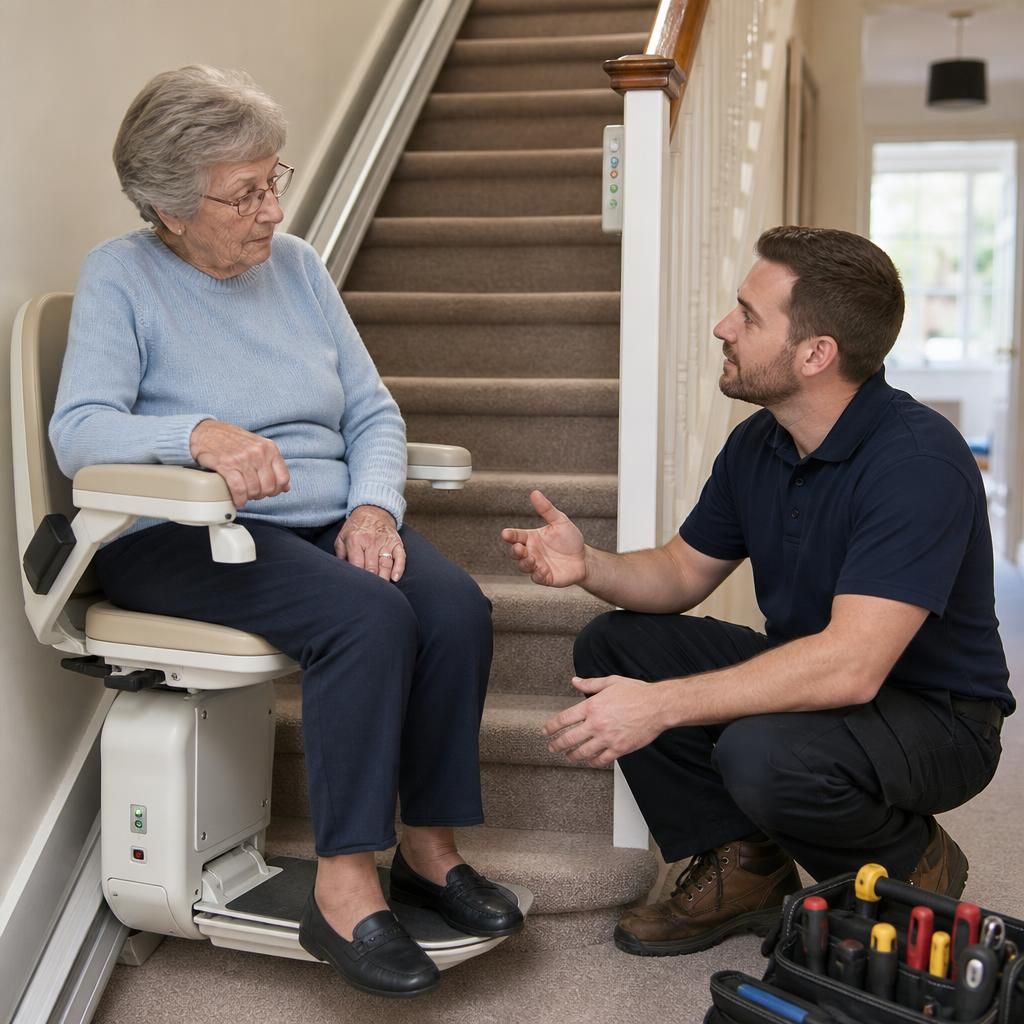
Contact us for stairlift breakdown support
If your stairlift has broken down, contact Independent Stairlifts for practical advice and repair support. Tell us where it stopped and describe any warning lights, beeps or unusual noises so we can help arrange the appropriate next step.