
What factors should I consider when choosing between a straight or curved stairlift for my home?
Choose a straight stairlift when your stairs follow one uninterrupted flight, while a curved stairlift is designed for stairs with bends, landings or multiple flights. Your decision should also consider the available space, comfort, access to other floors, installation requirements and budget, with a home assessment confirming the most suitable option.
A straight stairlift is usually suitable when your staircase runs in one uninterrupted flight without bends or intermediate landings. A curved stairlift is generally required when the stairs turn, include a landing, change direction or continue across multiple flights. The right choice also depends on how you use the stairs, the space available, comfort and transfer needs, the effect on other household members, installation requirements and your budget. A home assessment is the most reliable way to confirm which option will fit safely.
Start with the shape of your staircase. Straight stairlifts travel along a single, continuous rail. They are normally considered for a straightforward flight from one floor to another, although the stairlift still needs to be assessed for the available width, top and bottom access, and any doors or obstructions nearby.
Curved stairlifts are made for more complex layouts. Their rail can follow bends, corners, landings and changes in direction, allowing the user to travel between different floors without leaving the stairlift at each landing. A staircase with more than one flight may sometimes be served by separate straight stairlifts, but this would require a transfer between them and may not be practical or comfortable. The layout and the user’s ability to transfer safely should guide that decision.
Consider how easily you can get on and off. The safest stairlift is one that allows you to transfer without unnecessary twisting, reaching or balancing. Think about where you would sit at the bottom and top, whether there is enough room to approach the seat, and whether doors, radiators or furniture affect the transfer area. Features such as a powered swivel seat, adjustable seat height, suitable armrests and a powered or easy-to-operate footrest may be relevant, particularly if you have limited strength or movement.
At the top of the stairs, the seat may need to swivel so that you can step away from the stairlift onto the landing rather than directly towards the stairs. On a curved staircase, the rail may also be designed to finish in a position that improves access to the upper landing. These details need to be considered as part of the whole installation rather than selected in isolation.
Check the available space. Stairlift models differ in their folded width, seat dimensions and rail design. When the lift is parked or folded, it should leave sufficient room for other people to use the stairs where possible. This is particularly important on narrow staircases or in busy hallways. The assessment should also consider the width of the staircase at bends, the position of handrails, skirting boards and radiators, and whether the lift could obstruct a doorway or landing.
A curved rail is designed specifically for the individual staircase, so its route can take account of unusual corners and restricted areas. That does not mean every layout is automatically suitable; the installer must check clearances, parking positions and safe access at each point along the route.
Compare the cost in the context of the work required. Straight stairlifts are generally the simpler option when the staircase is suitable for a standard rail. Curved stairlifts involve a bespoke rail and more detailed design work, so they commonly cost more. The final price can also be affected by the number of floors served, the required parking positions, additional features, electrical work and any changes needed to accommodate the installation.
It is worth comparing the complete solution rather than only the initial equipment price. For example, a lower-cost straight arrangement may require a transfer at a landing or more than one lift, while a curved stairlift may provide a continuous route. A clear quotation should explain what is included, such as the assessment, rail, installation, removal of packaging and any relevant aftercare or warranty arrangements.
Think about how the stairlift will be used every day. If you need to travel between several floors, a curved stairlift may be more convenient because it can follow the full route. If you mainly need access between two levels on a simple staircase, a straight stairlift may provide the appropriate solution without additional design complexity. Consider whether you will use the lift independently, whether someone may need to assist you, and whether you need to carry small items between floors.
Controls should be easy to operate from the seat and, where appropriate, from the landings. The seat should provide stable support, and the footrest and safety belt should be straightforward to use. If more than one person uses the stairlift, adjustable settings and a suitable weight capacity should be discussed during the assessment.
Allow for installation conditions. A straight stairlift can often be installed more simply because its rail follows a single flight. A curved stairlift requires accurate measurement and manufacture of a rail to match the staircase, so the preparation and installation process may be more involved. The installer should explain the expected timescale, how access to the stairs will be managed and whether the stairlift can be installed without major structural changes.
Most stairlifts are fixed to the stairs rather than the wall, but the fixing method and any site-specific requirements should still be confirmed. If you live in a rented property, a listed building or a home with unusual construction, check whether permission or additional assessment is needed before work begins.
Use the home assessment to resolve the practical details. During an assessment, the staircase can be measured and the proposed route considered alongside your mobility, transfer ability and day-to-day routine. You can ask to see where the stairlift would park, how much stair width would remain, how the controls work and whether the seat position suits you. If the stairlift is intended for someone with a progressive condition, discuss whether the design will remain suitable if their mobility changes.
In summary, choose a straight stairlift when you have a simple, uninterrupted flight and a direct transfer can be made safely. Consider a curved stairlift when the staircase has bends, landings or multiple flights, or when a continuous route and carefully positioned seat would provide better access. The most suitable option is the one that fits both the staircase and the person using it, so a detailed assessment should be completed before selecting a model or accepting a quotation.
The shape of your staircase is the main factor when choosing between a straight and curved stairlift. A straight stairlift follows one uninterrupted flight, while a curved stairlift is made to follow bends, corners, intermediate landings and multiple flights.
A staircase with more than one flight may sometimes be served by separate straight stairlifts, but this means transferring at the landing. A curved stairlift can provide continuous travel between floors, which may be more suitable if transferring is difficult or unsafe. The assessment should also consider where the stairlift parks, whether there is enough room to approach and leave the seat, and how much stair width remains for other household members.
During your home assessment, ask to see the proposed rail route and parking positions. The installer can check clearances around handrails, doors, radiators and furniture, while also considering features such as a swivel seat or adjustable seat height. This ensures the chosen stairlift suits both the staircase and the person using it, rather than relying on the stair shape alone.
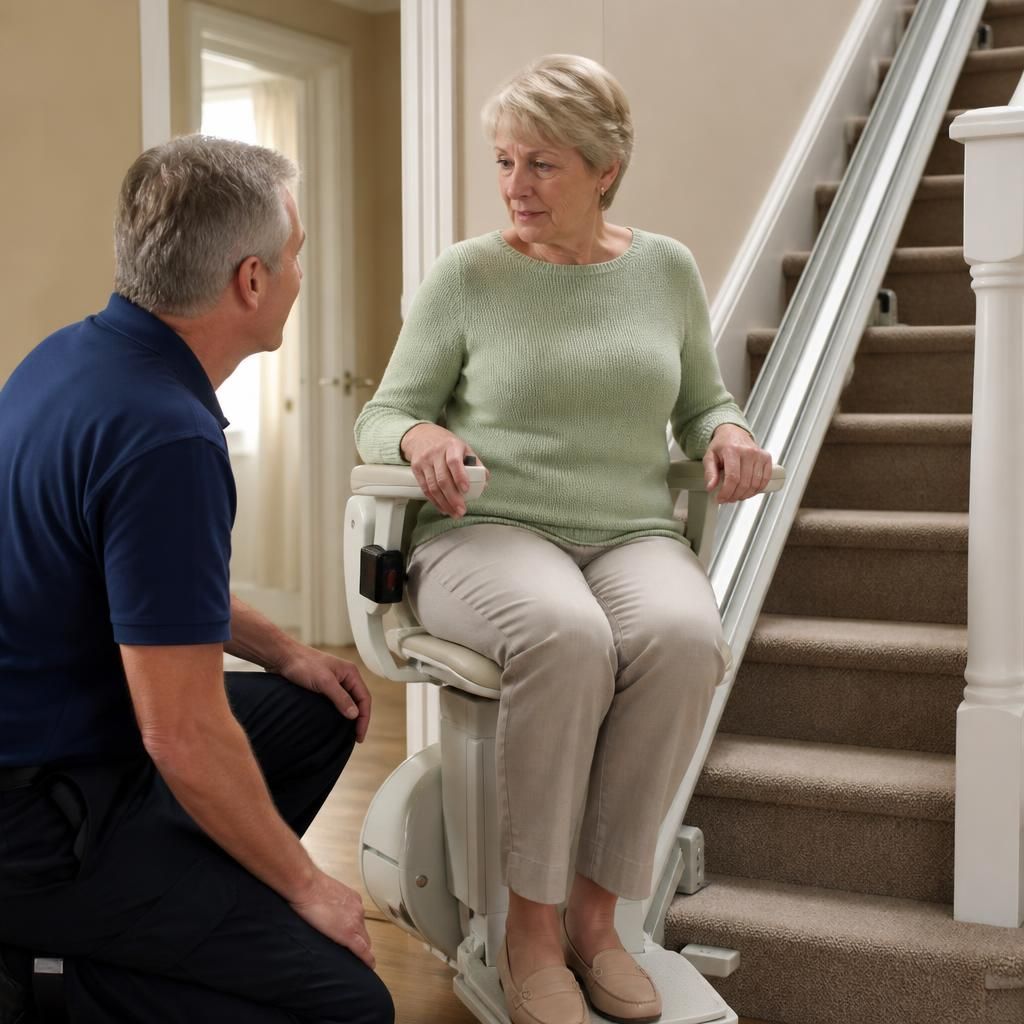
Arrange a Home Assessment for the Right Stairlift
Arrange a home assessment to confirm whether a straight or curved stairlift is suitable for your staircase, space and mobility needs. We can discuss the proposed rail route, parking positions and features before you decide.