
What are the different types of stairlifts available and how do I choose the right one for my home?
Stairlifts are available as straight, curved, outdoor and reconditioned models, with the right option depending on your staircase layout, indoor or outdoor location, mobility needs and budget. A professional home assessment will confirm the safest, most suitable design and whether features such as a powered swivel seat, folding rail or weather-resistant materials are needed.
The main types of stairlift are straight, curved, outdoor and reconditioned models. The right choice depends primarily on the shape and length of your staircase, whether it is indoors or outdoors, the user’s mobility and seating needs, and the available budget. A professional assessment is important because the safest solution is determined by the staircase and the way the user will approach, sit on and leave the stairlift, not simply by the number of steps.
Straight stairlifts are designed for staircases that run in one continuous direction without bends, intermediate landings or changes of angle. They are usually fitted to the stairs rather than the wall, so a suitable stairlift can often be installed without major structural alteration to the home. Straight models are generally the simplest option when the staircase layout is suitable.
Before choosing a straight stairlift, check whether the staircase has a landing, turn or change in gradient. A small change in direction can mean that a standard straight rail will not reach the required floor. The position of the stairlift when parked also matters, particularly in a narrow hallway or where it could obstruct a doorway. A folding rail may be useful if the rail would otherwise extend across a walkway or doorway at the bottom of the stairs.
Curved stairlifts are made for staircases with bends, corners, intermediate landings, multiple flights or unusual shapes. The rail is designed around the individual staircase and may follow one or more turns, allowing the user to travel between floors without transferring to another chair at a landing. Curved systems can also be suitable for some straight staircases where a tailored rail or particular parking position is required.
Curved stairlifts are more complex because the rail must be measured and manufactured to suit the staircase. The assessment will consider the width of the stairs, the direction and tightness of each turn, headroom, landing space and the safest position for getting on and off. In some homes, the most practical arrangement includes a parking point away from the top or bottom of the stairs, or a design that allows the seat to swivel safely at the landing.
Outdoor stairlifts are designed for external steps, such as access to a front door, garden, patio or raised entrance. They use materials and finishes intended to withstand rain, damp, sunlight and changes in temperature. Outdoor equipment still needs protection when not in use, such as a suitable cover or sheltered parking position, and the charging point must be located appropriately.
An outdoor stairlift should not be selected solely because it is described as weather-resistant. The installer should assess drainage, the condition and width of the steps, exposure to the elements, electrical arrangements and the position of the controls. Regular cleaning and checks are particularly important outdoors because dirt, moisture and debris can affect the rail, switches or moving parts.
Reconditioned stairlifts are previously used stairlifts that have been inspected, serviced and prepared for further installation. They can be a suitable option where the user wants to manage the purchase cost, especially for a straightforward staircase or where the anticipated period of use is limited. Availability depends on the rail configuration, the model and the condition of the equipment.
A reconditioned stairlift is not automatically suitable simply because it fits the general type of staircase. A straight rail may be reusable on another staircase with similar dimensions, but a curved rail is normally made for a particular layout and may not be transferable without modification. Ask what inspection and servicing have been carried out, which components are covered, whether the equipment is appropriate for the intended user and what warranty or aftercare is included.
The chair and operating features should be considered alongside the rail type. Common options include:
- Powered swivel seats, which turn the seat towards the landing to make getting off safer and reduce the need to twist.
- Manual or powered folding footrests, which can make it easier to park the stairlift and keep the stairs clear.
- Powered swivel or hinge rails, which can help where the rail would otherwise obstruct a doorway or circulation area.
- Perch or standing seats, which may suit someone who finds it difficult to bend the knees fully, provided they can stand securely and maintain the required posture.
- Different seat widths, armrest arrangements and support options, which can improve comfort and stability.
- Remote controls and call/send controls, which allow the stairlift to be moved when it is parked at the opposite end of the stairs.
A perch seat is not appropriate for everyone. It requires sufficient balance, strength and confidence to remain supported while travelling. Similarly, a standard seated stairlift may not provide enough support if the user has difficulty transferring from a wheelchair or standing safely at the top and bottom. The assessment should take account of the user’s current abilities as well as likely changes in mobility.
When choosing the right stairlift, start with the staircase layout. Measure or describe each flight, landing and turn, but do not rely on measurements alone when deciding which product to buy. A professional survey can identify hazards such as restricted headroom, radiators, doors opening onto the stairs, narrow landings, uneven surfaces and limited space to park the chair. It can also establish whether the stairlift can be used without preventing other people from using the stairs.
Next, consider how the user approaches the stairlift. The safest installation may require the chair to swivel at the top, stop before a doorway, or park beyond the lowest step. Think about transfers from a wheelchair or walking aid, whether assistance is available, and whether the user can operate the controls reliably. If more than one person will use the stairlift, the design must accommodate the needs of the person with the greatest difficulty while remaining practical for others.
Comfort and safety features should be selected for a reason rather than added without assessment. A seatbelt, supportive armrests, a suitable footrest and clear controls are fundamental considerations. Where vision, dexterity or memory is affected, simple controls and clear indicators may be more useful than complicated functions. Battery-powered stairlifts are designed to continue operating for a limited period during a mains power interruption, but the batteries still need to be maintained and replaced when required.
Budget is another consideration, but the lowest initial price is not necessarily the lowest overall cost. Compare the installation work, warranty, servicing arrangements, battery replacement, removal provisions and any adaptations required at the property. A new stairlift may offer the widest choice of configurations and features, while a reconditioned model may provide good value when the staircase and user’s requirements are straightforward. The important point is that the equipment is correctly matched, professionally installed and supported after installation.
Ask the installer to explain where the stairlift will park, how the user will get on and off at each level, what happens if the power fails, and which controls or safety sensors are included. You should also understand any restrictions on weight, seat use, weather exposure or carrying items. Do not carry another person or bulky objects on the stairlift unless the equipment is specifically designed and approved for that use.
The usual selection process is a home assessment followed by a recommendation based on the staircase and the user. The installer should discuss suitable alternatives, explain any limitations and provide a clear quotation. If the staircase is altered, decorated or obstructed after the assessment, tell the installer before installation so the design can be checked again.
In summary, choose a straight stairlift for a continuous straight flight, a curved stairlift for stairs with turns or more complex geometry, and an outdoor model for external access. Treat reconditioned equipment as a purchasing option that must still be checked for compatibility, condition and aftercare. A detailed assessment by Independent Stairlifts will help confirm the appropriate rail, seat and features for your home, while ensuring that everyday access, safe transfers and future mobility needs are properly considered.
The right stairlift is determined by the staircase layout and the user’s mobility needs, rather than by the number of steps alone. A professional assessment checks bends, landings, available headroom, parking space and how safely the user can get on and off at each level.
The assessment also helps identify useful features, such as a powered swivel seat, folding rail or perch seat. These should be selected for a specific access or comfort requirement, so the finished installation remains safe and practical for everyday use.
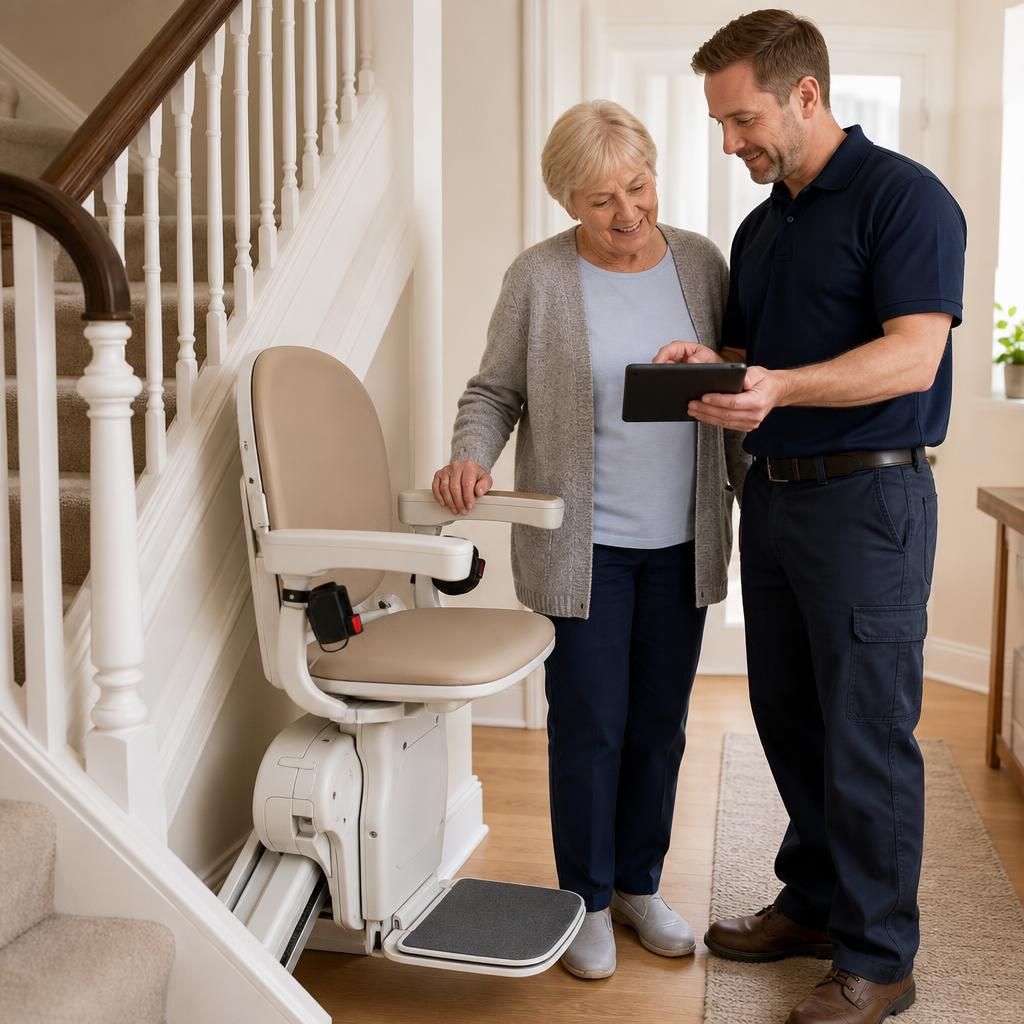
Arrange a stairlift assessment for your home
Arrange a home assessment with Independent Stairlifts to confirm which stairlift type, seat and safety features suit your staircase and mobility needs. Our assessment will also identify the most practical parking and transfer positions before you commit to a solution.