
How do I know if a stairlift installation company is trustworthy?
A trustworthy stairlift installation company will provide clear, impartial advice, assess your staircase and mobility needs properly, explain all costs and options, and use trained installers. It should also offer transparent warranty terms, responsive aftercare and evidence of appropriate experience, insurance and safety procedures.
A trustworthy stairlift installation company will assess your staircase and mobility needs properly, give clear advice about suitable options, explain the full cost before you commit, and provide evidence of safe installation and dependable aftercare. Trust should be demonstrated through its process and documentation, rather than relying only on advertising or sales claims.
Check the quality of the assessment
A reputable provider should arrange a proper assessment of your home before recommending a stairlift. This should cover the shape, width and condition of the staircase, available landing space, nearby doors and walkways, electrical supply and any potential obstructions. The assessor should also discuss how the stairlift will be used, including the user’s balance, flexibility, weight, ability to transfer on and off the seat, and whether anyone else uses the stairs.
The recommendation should be based on safe and practical use, not simply on the easiest model to sell. For example, the assessor may discuss a straight or curved rail, different seat designs, powered swivel or folding features, controls, and whether a reconditioned stairlift is appropriate. Ask what alternatives were considered and why the proposed model is suitable.
Look for clear, impartial advice
A trustworthy company should explain the advantages and limitations of each suitable option in straightforward language. It should not suggest that you need features that are irrelevant to the user, or pressure you into making an immediate decision. Be cautious if an assessor avoids questions, dismisses concerns about access or safety, or presents a discount that is available only if you sign straight away.
You should have enough information to compare options and discuss the decision with family members or carers if needed. A written quotation and time to consider it are important parts of a responsible sales process.
Review the quotation carefully
The quotation should identify the stairlift, the proposed installation and the total price. Check whether it includes:
- the site assessment and installation;
- delivery and any necessary alterations or electrical work;
- removal of packaging and, if relevant, an existing stairlift;
- demonstration and instruction after installation;
- warranty cover and its duration;
- call-out charges, servicing costs and other aftercare fees;
- the cost of batteries or other items that may need replacing; and
- any conditions that could cause the price to change.
Ask whether VAT applies to your circumstances and whether the quoted amount includes all work required to leave the stairlift ready for use. If the price is based on a reconditioned stairlift, ask what has been inspected, replaced or tested and whether the warranty differs from that of a new model.
Verify experience and installation standards
Ask how long the company has been installing stairlifts and whether its installers are directly employed or engaged as subcontractors. This is not necessarily a problem, but you should know who will carry out the work and who is responsible if an installation issue arises. The company should be able to describe its installer training, supervision and procedures for checking completed work.
It is also reasonable to ask whether the equipment and installation meet applicable UK safety requirements and relevant standards, such as BS EN 81-40 for powered stairlifts. A trustworthy provider should explain this clearly and provide product or installation documentation where appropriate. You can also ask for evidence of suitable public liability insurance and any relevant trade memberships or accreditation. Membership alone does not prove quality, but refusal to provide basic business information is a warning sign.
Confirm how safety will be handled
Before work begins, the installer should identify risks such as narrow steps, uneven flooring, low ceilings, doors opening onto the staircase, children or pets using the area, and difficulties transferring at the top or bottom. The completed installation should leave the staircase and landings as safe and accessible as reasonably possible.
The installer should demonstrate the controls, seat belt, swivel mechanism, safety sensors, charging points and emergency procedures. You should know how to stop the stairlift safely, what to do if it stops away from a charging point, and how to contact the company if it develops a fault. Ask for operating instructions in a form the user can understand, and do not accept an installation that leaves you unsure how to use it.
Examine the warranty and aftercare arrangements
A reliable company should provide warranty terms in writing rather than describing them only as “comprehensive”. Check what is covered, when cover starts, whether parts and labour are included, and which exclusions apply. Some warranties exclude damage caused by misuse, accidental damage, batteries or lack of recommended servicing, so these details matter.
Aftercare should include a clear method for reporting a fault and an explanation of how urgent breakdowns are handled. Ask whether support is available outside normal office hours, whether call-outs are chargeable after the warranty ends, and whether the company can continue to service the stairlift if the original installer is no longer involved. A trustworthy provider will not make it difficult to obtain help or hide ongoing costs.
Check independent evidence
Customer reviews can help, particularly when they mention the assessment, installation quality and response to faults rather than focusing only on price. Look for consistent, recent feedback across more than one source. A company should also be willing to provide a written reference or explain its complaints process. Treat testimonials shown only in sales material as one part of your research, not conclusive proof.
You can check that the business has a genuine UK contact address, accessible telephone support and clear terms and conditions. Make sure the name on the quotation, invoice and warranty is the same company responsible for the work. If a salesperson says a service is included, ask for that promise to be recorded in writing.
Understand your rights before agreeing
For a stairlift purchased in your home, consumer protection rules may give you cancellation rights, subject to the circumstances and the point at which you ask the company to begin work. Ask the provider to explain the cancellation process, particularly if a bespoke curved stairlift has been ordered or installation is requested during the cancellation period. Do not rely on verbal assurances; read the contract, terms of sale and notice of cancellation rights before signing.
If you feel pressured, are not given the required paperwork, or cannot obtain a clear answer about the total cost, pause the purchase and seek further advice. A trustworthy company should allow you to make an informed decision without using fear, urgency or confusing technical language.
A practical final check
Before choosing an installer, confirm that you have received a written assessment, an itemised quotation, warranty terms, installation details, user instructions and a named aftercare contact. You should know who is responsible for the work, what happens if the stairlift is unsuitable or faulty, and which costs may arise later. If those points are clear and the company’s advice is consistent with the user’s needs and the layout of your home, you have stronger evidence that the installation provider is trustworthy.
A trustworthy stairlift installer will base its recommendation on a proper assessment of your staircase and the user’s mobility needs, then confirm the proposed solution and total cost in writing. The assessment should consider the staircase layout, landing space, doors, electrical supply, seating position, transfers and the needs of other people using the stairs.
Before agreeing to the installation, check that the quotation clearly states what is included, such as delivery, fitting, alterations, demonstration, warranty cover and removal of an existing lift if required. It should also explain any possible extra charges, ongoing servicing costs and how breakdowns are handled. Clear documentation gives you something to refer to if the agreed work or aftercare differs from what was discussed.
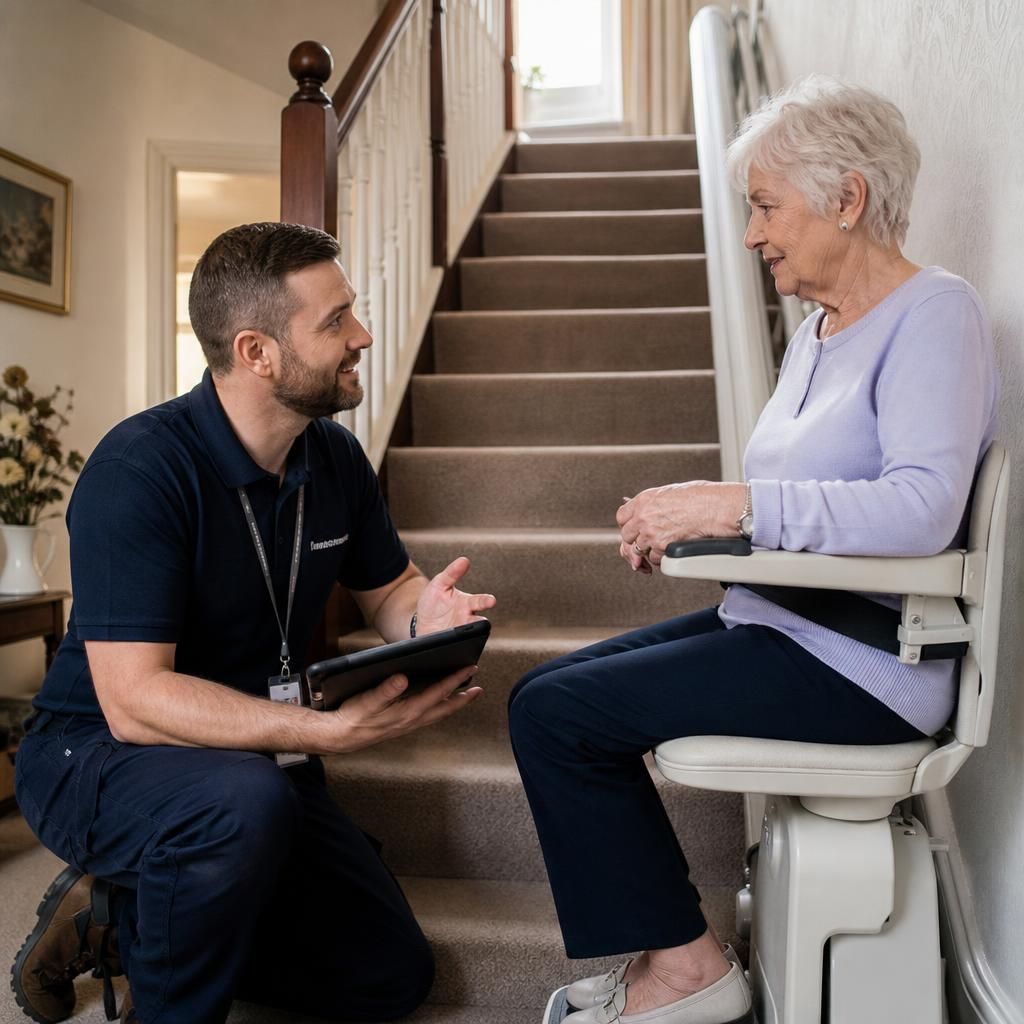
Ask our stairlift team about your installation options
Ask our stairlift team about your installation options, including the most suitable model for your staircase, user needs and budget. We can arrange a personalised assessment and explain the quotation, installation process and aftercare.