
Are there any legal or safety regulations I need to consider when selling my second hand stairlift?
Yes. A second-hand stairlift should be accurately described, safe to use and sold with relevant instructions and safety information; removal, inspection and reinstallation should be carried out by a competent professional, while businesses have additional responsibilities under UK product-safety and consumer-protection rules.
Yes. When selling a second-hand stairlift in the UK, you should describe it honestly, disclose known faults, provide the available safety and operating information, and ensure that removal and any subsequent installation are carried out safely by a competent person. The exact legal responsibilities depend on whether you are a private individual or selling in the course of a business.
Describe the stairlift accurately
Your advert and any discussions with the buyer should give a fair and accurate description of the stairlift. Include the manufacturer, model, approximate age if known, rail configuration, side of the staircase, whether it is straight or curved, and the condition of important components such as the batteries, seat, controls, charging points and safety sensors.
Make the buyer aware of anything that could affect safe operation or suitability, including intermittent faults, unusual noises, worn upholstery, missing keys or remotes, damaged covers, battery issues, previous repairs and whether the rail was made for a particular staircase. Do not describe a lift as “fully working”, “safe” or “ready to install” unless you have reasonable evidence to support that statement.
A private seller must not misrepresent the product or conceal a known defect. Keeping photographs, service records and written details of faults can help demonstrate what was disclosed before the sale.
Private sales and business sales have different duties
- Private sale: the stairlift should match its description and the seller must not make misleading statements or fraudulently hide defects. A private buyer will usually have fewer statutory rights than a consumer buying from a business, but this does not permit an unsafe or deceptively described sale.
- Sale by a business: additional consumer-protection duties apply. Under the Consumer Rights Act 2015, goods supplied in the course of business should be as described, of satisfactory quality and fit for any purpose made known to the seller. A business should also comply with applicable product-safety requirements and retain suitable records of its checks and communications.
If you regularly buy and sell stairlifts, advertise yourself as a supplier, or sell through a company, you may be treated as a trader even if a particular lift is used. Calling the transaction “private” does not remove responsibilities that apply to a business.
Product-safety information and documentation
Pass on the operating manual, maintenance information, safety notices, warranty details that can legally be transferred, and any relevant service or repair history. If the original instructions are unavailable, ask the manufacturer or a qualified stairlift engineer whether replacement documentation can be obtained. Do not guess at operating or safety instructions.
Where applicable, retain the lift’s identification details, including its model and serial number. Do not remove or obscure safety labels, warning notices or identification plates. A stairlift should not be sold as ready for use if it is incomplete, has been modified without proper assessment, or is missing a safety-critical component.
Product-safety rules can apply differently depending on how the stairlift was originally supplied, whether it has been substantially modified, and whether it is being supplied by a business. Used equipment may still need to meet relevant safety requirements when supplied commercially. If you are unsure about the status of a modified or older lift, obtain advice from a competent stairlift professional rather than relying on its age or original conformity marking.
Removal and electrical safety
Safe removal is an important part of the sale. A stairlift is connected to a domestic electrical supply and may be attached to the staircase in a way that requires specialist tools and knowledge. The power should be isolated correctly, the lift secured during dismantling, and the rail and components removed without damaging the stairs, wiring or surrounding property.
Do not ask an unqualified person to disconnect permanent electrical connections or attempt to remove the lift while it is powered. Batteries should be handled, stored and transported appropriately, and damaged or leaking batteries should not be passed to a buyer. Any electrical work should be completed by a suitably competent person in accordance with applicable electrical-safety requirements.
Inspection before resale
A visual inspection alone cannot confirm that a used stairlift is safe. Before resale, a competent engineer should assess relevant safety features, including the braking system, drive mechanism, batteries and charger, seat belt, swivel or folding mechanisms, arm controls, remote controls, sensors, limit switches, charging points and emergency functions. The engineer should identify whether the lift is suitable for reinstallation and record defects or parts that need replacement.
A safety check does not make an unsuitable lift suitable for every staircase. Curved rails are generally made for a particular layout, and even a straight stairlift may require checks of the rail length, landing clearance, direction of travel and electrical arrangements. The buyer should be told that a separate site assessment may be required before installation.
Reinstallation should be professionally assessed
The buyer should not assume that a removed stairlift can simply be fitted elsewhere. Safe installation depends on the staircase, available clearances, fixing points, power supply and the condition and compatibility of the equipment. Reinstallation should be carried out and tested by a competent stairlift installer, with the buyer given operating instructions and advice on safe use.
It is sensible to state in writing whether your price includes removal, transport, inspection, storage, reconditioning or reinstallation. If the sale is for parts or refurbishment only, say so clearly and do not present the equipment as suitable for immediate passenger use.
Insurance, records and disposal
If you are selling through a business, check that your public liability and product liability insurance covers used mobility equipment and any removal or installation service you provide. Keep the advert, photographs, written disclosures, inspection records, sale terms and details of the buyer or installer for a reasonable period.
Parts that are unsafe, contaminated or beyond economical repair should be disposed of through an appropriate waste route. Batteries and electrical components may require separate handling and should not be placed in ordinary household waste. If an installer removes the lift, ask how unwanted parts will be recycled or disposed of.
A practical compliance checklist
- Confirm the model, serial number, ownership and available documentation.
- Describe the age, condition, configuration and known faults accurately.
- Do not claim that the lift is safe, tested or ready to install without appropriate evidence.
- Arrange competent removal and protect the staircase and electrical supply.
- Have the lift inspected if it is being sold for reuse rather than parts.
- Tell the buyer that suitability and installation must be assessed at the new property.
- Provide manuals, safety information and service records where available.
- Use clear written terms, particularly about faults, refunds, removal, transport and installation.
- Follow the additional consumer and product-safety duties that apply if you are selling as a business.
If you are uncertain whether a particular stairlift can legally or safely be resold, stop the sale until it has been assessed by a competent stairlift company. This is especially important where the lift has been modified, suffered a fault, has missing safety components or is being offered for installation in a different type of staircase.
A used stairlift should be inspected by a competent stairlift professional before it is sold for reuse, particularly if it has known faults, missing parts or a history of modification. A visual check cannot confirm that the drive system, batteries, safety sensors, braking system and controls are reliable.
The sale should also make clear whether it includes removal, transport, inspection or reinstallation. The buyer’s staircase must be assessed separately, as a stairlift that worked safely in one property may not be suitable for another. If the equipment is being sold for parts or refurbishment only, state this clearly and do not describe it as ready for passenger use.
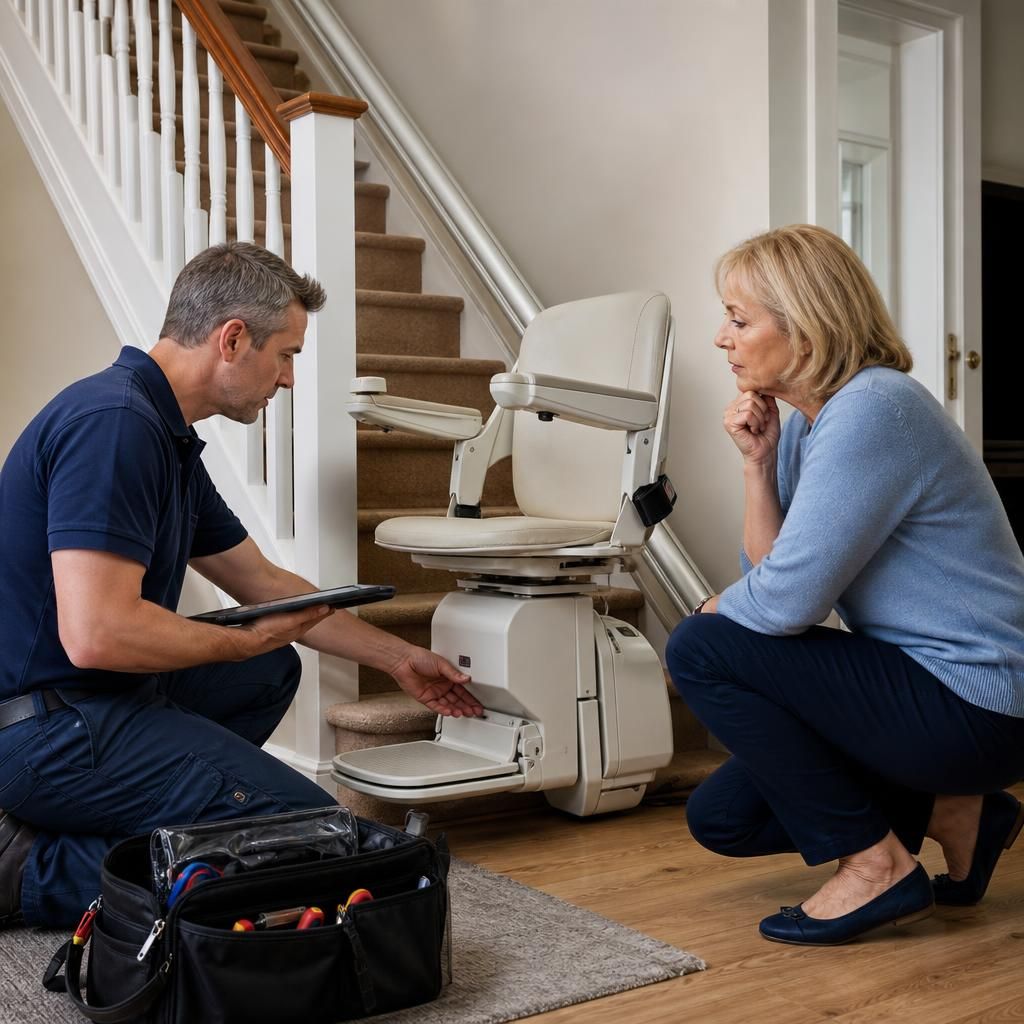
Get advice on selling your second hand stairlift
Contact Independent Stairlifts for practical advice on assessing, removing and selling your second-hand stairlift safely. We can help clarify whether it is suitable for reuse, refurbishment or parts and explain the next steps.