
What troubleshooting steps should I follow if my stairlift suddenly stops in mid-travel?
If your stairlift stops mid-travel, remain seated with the seat belt fastened and check for an obstruction, an unlatched seat or armrest, and signs of a power interruption. If it does not restart after these basic checks and a safe reset according to the user manual, switch it off and contact Independent Stairlifts for assistance rather than attempting a repair.
If your stairlift stops suddenly in mid-travel, stay seated with the seat belt fastened and do not try to climb off on the stairs. Check for a visible obstruction, confirm that the seat and armrests are locked in their normal travelling position, and look for signs of a power interruption. If it does not restart after these safe checks and the reset procedure in your user manual, switch it off and contact Independent Stairlifts for assistance.
Follow these steps in order:
- Remain safe in the seat. Keep the seat belt fastened, keep your hands and feet inside the stairlift, and avoid leaning towards the staircase. If you are at immediate risk because of a medical emergency, call the emergency services. Do not attempt to descend the stairs on foot while the lift is stopped unless there is no safer alternative.
- Release and reapply the control. Let go of the armrest control or joystick, wait briefly, and then try the direction required to continue travelling. Avoid holding the control continuously while checking the lift, as this can make it harder to identify whether the control is responding.
- Check the seat and armrests. Many stairlifts will not move unless the seat is correctly locked in the travelling position and both armrests are fully lowered. If your model has a swivel seat, return it fully to the position facing up or down the staircase, as appropriate. Do not force the seat or armrests if they feel jammed.
- Look for an obstruction. From the seated position, check the footrest, carriage and visible sections of the rail for an item that may have triggered a safety sensor. Common examples include clothing, footwear, toys, pets, household items or loose carpet edges. If the obstruction is within easy reach, remove it only when the stairlift is switched off and stationary. Never reach under the carriage or into a moving mechanism.
- Check the safety edges. A safety edge on the footrest or carriage may have detected contact with an object or the staircase. Make sure nothing is pressing against it. Do not tape down, hold in or bypass a safety switch; these features are designed to stop the lift before contact causes injury or damage.
- Check the power supply. Confirm that the stairlift’s isolation switch is on and that any nearby fused connection unit or power switch has not been turned off. If there has been a power cut, the lift may stop away from a charging point. Some models can complete a limited journey on their batteries, while others may need power restored before they will move. Do not remove covers or investigate internal wiring.
- Check the key and remote control. If your stairlift has a key switch, make sure the key is inserted and set to the operating position. If you are using a remote control, try the other control supplied with the lift, if available, and make sure its batteries are not exhausted. Keep remote controls pointed towards the stairlift where the model requires this.
- Carry out only the reset described for your model. After checking that the route is clear, use the normal on/off switch or reset procedure in the user manual. A safe reset commonly involves releasing the control, switching the lift off, waiting briefly and switching it on again, but procedures vary. Do not repeatedly reset the lift, disconnect the battery or attempt to override an emergency stop without model-specific instructions.
If the stairlift restarts, observe it closely on the next short journey. Stop using it and arrange a service if it stops again, travels unevenly, makes an unusual noise, shows an error message, continues beeping, or fails to reach its charging points. Repeated stopping can indicate a fault with the batteries, charger, drive system, safety circuit, controls or track, and should not be treated as a problem that will resolve itself.
If the lift remains stopped, leave it switched off if this is safe to do and contact Independent Stairlifts. Have the stairlift model or serial details available, describe where it stopped, and report any display message, beeping pattern, unusual sound, recent power cut or visible obstruction. Do not remove covers, alter wiring, lubricate the rail or attempt to repair the motor, batteries or safety sensors yourself. A trained engineer can diagnose the cause and confirm whether the stairlift can be returned to service safely.
If your stairlift stops mid-travel, remain seated with the seat belt fastened and keep your hands and feet clear of the mechanism. Check that the seat and armrests are fully in the travelling position, then look for an obvious obstruction around the footrest or rail.
Only remove an obstruction when the stairlift is stationary and switched off, and never reach beneath the carriage or bypass a safety sensor. If the lift does not restart using the reset procedure in your user manual, switch it off and contact Independent Stairlifts. Do not attempt to leave the lift on the stairs or repair its wiring, batteries or drive system yourself.
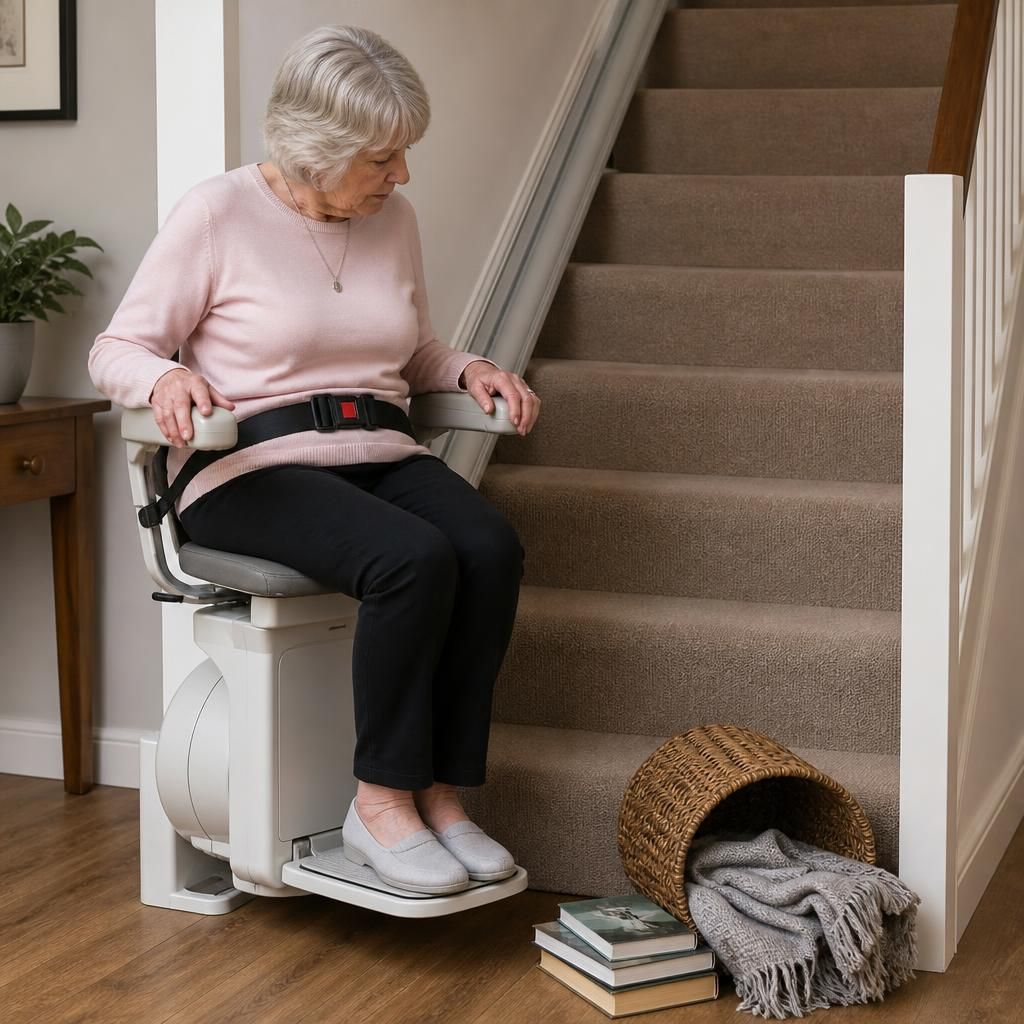
Need help with a stairlift that has stopped mid-travel?
If your stairlift remains stopped after these safe checks, switch it off and contact Independent Stairlifts for assistance. Tell us where it stopped and mention any error message, beeping, unusual noise or recent power interruption.