
How can I safely reset my stairlift when it doesn't start?
To safely reset a stairlift that will not start, switch it off at the isolator or mains supply, remove the key, wait briefly, then restore power and check that the seat, armrests, footrest and swivel seat are correctly positioned. If it still does not move, check the charging position, handset and visible obstructions without bypassing any safety device, then contact Independent Stairlifts for advice or an engineer visit.
To safely reset a stairlift that will not start, switch it off using the approved isolator or mains supply, remove the key, wait briefly, then restore power and check the lift’s operating position. Before trying to move it, make sure the seat, armrests, footrest and swivel seat are correctly secured. If the stairlift still does not respond, check its charging position, handset and visible obstructions, but never bypass a safety switch or attempt to force the lift to move.
A reset can clear a temporary control fault caused by a power interruption, an emergency stop or a control being left in an unusual position. It will not correct a flat battery, damaged wiring, a failed component or a mechanical obstruction. The exact procedure varies between models, so use the instructions supplied with your stairlift where they differ from the guidance below.
Before resetting the stairlift
- If the stairlift has stopped on the stairs, remain seated if it is safe to do so and keep your hands, feet and clothing clear of the track and moving parts. Do not climb off on the stairs unless there is no safer alternative.
- Remove anything that may be touching the footrest, carriage, seat or track. Check the area for loose rugs, furniture, toys, bags or clothing, but do not put your hands into a mechanism or remove a guarded cover.
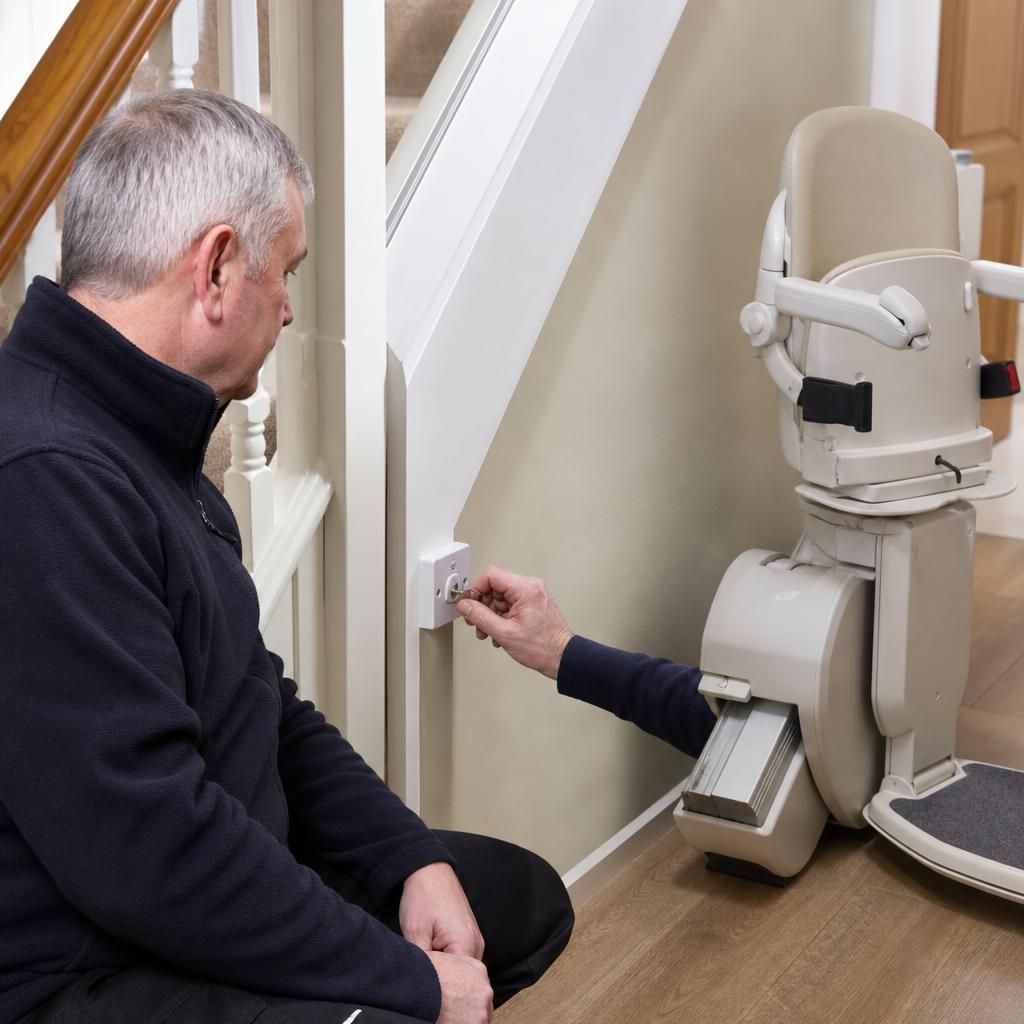
- Check whether the stairlift is switched on. Many models have a key switch, an isolator switch near the top or bottom of the stairs, and a power indicator. The key must normally be inserted and turned to the operating position.
Safe reset procedure
- Park the stairlift in its normal charging position if it can move. If it will not move, do not push or pull it along the track.
- Turn the stairlift off using its key switch or the designated isolator. If your installation has a separate mains switch, use that only as described in the user instructions.
- Remove the key and leave the stairlift without power for a short period. This allows the control system to shut down fully.
- Restore the power supply, insert the key and turn it to the operating position. Release any emergency-stop control only if your model has one and the instructions identify how it is reset. Never hold an emergency-stop button in, bridge it or otherwise defeat it.
- Check that the seat is facing the correct direction for travel, the swivel seat is locked, the armrests are down and the footrest is clear. A stairlift may not operate if one of these safety positions is incorrect.
- Use the armrest control or handset to request a short movement, keeping clear of the stairs and observing the lift. Stop immediately if it moves unexpectedly, makes an unusual noise, smells of overheating or shows a warning indication.
If the stairlift has recently experienced a power cut, check that the household supply and the stairlift’s charger are switched on. When parked correctly, the lift should normally make contact with its charging points. A stairlift that has been left away from its charging position may have insufficient battery power to start or may only produce a warning sound. Do not repeatedly operate the controls in an attempt to recover a flat battery.
If the armrest control does not work, try the handset only when it is safe to do so. Check that the handset is switched on, has a working battery and is paired or connected as required by the model. If one control works and the other does not, the fault may be limited to the handset, its battery or the control connection. Do not open the handset or stairlift casing unless you are qualified and the manufacturer’s instructions specifically permit it.
Some stairlifts will not start when the seat is not fully swivelled back, an armrest is raised, the footrest is obstructed, the carriage is not positioned correctly or a safety edge is detecting contact. These features are designed to prevent unsafe movement. Do not tape down a sensor, hold a switch closed or disconnect a safety device to make the stairlift operate.
Contact Independent Stairlifts for advice or an engineer visit if the reset does not restore operation, the stairlift stops again, an error code remains displayed, the batteries or charger appear faulty, or there is any sign of damage, burning, overheating or a damaged power cable. Contact us as soon as possible if the lift is stranded on the stairs or if the user cannot safely reach a landing. Have the stairlift model, the indicator or error code, what happened immediately before the fault and the checks already completed available when you call.
Do not continue using a stairlift that moves erratically, travels slowly with unusual noise, jolts, loses power, or stops between charging points. Do not dismantle the carriage, remove the cover, alter the track or replace batteries without appropriate advice. A safe reset is limited to the normal user controls and power isolation provided for the installation; persistent faults require inspection by a suitably trained stairlift engineer.
A stairlift reset can clear a temporary control fault after a power interruption or emergency stop, but it will not repair a flat battery, damaged component or mechanical obstruction. Before resetting, stay clear of the track and check that there is no object touching the footrest, carriage or safety edges.
Use only the normal user controls: switch off at the key switch or approved isolator, remove the key, wait briefly, then restore power. Check that the seat is locked in the travel position, the armrests are down and the footrest is clear before attempting a short movement. Never force the lift, bypass a safety switch or repeatedly operate it if it remains stationary. Contact Independent Stairlifts if it still will not start, stops again, displays an error or shows signs of damage or overheating.
Need help resetting your stairlift safely?
If your stairlift still will not start after these checks, contact Independent Stairlifts for advice or to arrange an engineer visit. Do not force the lift or bypass any safety device.