
What should I look for in a reliable stairlift maintenance contract?
A reliable stairlift maintenance contract should clearly define the servicing schedule, what parts and labour are covered, engineer response times, emergency support and all associated costs. Check whether cover applies to your specific stairlift, includes safety testing and excludes pre-existing faults or accidental damage before you agree.
A reliable stairlift maintenance contract should clearly set out the servicing schedule, the parts and labour included, engineer response times, emergency arrangements and every charge that may apply. It should also confirm that the cover is suitable for your particular stairlift, including its age, model, track design and location, rather than offering only general or limited protection.
Before agreeing to a contract, check the following points carefully.
- What is included in the cover: Confirm whether the contract covers routine servicing only, or also includes repairs, replacement parts, labour and call-out charges. Some agreements cover the engineer’s time but charge separately for components, while others include parts subject to stated exclusions or limits.
- Suitability for your stairlift: The provider should identify the make, model and type of stairlift covered. Curved, outdoor and reconditioned stairlifts can have different servicing requirements from standard straight models. Ask whether cover applies to the complete system, including the track, seat, controls, charging points, batteries and safety sensors.
- Service frequency and checks: A comprehensive plan should explain when routine servicing is due and what the engineer will inspect. Checks commonly include the drive system, batteries and charging, safety edges, seat belt, swivel mechanism, controls, track, limit switches, carriage and electrical connections. The engineer should test the lift under operating conditions and record any faults or safety concerns.
- Repair and response arrangements: Find out how to report a breakdown, during which hours support is available and how quickly an engineer is expected to respond. The contract should distinguish between routine appointments and urgent faults that leave the user unable to access essential parts of the home. If out-of-hours support is available, check whether it is included or charged separately.
- Parts availability: Ask how the provider deals with parts that are worn, discontinued or specific to an older model. A contract should not imply unlimited cover if some components are subject to availability, manufacturer support or a separate quotation. It is also sensible to ask whether equivalent parts may be used and whether any replacement carries its own warranty.
- Exclusions and limitations: Read the exclusions rather than relying on the summary. Common limitations can include accidental or deliberate damage, misuse, water damage, alterations by another party, faults that existed before the contract began and consumable items. Batteries, chargers, remote controls and upholstery may be treated differently from mechanical parts, so check each item individually.
- Pre-existing faults: A provider may inspect the stairlift before accepting it for cover. If a fault is found, it may need to be repaired first or excluded from the agreement. This is reasonable provided the condition is explained clearly and you receive the cost of any required work before authorising it.
- Total cost: Compare the full cost over the contract period, not just the advertised fee. Check whether VAT, an initial inspection, call-outs, replacement batteries, emergency visits, parts, travel or cancellation charges are additional. Ask when payment is taken and whether the price can change at renewal.
- Contract length and cancellation: The terms should state the start date, renewal process, notice period and your rights if you move home or no longer need the stairlift. Find out whether cover can be transferred to a new owner or whether it ends when the stairlift is removed. Avoid agreeing to an arrangement that is difficult to cancel or does not provide clear written terms.
- Engineer competence and records: Servicing should be carried out by suitably trained engineers using the correct procedures for the equipment. You should receive a service record showing the date of the visit, checks completed, faults found and work recommended. Keeping these records helps identify recurring problems and provides evidence of proper maintenance if a later dispute arises.
- Safety and user guidance: The engineer should explain any safety issue that affects continued use and tell you whether the stairlift should be taken out of service. A good contract supports safe operation; it does not replace everyday checks such as keeping the track clear, using the controls correctly and reporting unusual noises, jerky movement or reduced battery performance promptly.
It is also important to compare a maintenance contract with the likely alternative: paying for inspections and repairs as they arise. A contract can make costs easier to plan and may provide reassurance about engineer access, but it is not automatically the cheapest option for every stairlift. Consider the lift’s age, condition, usage, repair history and the availability of replacement parts. A lower-priced plan may offer less protection if it excludes labour, batteries or most common faults.
Ask for the terms in writing and check that any promises made during a telephone conversation appear in the contract. In particular, confirm the renewal price, response commitment, repair limits, exclusions and procedure for making a claim. If a clause is unclear, ask for an explanation before signing rather than assuming that a repair will be included.
For an existing stairlift, the most useful starting point is a review of its service history and current condition. Independent Stairlifts can help clarify what level of maintenance is appropriate for the installation, whether it is straight, curved or outdoor, and which items should be included in any proposed cover. A suitable contract should leave you knowing what will be checked, what will be repaired, how quickly help will be provided and exactly what you will pay if something falls outside the agreement.
The most important part of a stairlift maintenance contract is a clear definition of what happens when the lift develops a fault. Check whether the agreement includes engineer labour, call-out charges and replacement parts, or whether some of these costs are billed separately.
- Confirm whether batteries, chargers, remote controls and safety components are covered.
- Check for limits on repair costs, parts availability and the use of equivalent components.
- Look for exclusions covering accidental damage, misuse, water damage and faults that existed before the contract started.
- Make sure emergency visits and out-of-hours support are explained, including any additional charges.
Ask for these details in writing before agreeing to the contract. A lower fee may provide limited protection if common parts or engineer time are excluded.
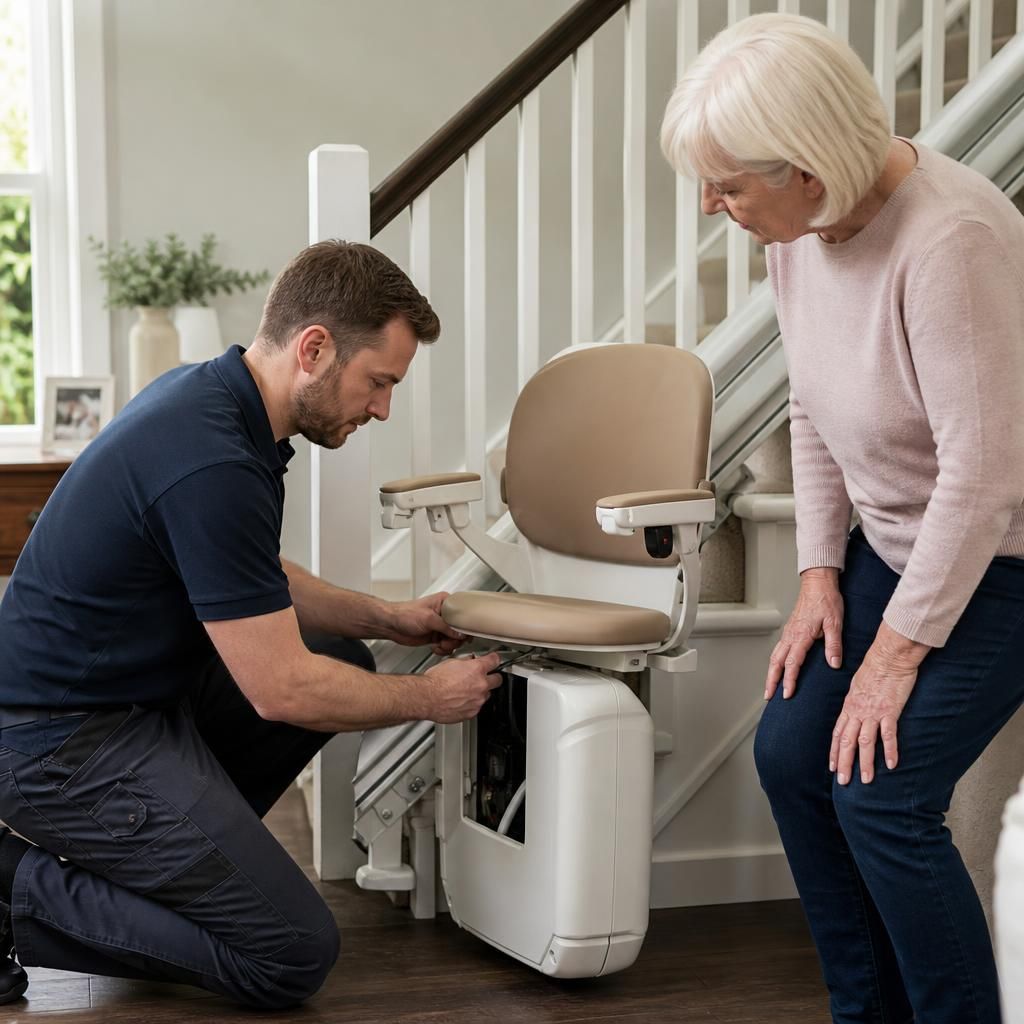
Discuss your stairlift maintenance needs
Speak to Independent Stairlifts about your stairlift’s condition, service history and maintenance requirements. We can help you understand the cover that may be suitable for your straight, curved or outdoor stairlift.