
How does regular stairlift maintenance benefit long-term reliability?
Regular stairlift maintenance improves long-term reliability by identifying wear, battery issues and developing faults before they cause a breakdown. Professional servicing also keeps the lift operating safely and smoothly, helping to prevent avoidable repair costs and extend its usable working life.
Regular stairlift maintenance improves long-term reliability by identifying wear, battery deterioration and developing faults before they cause a breakdown. A professional service checks the lift’s mechanical, electrical and safety systems, keeps its movement smooth and helps ensure that small issues are repaired before they become more disruptive or expensive.
A stairlift is used repeatedly and carries significant load on every journey. Components such as the carriage, drive system, track, seat mechanism, armrests, footrest and charging equipment are therefore subject to gradual wear. Routine servicing does not prevent every fault, but it provides an opportunity to detect changes in performance before they affect the lift’s safe operation.
Key benefits of regular stairlift maintenance include:
- Earlier fault detection: A technician can identify unusual noise, vibration, slowing, juddering, loose fixings or inconsistent stopping that may not be obvious during everyday use.
- More dependable starting: Battery condition, charging contacts and electrical connections can be checked to reduce the risk of the lift failing to start or stopping away from a charging point.
- Consistent movement: Cleaning, inspection and adjustment of relevant drive and track components can help the carriage travel smoothly and maintain reliable operation.
- Continued safety: Safety edges, sensors, swivel and locking mechanisms, seat belts, controls and emergency features can be tested to confirm that they respond as intended.
- Fewer avoidable breakdowns: Replacing a worn or ageing component during planned maintenance is generally less disruptive than waiting for it to fail while the stairlift is needed.
- Longer usable service life: Correct adjustment and timely replacement of consumable or wearing parts can reduce unnecessary strain on more expensive components.
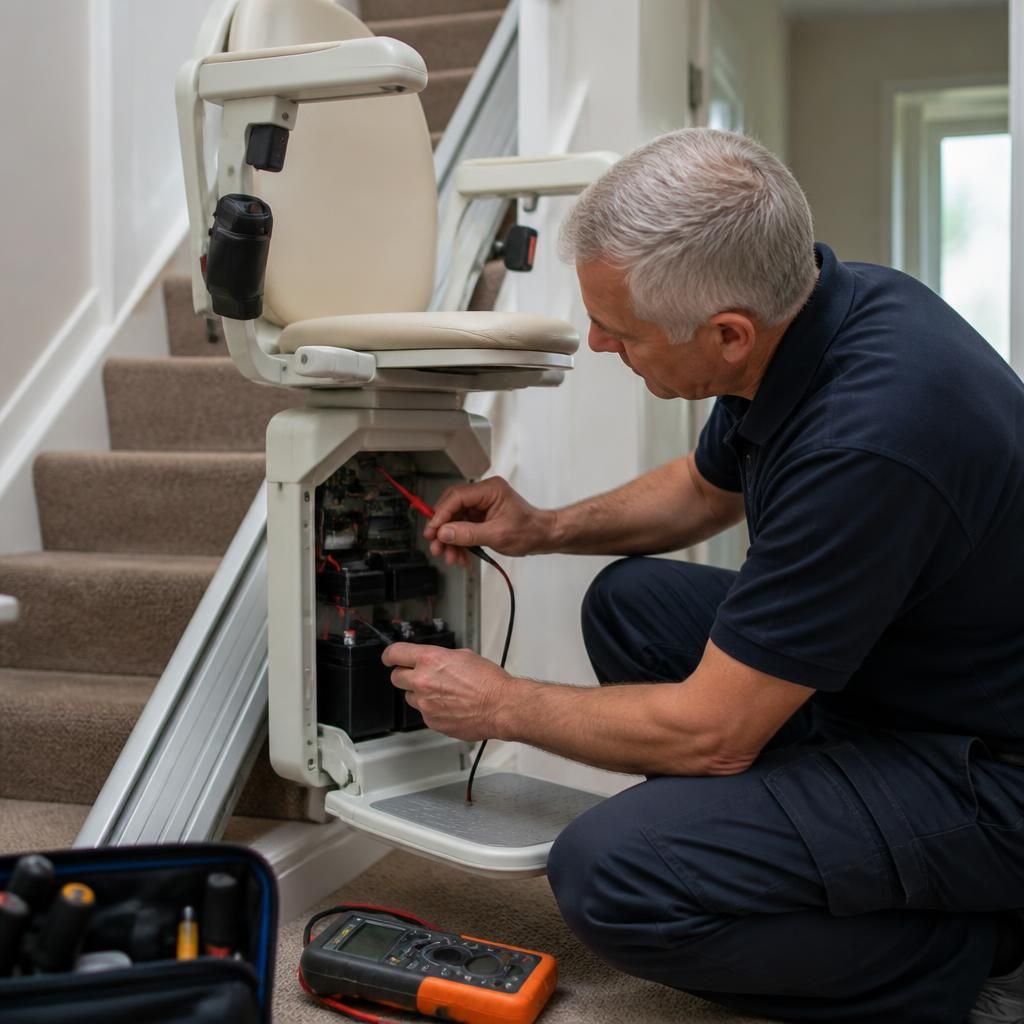
Battery care is particularly important because stairlifts rely on rechargeable batteries even when they are connected to mains electricity. Batteries gradually lose capacity with age and use. A service can assess their condition, inspect the charging system and identify signs that replacement may soon be needed. Keeping the lift parked correctly at its charging point when it is not in use also helps maintain battery availability.
Maintenance can also protect the lift from faults caused by its surroundings. Dust, pet hair, debris and objects left on or near the track may interfere with sensors or moving parts. On curved stairlifts, the bespoke track and carriage require careful inspection because the route is made to suit the individual staircase. Outdoor stairlifts may need additional attention because moisture, temperature changes and exposure to the elements can affect electrical connections, covers, controls and other components.
A comprehensive service will normally include a visual inspection, operational checks, safety testing, examination of the track and carriage, inspection of the seat and restraint, assessment of the batteries and charging points, and checks on controls and sensors. The technician should explain any defects found, distinguish between urgent repairs and developing wear, and provide clear advice about parts that may need attention later. The exact checks depend on the stairlift model, its age, how frequently it is used and the environment in which it operates.
Regular servicing is most effective when combined with sensible day-to-day use. Keep the track and landing areas clear, avoid placing weight on the footrest, use the seat belt as instructed and do not continue using the lift if it makes an unfamiliar noise, moves erratically or displays a warning. Do not attempt to repair electrical or safety components yourself. Contact a qualified stairlift technician and describe the symptoms, including when they occur and whether the lift is charging normally.
Maintenance records are useful for establishing a history of battery changes, repairs, recurring faults and safety checks. This information can help a technician diagnose problems more efficiently and identify patterns, such as a battery that is repeatedly losing charge or a component that is wearing sooner than expected. It can also help when arranging repairs, transferring responsibility for the property or assessing whether an older lift remains economical to maintain.
Regular maintenance does not guarantee that a stairlift will never fail. Batteries and other parts have a finite service life, accidental damage can occur and faults may arise between visits. However, planned servicing reduces the likelihood that deterioration will go unnoticed and gives you a better opportunity to plan repairs rather than dealing with an unexpected loss of access.
When reviewing a maintenance plan, check what inspections are included, whether minor adjustments and safety testing are covered, how repairs and replacement parts are charged, and what support is available if the stairlift stops working between scheduled visits. A clear plan should reflect the type of lift and the user’s circumstances rather than treating every installation in the same way. For an existing stairlift, the most appropriate service interval should be confirmed with a qualified provider and based on the manufacturer’s guidance, usage and condition.
In practical terms, regular maintenance supports reliability in three ways: it finds problems earlier, preserves the condition of working components and helps keep safety systems effective. This makes the stairlift more predictable for everyday use and can reduce the disruption and wider repair costs associated with preventable breakdowns.
Regular stairlift maintenance improves long-term reliability by identifying battery deterioration and charging faults before they leave the lift without enough power to operate. A technician can check the batteries, charging contacts and electrical connections, while confirming that the stairlift returns correctly to its charging point.
Rechargeable batteries gradually lose capacity through age and use. Early signs can include slower movement, reduced travel between charges, warning lights or the lift stopping sooner than expected. Identifying these symptoms during a planned service allows replacement to be arranged before the stairlift fails during everyday use. Keeping the lift parked at its charging point when not in use also helps maintain battery availability.
Book your stairlift maintenance assessment
Arrange a stairlift maintenance assessment to check its batteries, safety systems and moving components. We can identify developing issues and advise on any servicing or repairs needed to support reliable everyday use.