
What specific signs indicate that my lift chair requires professional maintenance?
Your lift chair requires professional maintenance if it moves unevenly, makes unusual noises, struggles to lift or recline, stops unexpectedly, or shows signs of electrical, mechanical or upholstery damage. Arrange an inspection promptly if the handset, battery, power supply or safety features are not working reliably, and stop using the chair if its movement feels unsafe or unstable.
Your lift chair requires professional maintenance when its movement, controls, power supply, structure or safety features no longer work as intended. Warning signs include uneven lifting or reclining, unusual noises, hesitation, unexpected stopping, a handset that works intermittently, visible cable damage, or a chair that feels unstable. Stop using the chair and arrange an inspection promptly if it moves unpredictably, will not stop when expected, smells of overheating, shows exposed wiring or has suffered an impact.
Changes in movement
- The chair lifts, lowers or reclines more slowly than usual.
- Movement is jerky, uneven or accompanied by hesitation.
- The footrest does not extend or retract fully, or the backrest stops short of its normal position.
- The chair stops part-way through a movement, reverses unexpectedly or only operates in certain positions.
- The chair rocks, tilts or feels unstable when lifting, reclining or returning to an upright position.
These symptoms may relate to the motor, actuator, drive mechanism, frame, limit switches or an obstruction. Do not force the chair through a movement or continue using it to see whether the fault clears, as this can place additional strain on the mechanism and may create a safety risk.
Unusual sounds or smells
A lift chair can make some operational noise, particularly while its motor and mechanism are moving. However, arrange professional maintenance if you notice new or worsening grinding, clicking, knocking, squealing, scraping or straining sounds. A burning smell, smoke, heat around the motor, transformer or plug, or repeated electrical clicking requires the chair to be switched off and disconnected from the power supply if this can be done safely. Do not use it again until it has been assessed.
Problems with the handset or controls
- The handset operates only when its cable is moved or held in a particular position.
- Buttons stick, feel damaged or do not respond consistently.
- The chair carries on moving after the control is released, or does not stop as expected.
- Only some functions work, despite the chair being connected correctly.
- The handset, cable or connector has been trapped, stretched, crushed or visibly damaged.
Check that the handset connector has not become loose and that the chair is not obstructed before requesting help. Do not open the handset or attempt to bypass a control, as the controls are part of the chair’s safety and operating system.
Electrical and power-related warning signs
Professional attention is appropriate when the chair repeatedly loses power, trips a circuit, fails to respond after a power interruption or operates only intermittently. Inspect the plug, mains lead and transformer from the outside for cuts, crushing, loose connections or heat damage, but do not repair them yourself. Keep cables clear of the chair’s moving parts and avoid using an extension arrangement that is not suitable for the equipment.
If the chair has a rechargeable battery backup, a battery that no longer holds charge, discharges unusually quickly or causes unreliable operation should be assessed. Battery replacement and electrical testing should be carried out using the correct parts and procedure for the chair.
Visible damage or changes to the chair
Arrange maintenance if you find cracks, bent components, loose fasteners, damaged upholstery around the mechanism, exposed moving parts or evidence that the chair has been struck or overloaded. Pay particular attention to the footrest, scissor mechanism, base, armrests and areas beneath the seat. Loose upholstery, cushions or objects can become caught in the mechanism and should be removed only when the chair is disconnected and cannot move.
Unusual wear on one side of the chair, a change in its sitting position or a frame that no longer appears square can indicate a developing mechanical problem. Do not dismantle the chair to investigate, since this may create further damage and can affect warranty or service arrangements.
When the fault is urgent
Disconnect the chair from the mains, provided it is safe to do so, and seek professional advice without further use when there is smoke, a burning smell, exposed wiring, a damaged power lead, uncontrolled movement, a trapped person, a failed stopping function or significant instability. If someone is trapped or injured, prioritise their safety and seek appropriate emergency assistance rather than trying to move or dismantle the chair.
For less urgent symptoms, such as increasing noise, slower movement or an intermittent handset, book a service before the chair stops working completely. Early assessment can identify worn components, cable faults, obstructions or adjustment issues before they affect safe transfers or leave the chair unusable.
What a professional maintenance visit may include
- Checking the frame, base, motor, actuator, drive mechanism and moving joints.
- Testing lifting, reclining, footrest and return-to-upright functions.
- Inspecting the handset, cables, connectors, transformer, plug and battery system.
- Checking for trapped material, loose fixings, abnormal wear and correct alignment.
- Assessing safety features and confirming that the chair stops and operates correctly.
- Identifying whether adjustment, cleaning, a replacement part or a more detailed repair is required.
Before the visit, note when the problem occurs, which function is affected and whether the fault is constant or intermittent. Keep the chair accessible, remove loose items from around it and have any service or warranty information available. This helps the technician assess the fault efficiently without encouraging you to carry out work that should be completed by a qualified professional.
Routine professional servicing is also sensible when the chair has been heavily used, has been moved to a different location, has been stored for a period, or has developed repeated minor faults. A chair that appears to work may still need inspection if its movement or sound has changed. Professional maintenance complements the simple checks described in your care instructions and helps keep the chair safe, reliable and suitable for everyday use.
A lift chair needs professional maintenance when its movement, controls or power supply become unreliable, particularly if it moves unpredictably, fails to stop, makes unusual noises or shows signs of overheating. Stop using the chair and disconnect it from the mains if this is safe, then arrange an inspection.
Less urgent changes, such as slower lifting, intermittent handset operation, increasing noise or a footrest that no longer reaches its normal position, should also be reported before the fault worsens. A technician can check the motor, actuator, wiring, handset, frame and safety functions, identifying whether the chair needs adjustment, cleaning or a replacement part.
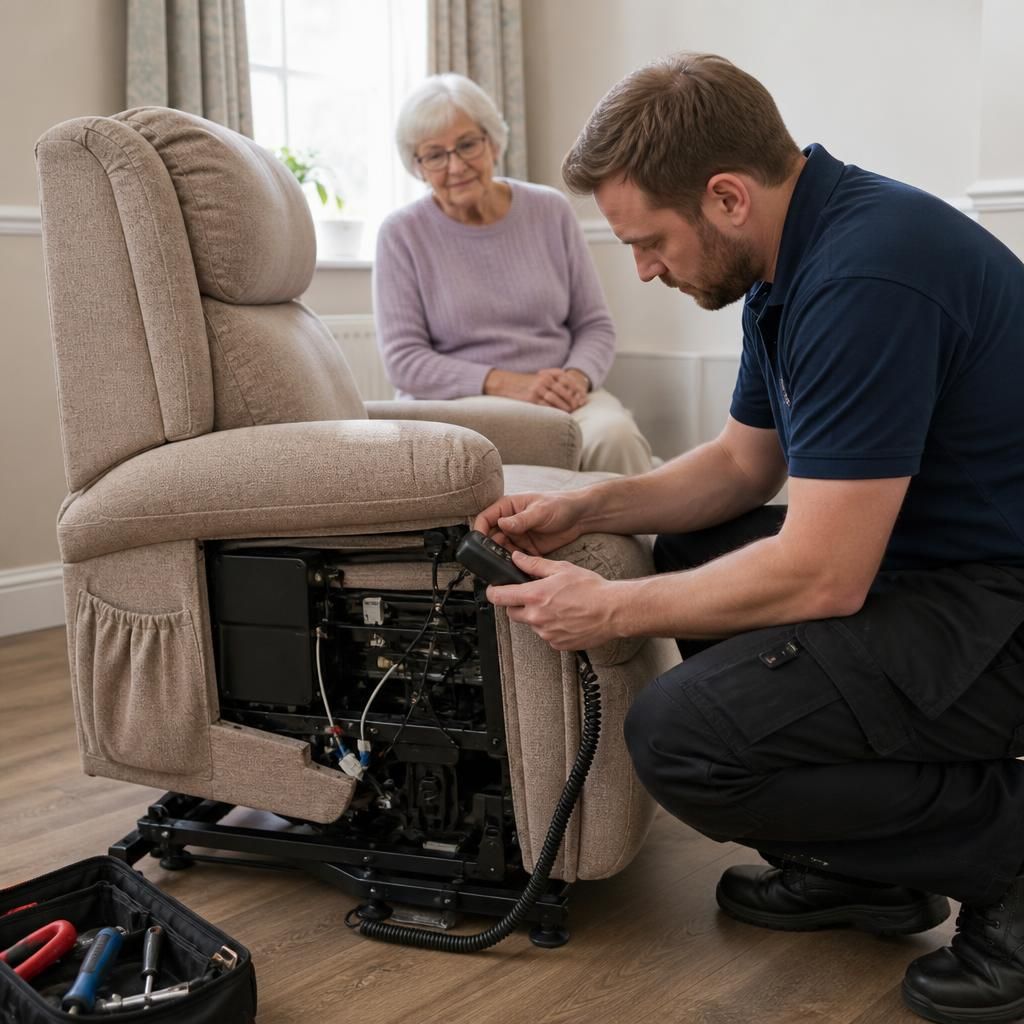
Arrange Professional Lift Chair Maintenance
If your lift chair is moving unevenly, making unusual noises, losing power or showing any other warning sign, arrange professional maintenance before the problem worsens. Contact Independent Stairlifts to discuss an inspection and the most appropriate next step.