
What should I look for in a professional lift chair maintenance service?
A professional lift chair maintenance service should provide a qualified inspection of the chair’s motor, mechanism, handset, wiring, battery or power supply, upholstery and safety features, followed by clear advice on any repair or replacement work needed. Look for an experienced provider that explains the findings, uses suitable parts, checks the chair in operation and offers dependable aftercare.
A professional lift chair maintenance service should combine a competent inspection, safe testing, suitable parts and clear advice. The technician should assess the chair’s lifting and reclining mechanisms, motor, handset, wiring, battery or power supply, frame, upholstery and safety features, then explain any work required before carrying it out. A reliable service also includes an operational test, a written record of the findings and practical aftercare advice.
Check the provider’s experience with lift chairs
Lift chairs are not simply ordinary armchairs with a motor. Their movement depends on electrical components, mechanical linkages and safety controls working together. Choose a service provider that regularly works on lift and recliner chairs, rather than one whose experience is limited to general furniture repairs or unrelated mobility equipment.
The provider should be able to identify the type of chair and its movement system before starting work. This may include a single-motor or dual-motor mechanism, mains-powered operation, rechargeable battery backup or a particular handset and control system. Familiarity with different designs helps the technician diagnose faults accurately and avoid unsuitable adjustments or parts.
Look for a structured inspection
A proper service should be more than checking whether the chair moves when the technician arrives. The inspection should cover:
- the motor, actuator and lifting or reclining mechanism;
- the handset, buttons, cable and control connections;
- the mains lead, plug, transformer and any battery or backup supply;
- wiring, connectors and accessible electrical components;
- the frame, footrest, moving joints and fixings;
- the chair’s stability while lifting, lowering and reclining;
- limit switches, pinch points and other safety features;
- unusual noise, vibration, stiffness, uneven movement or delayed response; and
- the condition of the upholstery and any pressure or support areas that could affect safe use.
The chair should be tested through its full range of movement where it is safe to do so. Testing should include the lift position, sitting position and reclined position, rather than focusing only on the symptom reported. A fault that appears to be a failed handset, for example, may result from a damaged cable, a loose connection or a problem with the control box.
Ask how safety is assessed
Safety should be central to the service. The technician should check whether the chair moves smoothly and stops correctly, whether it remains stable on the floor, and whether cables are positioned safely and protected from trapping or abrasion. They should also look for loose components, damaged insulation, exposed wiring and obstructions around the moving mechanism.
Ask what the technician will do if a safety concern is found. A responsible provider should explain whether the chair can continue to be used, whether it should be taken out of service temporarily, and what repair is needed. Do not continue using a chair that gives an electric shock, smells of burning, makes a severe grinding noise, moves unexpectedly or has visibly damaged wiring. Disconnect it from the power supply if this can be done safely and request professional advice.
Make sure the findings are explained clearly
After the inspection, you should receive a straightforward explanation of the chair’s condition. This should distinguish between:
- routine adjustments or cleaning that can be completed during the service;
- wear that should be monitored;
- parts that need replacing for reliable or safe operation; and
- faults that require further diagnosis or repair.
Useful advice should relate to the actual chair and its use in the home. For example, the technician might explain how to keep the mechanism clear, how to position the chair safely, or why repeated overloading, trapped cables or incorrect use of the handset could contribute to a fault. Be cautious of a service that recommends extensive work without identifying the affected component or explaining the reason for it.
Check the approach to replacement parts
Ask whether replacement parts are suitable for the specific make and model of chair. This is particularly important for handsets, control boxes, motors, transformers, batteries and mechanical components, as parts that look similar may have different electrical ratings, connections or movement characteristics.
A professional provider should explain whether a part is new, reconditioned or another approved replacement, and should make clear how this affects the repair and any available warranty. Parts should be fitted securely and tested as part of the complete chair system. Replacing a component without checking the related wiring, controls and mechanism may only provide a temporary solution.
Confirm what is included in the service
Before booking, ask what the maintenance visit covers. A useful service may include visual and functional checks, cleaning or adjustment of accessible moving parts, electrical and cable checks, testing of the handset and controls, and an explanation of any recommendations. It is also sensible to ask whether diagnosis, travel, labour, parts and follow-up visits are charged separately.
The provider should tell you if additional repair work is outside the original service and obtain your agreement before fitting chargeable parts or carrying out substantial work. A written quotation or clear estimate helps you compare the cost of repair with the age, condition and likely remaining service life of the chair.
Ask for service records and aftercare
A maintenance record should identify the chair, the date of the visit, the checks completed, any faults found and work carried out. It should also record parts fitted and recommendations for future attention. Keeping this information is useful if a fault returns, if another technician needs to diagnose the chair, or if you need to check warranty conditions.
Good aftercare means knowing who to contact if the chair stops working soon after the service and what information to provide. Ask whether the provider offers follow-up support, how urgent faults are handled and whether advice is available by telephone. A clear process is especially useful where the chair is the person’s main aid for standing, sitting or resting.
Consider qualifications, insurance and warranty requirements
Ask about the technician’s relevant training and practical experience, particularly for electrical inspection and powered mobility equipment. The provider should also work in accordance with applicable safety requirements and have appropriate insurance for work carried out in customers’ homes.
If the chair is still under warranty, check the manufacturer’s maintenance and repair conditions before authorising work. Some warranties require approved parts, specific service procedures or records of professional attention. Unauthorised modifications or unsuitable components may affect warranty cover. The service provider should be willing to work within those requirements or explain when a manufacturer or authorised repair route is more appropriate.
Be wary of warning signs
- A service described as a quick reset or visual check with no full operational test.
- Recommendations for expensive parts without a clear diagnosis.
- Parts offered without checking the chair’s make, model and electrical requirements.
- Pressure to approve work before the fault and cost have been explained.
- No record of the inspection or work completed.
- Instructions to continue using a chair despite an identified electrical or mechanical safety risk.
- Unclear charges for the visit, labour, parts or a return appointment.
For an existing lift chair customer, the best choice is a service that treats maintenance as a safety and reliability check, not just a minor repair. Before booking, provide the chair’s make and model if available, describe any symptoms, mention when the fault occurs and explain whether the chair is difficult to use for standing or sitting. This gives the technician useful information in advance and helps ensure that the inspection, advice and any replacement parts are appropriate for the chair and the person using it.
A professional lift chair maintenance service should include a full safety and operational inspection, not just a quick check that the chair moves. The technician should test the lift and recline functions, handset, motor, wiring, power supply, moving joints and stability, while looking for trapped cables, loose fixings, unusual noise or uneven movement.
After testing, you should receive a clear explanation of any issue found, what needs attention and whether the chair remains safe to use. A written service record should note the checks completed, parts fitted and any recommended follow-up work, giving you useful information if a fault returns or warranty support is needed.
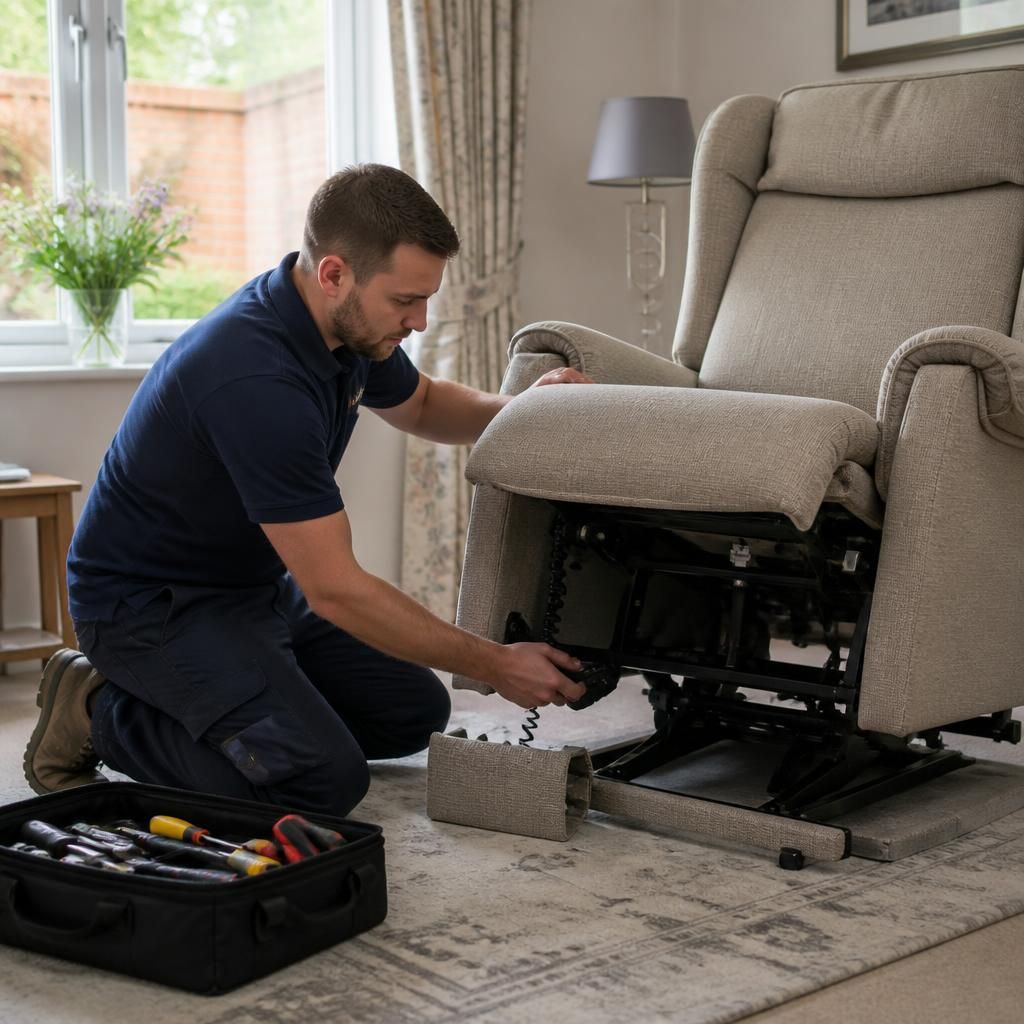
Arrange Professional Lift Chair Maintenance
Arrange professional lift chair maintenance to have the motor, mechanism, handset, wiring, power supply and safety features checked properly. Contact Independent Stairlifts to discuss your chair’s make, model and any symptoms before booking a service.