
What are the most common maintenance issues for lift chairs, and how can they be addressed effectively?
The most common lift chair maintenance issues are power faults, worn or obstructed mechanisms, handset problems, loose connections and battery failure in backup systems. Address them by checking the power supply and visible connections, keeping the mechanism clear, and arranging professional inspection or repair when the chair remains unreliable, makes unusual noises or shows signs of electrical or mechanical damage.
The most common lift chair maintenance issues are power-supply faults, damaged or disconnected cables, handset problems, obstructed mechanisms, worn drive components and failed backup batteries. Some basic checks can safely identify the likely cause, but electrical faults, damaged wiring, unusual movement and mechanical wear should be assessed by a suitably qualified technician rather than repaired at home.
Power supply and charging faults
A lift chair may stop operating if its plug has been disturbed, the socket has tripped, the transformer is disconnected or the power lead is damaged. If the chair has a rechargeable battery backup, depleted or ageing batteries can also prevent movement, particularly after a power cut or when the chair is used away from the mains supply.
- Check that the mains plug is fully inserted and that the socket works with another suitable appliance.
- Check the visible connections between the mains lead, transformer, battery pack and chair, without opening electrical housings.
- Make sure the transformer is positioned where it will not be crushed, pulled or repeatedly knocked.
- If the chair has recently been moved, check that a cable has not been stretched or trapped beneath the frame.
Do not continue using the chair if a lead is split, scorched, unusually hot or giving off a burning smell. Switch it off at the mains and arrange professional advice. A technician can test the transformer, wiring, control system and batteries, and replace components with compatible parts.
Handset and control problems
A lift chair can appear to have a motor fault when the real problem is a handset, damaged handset lead or loose connection. Symptoms include buttons that work intermittently, movement in only one direction, or no response despite the chair receiving power. A handset may also become unreliable if it has been dropped, exposed to liquid or caught between the chair and a wall.
Keep the handset and its cable clear of the moving parts. Check the plug connection if it is accessible and designed to be removed, and make sure the handset has not been placed under the chair or trapped in the upholstery. Avoid repeatedly pressing buttons when the chair does not respond, as this will not overcome a control or motor fault. If the handset remains unreliable, it may need testing or replacement rather than cleaning or modification.
Obstructions and restricted movement
Footrests, riser mechanisms and reclining sections need sufficient clearance to move safely. Cables, cushions, blankets, pets, furniture and objects dropped beneath the chair can obstruct the mechanism. Dust and debris can also accumulate around moving sections, although routine cleaning will not correct worn or misaligned components.
- Return the chair to a position where it is safe to inspect.
- Remove visible objects from beneath and around the chair.
- Check that the chair is not pressed against a wall or another item of furniture.
- Operate it only if the movement is smooth and there is no sign of trapping, distortion or instability.
Never reach into the mechanism while the chair is connected to the mains, and do not force a footrest or lift section back into position. If the chair stops part-way through a movement, isolates unexpectedly or remains uneven, professional inspection is required.
Motor, actuator and drive-system wear
Lift chairs use powered actuators and drive components to raise, lower, recline and return the chair. Wear may cause slower movement, hesitation, reduced lifting power, uneven operation, clicking, grinding or repeated stopping. These symptoms can result from a failing motor, worn gears, a damaged drive shaft, a control fault or excessive load on the mechanism.
Unusual noise should not be treated as normal ageing. Stop using the affected function if the chair jerks, moves unevenly, struggles to lift or makes a new grinding or knocking sound. A technician can inspect the actuator and mounting points, check alignment and load, and determine whether adjustment, lubrication, repair or replacement is appropriate. Do not apply oil or grease unless the manufacturer’s instructions specifically identify the component and lubricant; unsuitable products can damage parts or attract debris.
Loose connections and damaged cables
Connections can loosen after a chair has been repositioned, while repeated movement can place strain on cables. A loose connection may cause intermittent operation, sudden stopping or a chair that works only when the handset or cable is held in a particular position. Cables can also become pinched beneath the base or worn where they pass close to moving sections.
Only inspect connections that are clearly visible and intended for routine user access. Do not remove covers, splice wires or bypass a safety switch. If a cable is frayed, crushed, exposed or warm to the touch, disconnect the chair from the mains if it is safe to do so and request professional repair.
Backup battery failure
Many lift chairs include batteries that provide limited operation during a power interruption. They gradually lose capacity and may not show an obvious fault until the mains supply is unavailable. Warning signs include a weak or absent response during a power cut, repeated low-battery indications, leakage or batteries that are beyond the replacement interval stated in the chair’s instructions.
Battery replacement should use the correct specification and connection arrangement for the chair. Do not substitute batteries based only on appearance or attempt to recharge disposable cells. A service visit can check the battery condition, charging circuit and transformer together, as replacing a battery will not resolve a separate charging fault.
Frame, upholstery and stability issues
Not every maintenance problem is electrical. Loose fasteners, a damaged footrest, compressed cushioning, torn upholstery or a chair that rocks on the floor can affect comfort and safe operation. Avoid placing excessive weight on the arms or using them to pull the chair across the floor. Do not use the chair if its frame is unstable, a footrest is bent or a lifting section does not remain level.
Keep the chair on a suitable, level surface and follow the manufacturer’s cleaning instructions. A professional can check the frame, mounting points, fasteners and moving sections, then identify whether a part can be adjusted or needs replacement.
How to address a fault safely
- Stop the chair and note what happened: whether it failed while lifting, reclining or returning, and whether there was a sound, smell or visible warning.
- Check the mains supply, accessible plugs and visible obstructions without dismantling the chair.
- Keep people and pets away from the moving sections while testing.
- Try the control only once the chair is clear and the connections appear secure.
- If the fault remains, isolate the chair where appropriate and contact the service team with the model details and a description of the symptoms.
Do not use a chair that has exposed wiring, an overheating transformer, smoke, a burning smell, fluid leakage, severe instability or uncontrolled movement. Do not bypass safety features or continue testing a fault that could trap someone. These conditions require prompt professional attention.
Regular professional servicing can identify wear before it causes a complete failure. The inspection may include the power system, handset, batteries, actuator, frame, fasteners, moving clearances and safety operation. Keep a note of recurring symptoms and any recent changes, such as relocation, a power cut or liquid spillage; this information helps the technician diagnose the underlying cause rather than simply replacing the most visible part.
Many lift chair faults that appear to be motor failures are caused by a disrupted power supply, loose accessible connection or faulty handset. Check the plug, socket, transformer connection and visible cables without removing covers, and make sure nothing is trapped beneath the chair or within its moving sections.
- Stop using the chair if a cable is frayed, crushed or unusually warm.
- Do not force the footrest or lift mechanism if movement is uneven or stops part-way.
- Arrange professional inspection if the chair still fails to respond, makes unusual noises, smells of burning or moves unpredictably.
A technician can test the handset, transformer, wiring, actuator and backup battery together, helping identify the underlying fault rather than replacing an unrelated component.
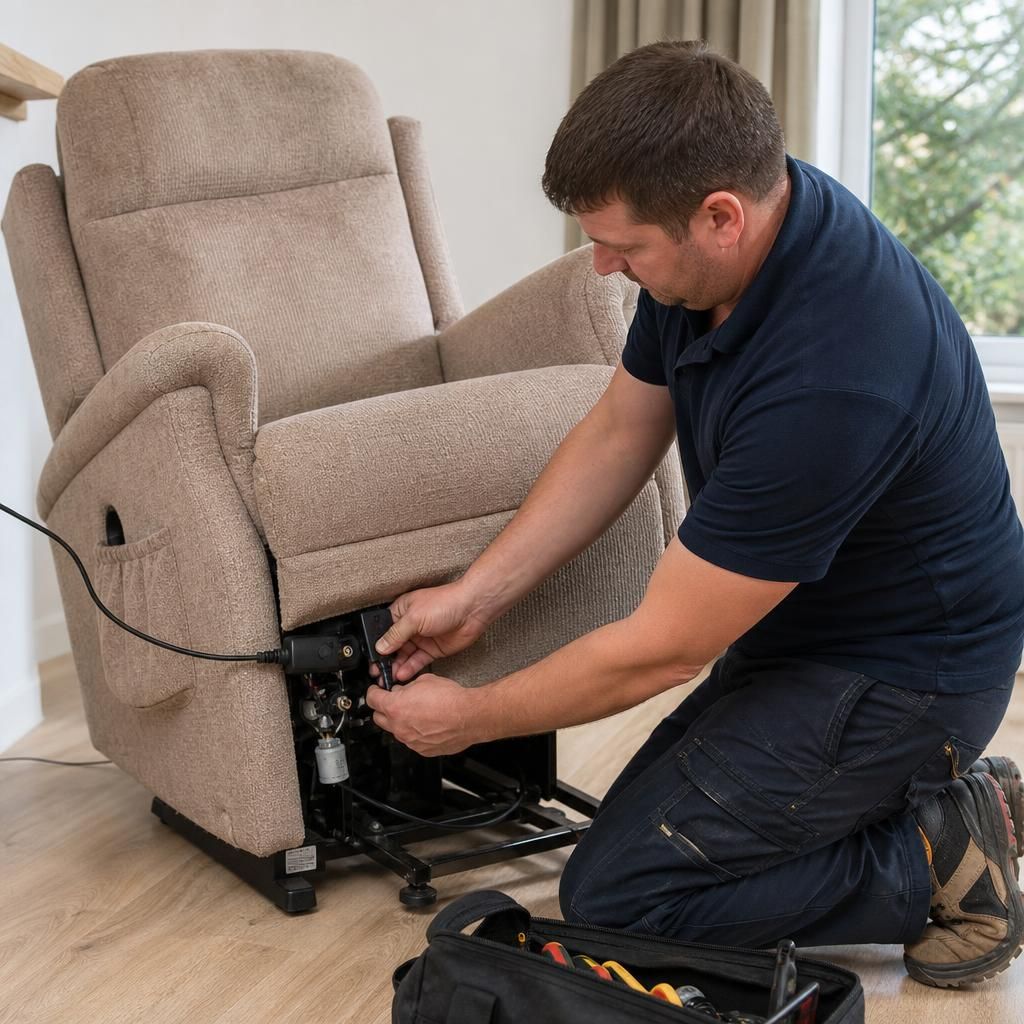
Arrange Professional Lift Chair Maintenance
If your lift chair has a recurring fault, unusual movement, damaged wiring or reduced battery performance, arrange professional lift chair maintenance with Independent Stairlifts. Our team can assess the chair, identify the underlying issue and advise on suitable repairs or replacement parts.