
What are the benefits of choosing professional lift chair maintenance over DIY maintenance?
Professional lift chair maintenance provides a thorough safety inspection, accurate fault diagnosis and correct adjustments that DIY maintenance may not achieve. It can improve reliability, help prevent avoidable damage, support warranty requirements and extend the chair’s usable life while reducing the risk of injury from incorrect repairs.
Professional lift chair maintenance is safer and more thorough than DIY maintenance because it combines a structured inspection, specialist fault diagnosis and correct adjustment of the chair’s electrical, mechanical and upholstery components. A qualified technician can identify developing faults that may not be visible during routine cleaning, carry out work in line with the manufacturer’s instructions and confirm that the chair is safe to use after servicing.
Improved safety
Lift chairs contain powered motors, wiring, control switches, moving linkages and lifting mechanisms. These components must work together in the correct sequence to raise, lower and recline the chair safely. Professional servicing can include checks for damaged cables, loose connections, worn mechanisms, unusual movement, insecure fixings and obstructions around the moving parts.
This is particularly important where the chair is used to support standing or sitting. A fault that causes the chair to stop unexpectedly, move unevenly or fail to reach its intended position could increase the risk of a fall. A technician can assess the complete operating system rather than concentrating only on the symptom reported.
More accurate fault diagnosis
A lift chair that does not move may have a problem with the handset, power supply, transformer, wiring, motor, control box or mechanical frame. These faults can produce similar symptoms, so replacing a visible part without identifying the underlying cause may not resolve the problem.
Professional maintenance uses a methodical process to trace the fault and test related components. This helps avoid unnecessary parts, incorrect connections and repeated breakdowns. It also allows the technician to distinguish between a maintenance issue, a repairable fault and a component that needs replacement.
Correct adjustments and preventative work
Regular use can cause fixings to loosen, moving parts to become less smooth and components to show signs of wear. Professional servicing can identify these changes before they lead to a more disruptive failure. Where appropriate, the technician can make adjustments, clean suitable components, check alignment and carry out maintenance recommended for that particular model.
Lubrication is not suitable for every part of every lift chair. Applying a general-purpose lubricant to the wrong mechanism can attract dust, affect electrical components or interfere with the manufacturer’s specified materials. A professional should decide whether lubrication is required and use a product and method suitable for the chair.
Lower risk of accidental damage
DIY maintenance is generally limited to safe user checks, such as keeping the chair clear, checking for visible cable damage and confirming that the power supply is connected correctly. Removing covers, altering wiring, dismantling the frame or working on the motor and control system can create additional faults and may expose the user to electrical or mechanical hazards.
Professional technicians have the relevant knowledge to handle these components without forcing connections or adjusting mechanisms incorrectly. This is important because an apparently minor mistake can affect the chair’s lifting action, stability or ability to stop correctly.
Support for reliability and usable life
Maintenance cannot prevent every component from wearing out, but it can help identify wear at an earlier stage and keep the chair operating as intended. Addressing small issues before they affect other components may reduce avoidable strain on the motor and mechanism. It also provides an opportunity to discuss how the chair is being used, including positioning, access and any recurring operating problems.
A technician can explain which parts may need monitoring and whether the chair remains suitable for the user’s needs. If the chair is regularly overloaded, positioned where its mechanism is obstructed or operated with a damaged handset or cable, correcting those conditions can help reduce repeat faults.
Better protection of warranty and manufacturer requirements
Warranty terms vary by manufacturer and model. Some require servicing or repairs to be completed by an approved or suitably qualified provider, while unauthorised modifications may affect future support. Professional maintenance does not automatically preserve every warranty, so the relevant terms should be checked before work is arranged.
Keeping service records, repair details and replacement-part information can also be useful if a warranty claim or future diagnosis is needed. A professional service should make clear what was inspected, what work was completed and whether any further attention is recommended.
What professional maintenance may include
- Checking the chair’s overall condition, stability and safe operation.
- Inspecting the handset, transformer, power lead, plugs and accessible wiring for damage or poor connections.
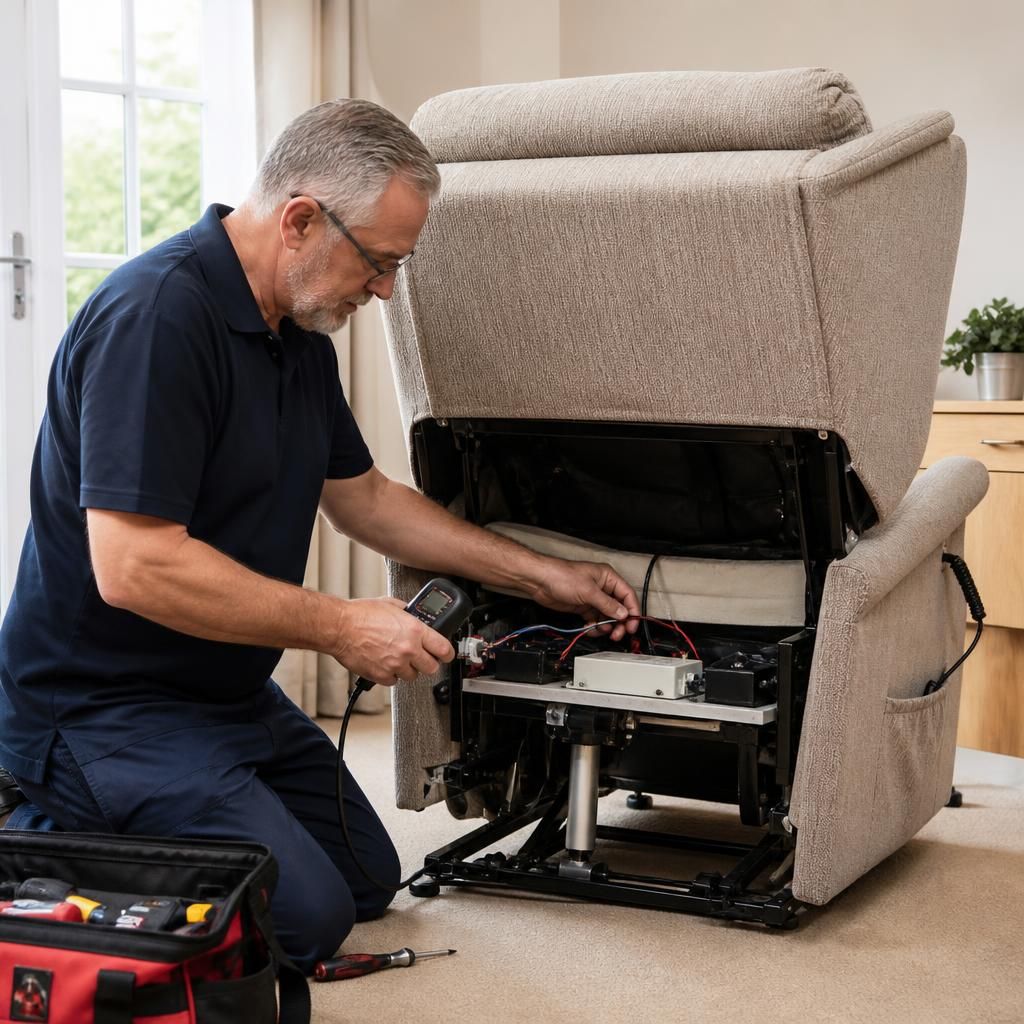
- Testing the motor, control box, lifting movement and reclining function.
- Examining the frame, linkages, fixings and moving parts for wear, looseness or obstruction.
- Checking that the chair starts, stops and changes position correctly.
- Making suitable adjustments or carrying out maintenance in accordance with the model’s requirements.
- Explaining any repair, replacement or follow-up work that may be needed.
The exact inspection depends on the chair’s design, age, condition and fault history. Maintenance is not the same as replacing every worn component, and a technician should explain any recommended repair before proceeding.
When not to continue using the chair
Stop using the lift chair and seek professional advice if you notice a burning smell, sparking, exposed wiring, a damaged power lead, fluid near electrical parts, sudden uncontrolled movement, severe grinding or repeated failure to stop. Do not attempt to bypass a safety feature or continue operating the chair to see whether the problem clears. If the user is trapped or unable to exit safely, obtain appropriate assistance rather than forcing the mechanism.
Home care still has a useful role between professional services. Keep the area around the chair clear, avoid trapping the power cable, follow the operating instructions, clean the upholstery using suitable methods and report changes in movement or noise promptly. These checks complement professional servicing but do not replace inspection of internal electrical and mechanical components.
Overall, professional lift chair maintenance provides a safer way to assess the complete chair, identify faults accurately and address wear before it becomes a larger problem. DIY checks are appropriate for basic care and visible issues, but internal repairs, electrical work and adjustments to the lifting or reclining mechanism should be left to a suitably qualified technician.
Professional lift chair maintenance provides a safer and more complete inspection than DIY checks because a technician can assess the chair’s electrical system, motor, control box, frame and lifting mechanism together. This helps identify faults that may not be visible during routine cleaning or basic troubleshooting.
A chair that moves unevenly, stops unexpectedly or fails to recline may have a problem with the handset, transformer, wiring, motor or internal mechanism. These components can produce similar symptoms, so replacing an accessible part without testing the complete system may leave the underlying fault unresolved. A qualified technician can trace the cause, make model-appropriate adjustments and confirm that the chair starts, stops and changes position safely.
DIY care remains useful for keeping the area clear, checking visible cables and following the operating instructions. However, covers, wiring, motors and lifting mechanisms should not be dismantled or adjusted without suitable knowledge. Incorrect repairs can create further faults, affect the chair’s stability or increase the risk of injury.
Arrange professional lift chair maintenance
Arrange professional lift chair maintenance with Independent Stairlifts to have your chair’s electrical, mechanical and lifting systems checked by a suitably qualified technician. Contact us to discuss your chair’s condition and book a suitable service.