
How often should lift chair maintenance be performed to ensure optimal performance?
Most lift chairs should receive professional maintenance at least once a year, or in line with the manufacturer’s guidance. Arrange an earlier inspection if the chair is used heavily, makes unusual noises, moves unevenly, or shows any other change in performance.
Most lift chairs should have professional maintenance at least once a year, or more often if the manufacturer recommends a different interval. An annual service helps identify wear, electrical faults and mechanical problems before they affect safe operation. Arrange an earlier inspection if the chair is used heavily, develops unusual noises, moves unevenly, or shows any other change in performance.
The correct interval depends on how the chair is used, its age, condition and environment. A lift chair used several times each day places more demand on its motor, lifting mechanism, handset and upholstery than one used occasionally. Chairs used by people who need the lift function for every transfer may also benefit from more frequent checks, particularly where any fault could affect safe standing or sitting.
Follow the manufacturer’s maintenance instructions wherever they differ from general guidance. The manual may specify service intervals, approved replacement parts, cleaning products or checks that are specific to the chair’s design. Keeping to these requirements can also help protect the validity of any applicable warranty. If the chair is still covered, check the warranty terms before arranging repairs or attempting to remove covers or electrical components.
Arrange professional maintenance sooner when you notice:
- Delayed, hesitant or uneven movement when raising, lowering or reclining.
- Grinding, clicking, knocking or squeaking sounds that were not previously present.
- A handset that works intermittently, becomes unusually warm or needs repeated pressing.
- A power lead, plug or connection that is damaged, loose or showing signs of heat.
- The chair stopping part-way through a movement or failing to return to its normal position.
- Unexpected movement, rocking, instability or difficulty locking in position.
- Visible damage to the frame, wiring, footrest, armrests or lifting mechanism.
- A burning smell, smoke, sparking or a circuit breaker that repeatedly trips.
Some of these signs indicate a developing fault rather than routine wear. Stop using the chair and disconnect it from the power supply if there is smoke, sparking, a burning smell or obvious electrical damage. Do not continue operating a chair that has become unstable or moves unpredictably. Contact a suitably qualified service provider for advice and avoid dismantling the mechanism yourself.
What is checked during professional maintenance? A technician will normally inspect the chair’s structure, lifting and reclining mechanisms, motor, drive components, handset, cables and power connections. They may check that the chair operates smoothly through its full range of movement, that moving parts are secure, and that safety features are working correctly. Where appropriate, worn parts can be adjusted, lubricated or replaced using compatible components. The technician should also identify issues that are not obvious during normal use, such as loose fixings or progressive wear around the mechanism.
Professional servicing is not always a substitute for a repair. If a component has failed, maintenance may identify the cause but the chair may still require a separate repair or replacement part. Ask what work has been completed, whether any parts need replacing and whether further use is safe while you decide how to proceed.
Between services, carry out simple checks without interfering with the mechanism. Keep the area around the chair clear so the footrest and lifting movement cannot catch on furniture, rugs, pets or cables. Check that the power lead is not trapped or stretched, keep the handset where it cannot be crushed, and look for visible damage. Clean the chair according to its care instructions and avoid spilling liquid near the handset, motor or electrical connections.
Do not apply oil or grease unless the manufacturer or a qualified technician specifically advises it. Incorrect lubrication can attract dust, damage components or affect the chair’s operation. Do not place weight on the footrest while it is moving, exceed the stated user limit, or attempt to repair electrical parts without the necessary training.
For most customers, scheduling a professional service every year provides a sensible baseline. A shorter interval may be appropriate for frequent daily use, an older chair, a chair exposed to difficult conditions, or one that has previously needed repeated repairs. Annual maintenance should be treated as a planned safety and reliability check, while any noticeable change in operation should be dealt with promptly rather than left until the next scheduled service.
Professional lift chair maintenance should generally be arranged at least once a year, unless the manufacturer specifies a different interval. This routine service allows a technician to check the lifting and reclining mechanisms, motor, handset, cables, power connections and safety features before wear develops into a more serious fault.
An earlier inspection may be appropriate if the chair is used heavily, is older, or has previously required repairs. Arrange professional advice promptly if you notice:
- Uneven, hesitant or delayed movement
- New grinding, clicking, knocking or squeaking sounds
- Intermittent handset operation or repeated need to press the control
- The chair stopping during a lift, recline or return movement
- Loose wiring, damaged cables, instability or a burning smell
Do not wait for the annual service if the chair moves unpredictably or shows electrical damage. Stop using it, disconnect the power where safe to do so, and contact a suitably qualified technician.
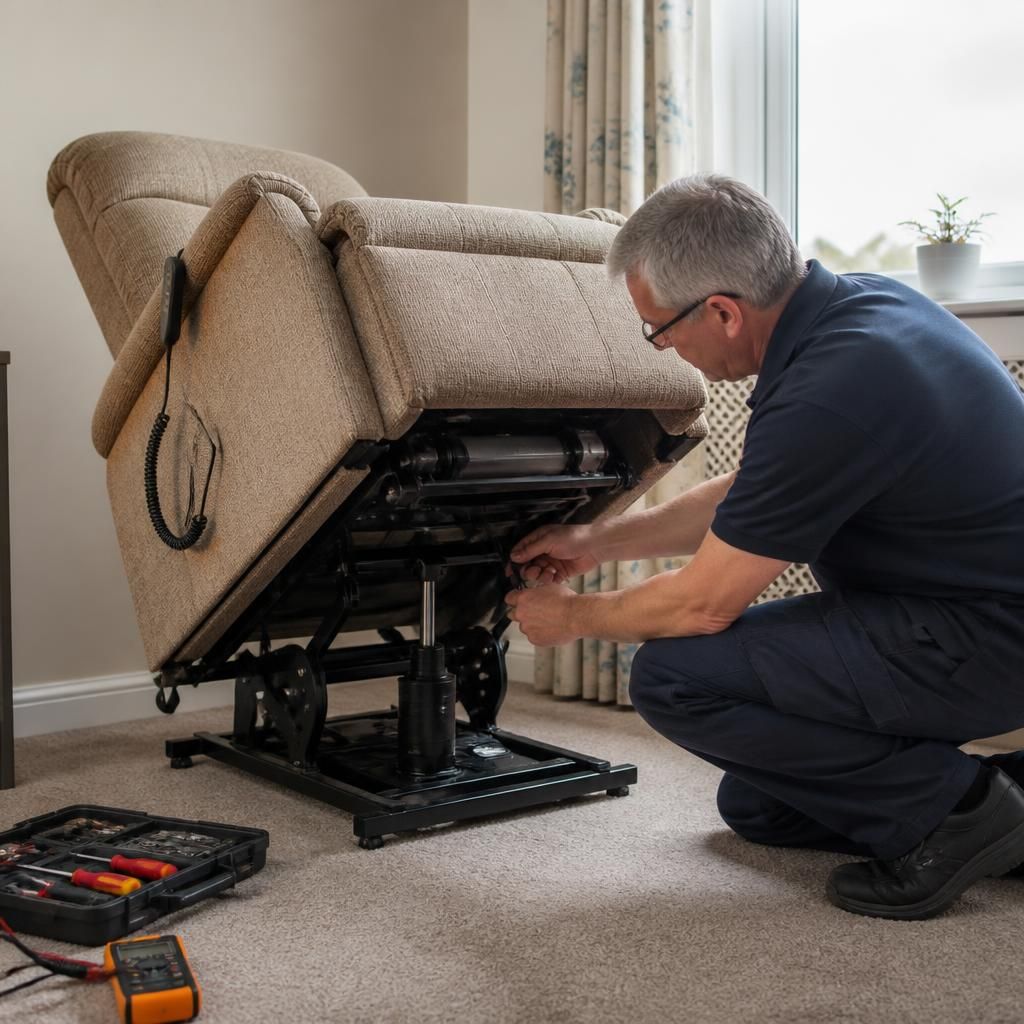
Book your lift chair maintenance service
If your lift chair is due for its annual service, or you have noticed a change in its movement or operation, book a maintenance appointment with Independent Stairlifts. Our team can assess the chair and advise whether routine servicing, repairs or replacement parts are needed.