
What should I look for when choosing replacement parts for my Handicare stairlift?
When choosing replacement parts for your Handicare stairlift, check that each part is genuine or specifically approved for your exact model and supplied with the correct safety and compatibility information. A qualified stairlift engineer can confirm the part, assess related wear and install it safely, particularly for electrical, drive and safety components.
Choose replacement parts for a Handicare stairlift by confirming the exact model, checking that the part is genuine Handicare or specifically approved for that model, and ensuring it meets the required safety and electrical specifications. The correct part should be supplied through a reliable source and, where it affects movement, braking, charging or other safety functions, fitted and tested by a qualified stairlift engineer.
Handicare stairlifts are not all built to the same specification. Parts that look similar may differ in dimensions, connectors, voltage, software compatibility or the way they interact with the stairlift’s safety systems. Using a part based only on its appearance, or on the general age of the lift, can result in poor performance, repeated faults or an unsafe installation.
Confirm the stairlift model and specification
Before ordering a replacement, identify the precise Handicare model and any relevant variation. An engineer may also need the stairlift’s serial number, production information, rail configuration and the existing part number. This is particularly important where a model has had revisions during its production period.
- Check the identification label on the stairlift, usually found on or near the carriage, motor unit or another accessible component.
- Record the part number from the existing component if it can be read safely.
- Provide details of the fault and when it occurs, such as during travel, charging, starting or stopping.
- Tell the supplier whether the lift is installed on a straight, curved or outdoor rail, as the required components may differ.
Do not remove covers or dismantle the lift simply to locate a label or part number. An engineer can identify the component without creating additional damage or exposing you to electrical or mechanical hazards.
Check whether the part is genuine or approved
Genuine Handicare parts are designed for the relevant equipment and are supported by the manufacturer’s technical information. An approved alternative may also be suitable, but it must be specifically identified as compatible with the exact stairlift model and part application. A generic item with similar dimensions is not automatically a safe substitute.
Ask for clear information about the part’s compatibility rather than relying on descriptions such as “universal”, “replacement” or “fits most stairlifts”. The supplier should be able to explain which models the part is intended for and whether any additional components, adjustments or programming are needed.
Give priority to safety-critical components
Some parts have a direct effect on safe operation and should not be selected or fitted without professional advice. These can include:
- Drive, motor and gearbox components
- Braking and speed-control components
- Overspeed or other protective devices
- Seat swivel, locking and restraint components
- Armrest, footrest and obstruction-sensor switches
- Charging equipment, batteries and electrical control components
- Rail, carriage and fixing components
A replacement may correct the original symptom without addressing the underlying cause. For example, a battery that repeatedly loses charge could be affected by a charging fault, wiring issue or excessive mechanical resistance. Replacing the battery alone may therefore provide only a temporary solution. A qualified engineer should test the stairlift and its related systems before deciding which part is needed.
Check electrical and physical compatibility
For electrical parts, confirm the correct voltage, current rating, connector type, polarity and charging characteristics. Batteries must be the correct type and specification for the stairlift; fitting an unsuitable battery can damage the charger or create a safety risk. Chargers and power supplies should also match the stairlift’s requirements rather than simply fitting the existing socket or plug.
For mechanical parts, check the dimensions, fixing points, orientation, materials and load requirements. A component that can be attached physically may still be unsuitable if it does not align correctly, withstand the required forces or work with the lift’s safety controls.
Consider the condition and history of the part
Ask whether the part is new, reconditioned or used, and find out what inspection or testing it has received. A reconditioned component can be appropriate in some situations, but its suitability depends on the part type, the condition of the stairlift and the availability of technical support. Used safety, drive or electrical components require particular caution because their remaining service life may be uncertain.
For a heavily worn stairlift, replacing one component may not be the most practical option if related parts are also deteriorated or no longer available. An engineer can assess the complete lift and explain whether a repair, a wider refurbishment or another solution is appropriate.
Check support, warranty and documentation
Use a supplier that can provide accurate part identification, fitting guidance and aftercare. Before purchase, check:
- Whether the part is covered by a warranty and what that warranty includes
- Whether the warranty depends on installation by a qualified engineer
- Whether fitting the part could affect the stairlift’s existing warranty cover
- Whether installation, testing and call-out costs are separate from the part price
- Whether the part can be returned if the fault is found to have a different cause
- Whether instructions, conformity information or other technical documentation are supplied where relevant
Keep the invoice, part details and installation record. This information can help with future servicing, warranty queries and identification of compatible components.
Have the replacement fitted and tested correctly
Replacing covers, batteries or simple user-serviceable items may appear straightforward, but the correct procedure varies by model. Components connected to the carriage, rail, controls or safety circuits should be handled by a qualified stairlift engineer. After fitting, the engineer should check secure fixings, electrical connections, travel, charging, stopping, obstruction detection and other relevant safety functions.
Do not continue using the stairlift if it behaves differently after a part has been fitted, including unexpected noise, juddering, hesitation, uncontrolled movement, repeated stopping, a burning smell or a failure to charge. Switch it off if it is safe to do so and arrange a professional inspection. Do not bypass a safety switch or continue replacing parts without a diagnosis.
The most reliable approach is to provide the model and serial information, describe the symptoms and arrange an assessment before ordering. This helps ensure that the replacement part is compatible, preserves the operation of the stairlift’s safety systems and avoids paying for a component that does not address the actual fault.
Choosing the correct replacement part for a Handicare stairlift starts with accurate identification of the stairlift model and the component being replaced. Parts that look alike can have different connectors, dimensions or electrical specifications, so appearance alone is not a reliable guide.
Before ordering, check the identification label and note the model, serial information and existing part number where these can be read safely. Tell the engineer or supplier what the stairlift is doing, such as failing to charge, stopping during travel or making an unusual noise. This helps distinguish the failed component from an underlying issue elsewhere in the system.
For batteries, chargers, controls, drive components and safety switches, use a genuine Handicare part or one specifically approved for the exact model. A qualified stairlift engineer should confirm compatibility, install the part where necessary and test the lift’s travel, charging and safety functions afterwards.
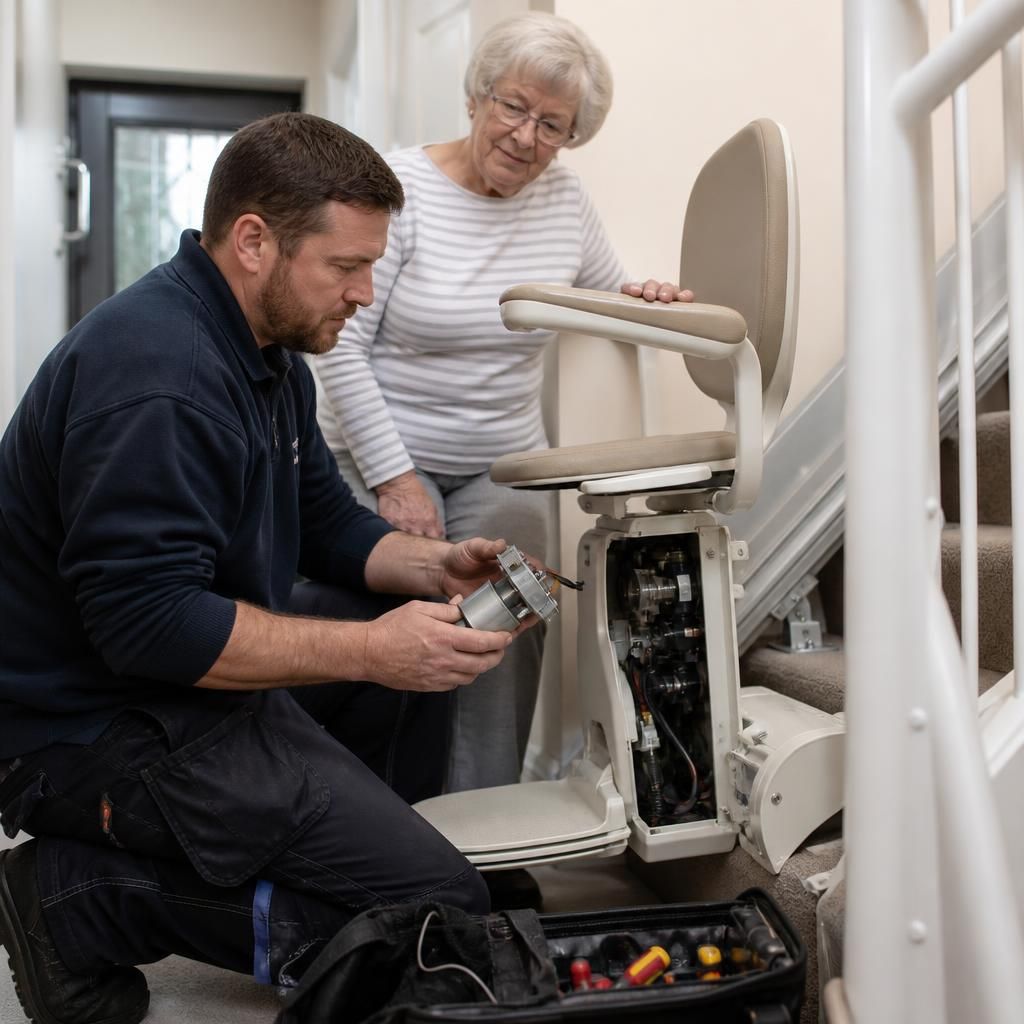
Ask us to identify the right Handicare replacement part
Contact us with your Handicare stairlift model, serial information and the symptoms you have noticed, and we can help identify the correct replacement part. Where needed, we can arrange a qualified engineer to assess, fit and test it safely.