
What specific mobility challenges are you facing with your current staircase?
Common mobility challenges include difficulty climbing or descending, pain or fatigue, reduced balance, and feeling unsafe on steep, narrow, curved or split-level stairs. A stairlift assessment can identify whether a straight, curved, outdoor or bespoke solution would provide safer, more comfortable access based on your staircase and mobility needs.
Mobility challenges on a staircase commonly involve difficulty lifting the legs, pain in the hips or knees, reduced balance, fatigue, breathlessness, or fear of falling. The right stairlift can reduce the need to climb the stairs, but the suitable solution depends on both your mobility needs and the layout of the staircase. An assessment should consider how you use the stairs now, how your needs may change, and whether a stairlift can be installed without restricting safe access for other people in the home.
You may benefit from discussing a stairlift if you are finding it difficult to:
- Climb or descend the stairs without stopping, resting or pulling on the handrail.
- Manage pain, stiffness or weakness in your knees, hips, ankles or back.
- Maintain your balance, particularly when turning at the top or bottom of the staircase.
- Carry items between floors while keeping one hand available for the handrail.
- Use the stairs safely when tired, unwell or short of breath.
- Reach bedrooms, bathrooms or other essential rooms without relying on assistance.
- Use a staircase that feels too steep, narrow, uneven or awkward to navigate.
A stairlift may also be appropriate where the main difficulty is confidence. Avoiding the stairs can gradually limit how you use your home, while repeatedly managing them when they feel unsafe may increase the risk of a slip or fall. A stairlift provides a seated route between floors, although you should still be able to transfer safely into and out of the seat and remain seated during travel.
The shape of the staircase affects the type of equipment required. A straight stairlift is designed for a continuous flight without intermediate turns or landings. A curved stairlift follows bends, corners and changes in direction, with a rail made for the individual staircase. Split-level layouts may need a carefully planned arrangement, particularly where there is a landing between flights. Spiral, unusually steep or tightly turning stairs require a detailed survey to establish whether a conventional stairlift is suitable and whether there is enough room at the boarding and exit points.
Narrow stairs do not automatically rule out a stairlift. The available width must be considered alongside the stairlift’s folded dimensions, your seated position, the handrail and the space needed for other household members to pass. In some homes, a slimline design, a different seat configuration or a rail that parks in a more suitable position can help. These options must be assessed rather than assumed, because a solution that fits the rail may still be unsuitable if it leaves inadequate clearance.
Your physical needs also affect the specification. If bending is difficult, a higher seat or powered swivel function may make getting on and off easier. If your knees or hips are painful, the seat height, footrest position and operating controls should be checked carefully. If balance is limited, the armrests, seat belt and swivel mechanism become particularly important. If you use a wheelchair or walking frame, the stairlift will usually require a safe transfer to a separate seat; the assessment should therefore consider where the mobility aid can be left at each level and whether the landing provides enough space.
For outdoor steps, access to a garden, entrance or split-level exterior area creates additional considerations. Outdoor stairlifts need equipment and controls appropriate for exposure to weather, as well as a safe surface for boarding and leaving the seat. Lighting, drainage, handrails and the condition of the steps should be reviewed as part of the overall access plan.
Power supply is another practical point. Stairlifts are generally battery powered and recharge at designated points, but the charging arrangements must be suitable for how the lift is parked and used. Ask how the lift behaves during a power interruption, how it is manually released if necessary, and who to contact if it stops working. Regular servicing and prompt attention to unusual noises, slower movement or charging problems help maintain reliable operation.
During an assessment, explain exactly what is difficult rather than only describing the staircase. Mention pain, fatigue, balance problems, falls or near misses, transfers, medication-related tiredness and any expected changes in your mobility. Demonstrate how you currently approach the stairs if it is safe to do so. The assessor should also review the top and bottom landing, doorways, radiator or furniture positions, available lighting and the needs of anyone else using the staircase.
A stairlift is not the only possible answer in every situation. If you cannot transfer safely, cannot remain seated, or need to move a wheelchair without leaving it, another form of access equipment may be more appropriate. Occupational therapy or clinical advice can help clarify the safest approach where your mobility or health has changed. When a stairlift is suitable, a properly matched installation should address the specific obstacle rather than simply placing a standard model on the stairs.
Independent Stairlifts can assess the staircase, access points and your day-to-day requirements before recommending a straight, curved, outdoor, reconditioned or bespoke solution. The aim is to identify the practical cause of the difficulty and specify equipment that supports safe, comfortable movement throughout your home.
A stairlift assessment should consider how your mobility affects using the staircase, not just whether the rail can be fitted. Pain, weakness, poor balance, fatigue or difficulty bending can influence the seat height, swivel function, armrests, footrest and controls needed for a safe transfer.
Tell the assessor about any hesitation, near misses, rests or assistance you need on the stairs. If you use a walking frame or wheelchair, the assessment should also check where it can be left at each level and whether there is enough room to board and leave the stairlift safely.
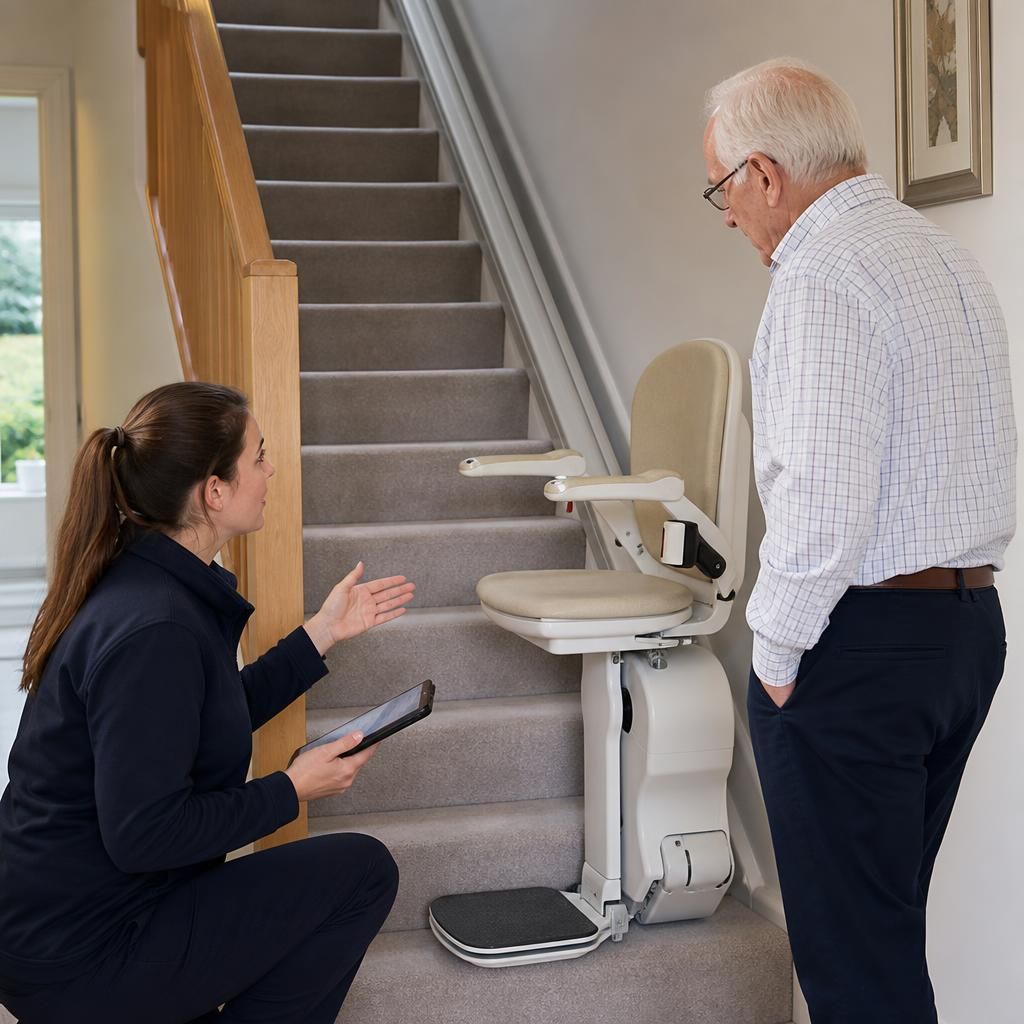
Discuss your specific staircase mobility challenges
Discuss your specific staircase mobility challenges with Independent Stairlifts so we can assess your needs, staircase layout and the most suitable stairlift options. Contact our team to arrange a personalised assessment.