
What factors should I consider when budgeting for a stairlift?
When budgeting for a stairlift, consider the shape and length of your staircase, the type of lift required, installation requirements, optional features and any ongoing servicing or repair costs. A professional assessment can provide an accurate quotation based on your home, mobility needs and the most suitable stairlift configuration.
When budgeting for a stairlift, consider more than the purchase price. The overall cost is affected by the shape and length of the staircase, the stairlift model, installation requirements, seating and safety features, and future servicing or repair needs. A professional home assessment is the most reliable way to receive an accurate quotation based on your property and mobility requirements.
The shape and layout of the staircase
Straight stairlifts generally have a simpler installation and use a standard rail, so they are usually less complex to price than lifts for stairs with bends, landings or changes in direction. A curved stairlift requires a rail designed to follow the exact route of the staircase. The number and tightness of bends, the position of landings, the available space at the top and bottom, and any intermediate floors can all affect the design and installation work.
Spiral, split-level, unusually steep or narrow staircases may require a more detailed assessment. In some homes, the stairlift may need a compact seat, a special rail arrangement or an alternative parking position. An outdoor stairlift also needs equipment suitable for exposure to weather, together with appropriate fixing and electrical arrangements.
The type of stairlift and its specification
Budget for the model that properly supports the intended user, rather than choosing solely on the lowest initial price. Important considerations include the user’s weight, balance, flexibility, confidence when transferring on and off the seat, and ability to operate the controls. A standard seated lift may be suitable for many users, while someone who finds sitting or bending difficult may need a perch-style or more supportive configuration, subject to a professional assessment.
Consider whether the stairlift is intended for occasional use, everyday access between floors or longer-term support. A reconditioned stairlift can be a cost-effective option where a suitable model and rail configuration are available. However, curved rails are made for individual staircases, so a used stairlift is not automatically interchangeable between homes. Ask what has been inspected or replaced, what warranty is included and whether servicing support is available.
Installation and preparation costs
Installation is normally part of the quotation, but it is important to confirm exactly what is included. The installer may need to account for restricted access, unusual flooring, limited space around the staircase, or the removal of an existing lift. Some properties may also require electrical work or other preparation before installation. A stairlift is commonly fixed to the staircase rather than the wall, but the condition and construction of the stairs still need to be checked.
Ask whether delivery, installation, testing, user instruction, old equipment removal and making good after removal are included. These details can make quotations easier to compare and help prevent unexpected additional charges.
Features that may affect the price
Optional features can change both the purchase price and the suitability of the lift. Depending on the model and the user’s needs, these may include:
- a powered swivel seat to make getting on and off easier;
- a powered or automatic footrest;
- an adjustable seat, armrests or controls;
- a folding or retractable rail where space at the bottom of the stairs is restricted;
- hinged rail sections to avoid obstructing a doorway or passage;
- additional remote controls for calling the lift between floors;
- weather protection and suitable controls for an outdoor installation; and
- specialised seating or safety adaptations for particular mobility needs.
Only include features that provide a practical benefit. For example, a powered swivel function may be valuable if the user cannot safely twist or turn at the top of the stairs, whereas an unnecessary upgrade may add cost without improving everyday use. The assessment should identify which features are essential, useful or optional.
Aftercare, servicing and repairs
A realistic budget should include the cost of keeping the stairlift reliable after installation. Check what the warranty covers, how long it lasts, whether call-outs or replacement parts are included, and whether there is an optional service plan. Batteries and other wear components eventually require attention, while damage, misuse or faults outside the warranty may be chargeable.
Ask how technical support is provided and whether servicing is recommended for the particular model and level of use. Keeping the stairlift clean, using it as instructed and reporting unusual noises, movement or charging problems promptly can help identify issues before they become more disruptive. Do not attempt electrical or mechanical repairs yourself.
Rental, purchase and reconditioned options
If the stairlift is needed temporarily, rental may reduce the initial outlay and can be appropriate during rehabilitation or while a longer-term decision is being made. Compare the full rental commitment, including installation, collection, maintenance, damage terms and any minimum period, rather than looking only at the regular rental charge.
Buying a reconditioned lift may reduce the upfront cost, particularly for a straightforward staircase. Confirm that the equipment has been professionally checked, that the installation is covered and that warranty and repair arrangements are clear. For a curved or unusual staircase, a new bespoke rail may still be needed even if the lift mechanism is reconditioned.
Funding and VAT considerations
Some people may be eligible for support through local authority, charitable or health-related schemes, depending on their circumstances and location. Eligibility rules vary, so check with the relevant organisation before relying on funding in your budget. If the stairlift is being purchased or adapted for a disabled person, VAT relief may be available in certain circumstances. The conditions are specific, and the supplier will need the appropriate information or declaration; ask for guidance before the order is finalised.
How to compare quotations
Request a written quotation following an assessment of the staircase and intended user. It should identify the stairlift type, rail design, seat and safety features, installation work, warranty, aftercare and any exclusions. Check whether the quotation is fixed, how long it remains valid and what could cause the price to change.
It is also useful to ask whether the lift can be removed or relocated if circumstances change, what happens if the user can no longer operate it safely, and whether replacement or resale options are available. The cheapest quotation may not represent the lowest overall cost if it excludes essential features, preparation work or aftercare.
Before making a decision, consider the user’s current and likely future needs, the available space on the stairs, how often the lift will be used and the support available if a fault occurs. Independent Stairlifts can assess the staircase, discuss suitable new, bespoke or reconditioned options, and explain the costs included in the quotation so you can budget with a clear understanding of the complete installation.
Budgeting for a stairlift means assessing the complete cost of supplying, installing and supporting the lift, rather than comparing purchase prices alone. The staircase layout, required specification, installation work and future aftercare can all affect the final quotation.
Ask for a written quotation based on a home assessment and check that it clearly includes:
- the stairlift, rail and required seating or safety features;
- delivery, installation, testing and user instruction;
- any preparation work, removal of an existing lift or making good;
- warranty terms, servicing arrangements and possible call-out charges; and
- any exclusions or circumstances that could change the quoted price.
This makes it easier to compare like-for-like options and identify whether a reconditioned, rental or bespoke stairlift is the most appropriate choice for the user and property.
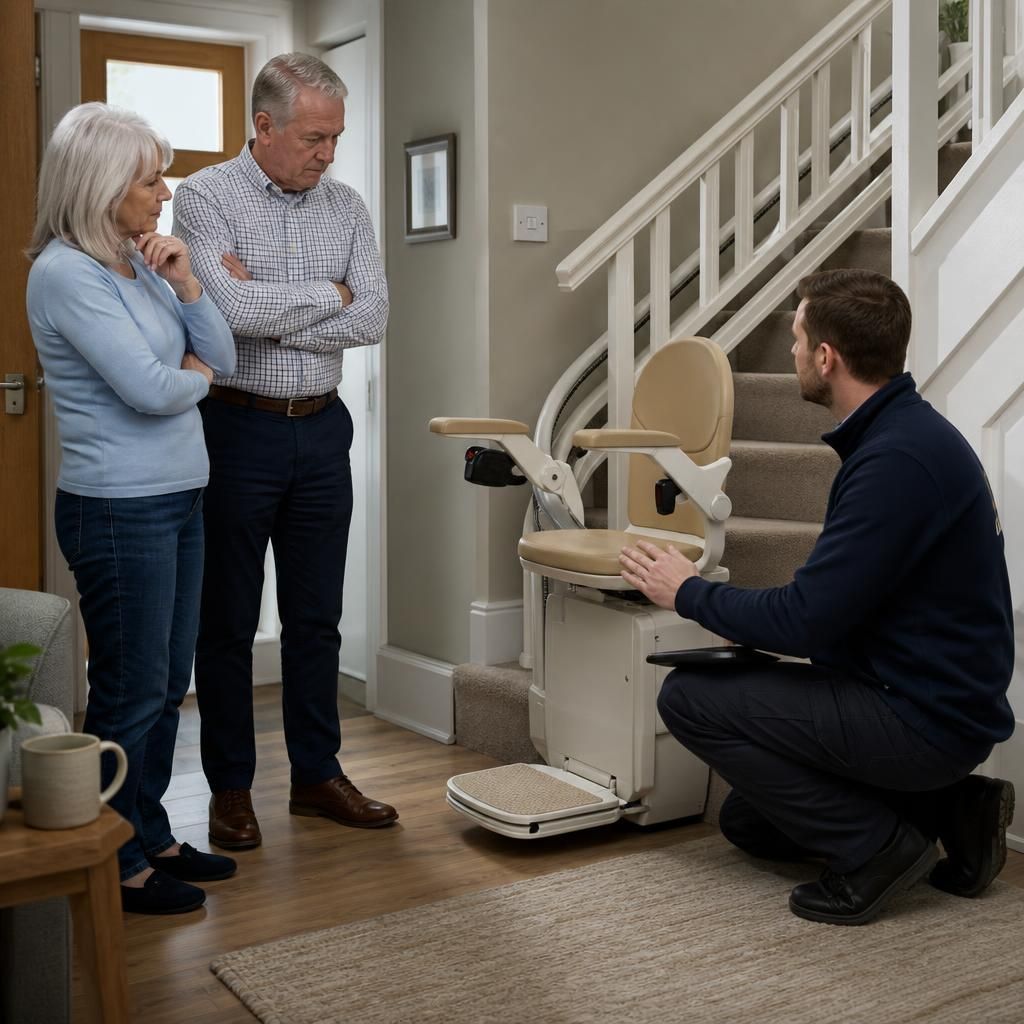
Request a Clear Stairlift Cost Assessment
Request a stairlift assessment from Independent Stairlifts for a clear quotation based on your staircase, mobility needs and preferred specification.
We can explain what is included, including installation, warranty and aftercare, so you can compare the complete cost with confidence.