
What are the key maintenance requirements and costs associated with maintaining your stairlift over time?
Stairlift maintenance usually involves routine cleaning and checks, battery replacement when required, and professional servicing to inspect the rail, drive system, safety features and controls. Ongoing costs vary by model, usage, age and service plan, while repairs and replacement parts are generally charged separately unless covered by a warranty or maintenance agreement.
Maintaining a stairlift involves regular cleaning and user checks, keeping the batteries charged, and arranging professional servicing at suitable intervals. The main ongoing costs are servicing, replacement batteries, repairs and occasional replacement parts. The amount you spend depends on the stairlift’s age, design, usage, condition and whether a warranty or maintenance agreement is in place.
Routine maintenance carried out at home
Simple care helps reduce avoidable wear and can identify problems before they affect reliability. Follow the instructions supplied with your model, and:
- Keep the rail, seat, footplate and controls free from dust, dirt and obstructions. Use a soft, slightly damp cloth where appropriate and avoid spraying liquid into electrical components.
- Keep the charging points clean and ensure the stairlift is left at its designated charging position when not in use. A stairlift that is regularly left away from its charger may not have enough power for the next journey.
- Check that the seat, armrests, footplate and swivel mechanism move and lock correctly.
- Make sure the seat belt fastens securely and that safety sensors stop the lift when they contact an obstruction.
- Keep children, pets and objects away from the rail and moving parts.
- Do not attempt to lubricate, adjust or dismantle the stairlift unless the manufacturer’s instructions specifically permit it. Incorrect lubrication or adjustment can affect the drive system and safety mechanisms.
These checks are not a substitute for professional servicing. If the lift makes an unusual noise, travels unevenly, stops unexpectedly, loses power, displays a fault code or fails to charge, stop using it if it is unsafe and contact a qualified stairlift engineer.
What a professional service normally includes
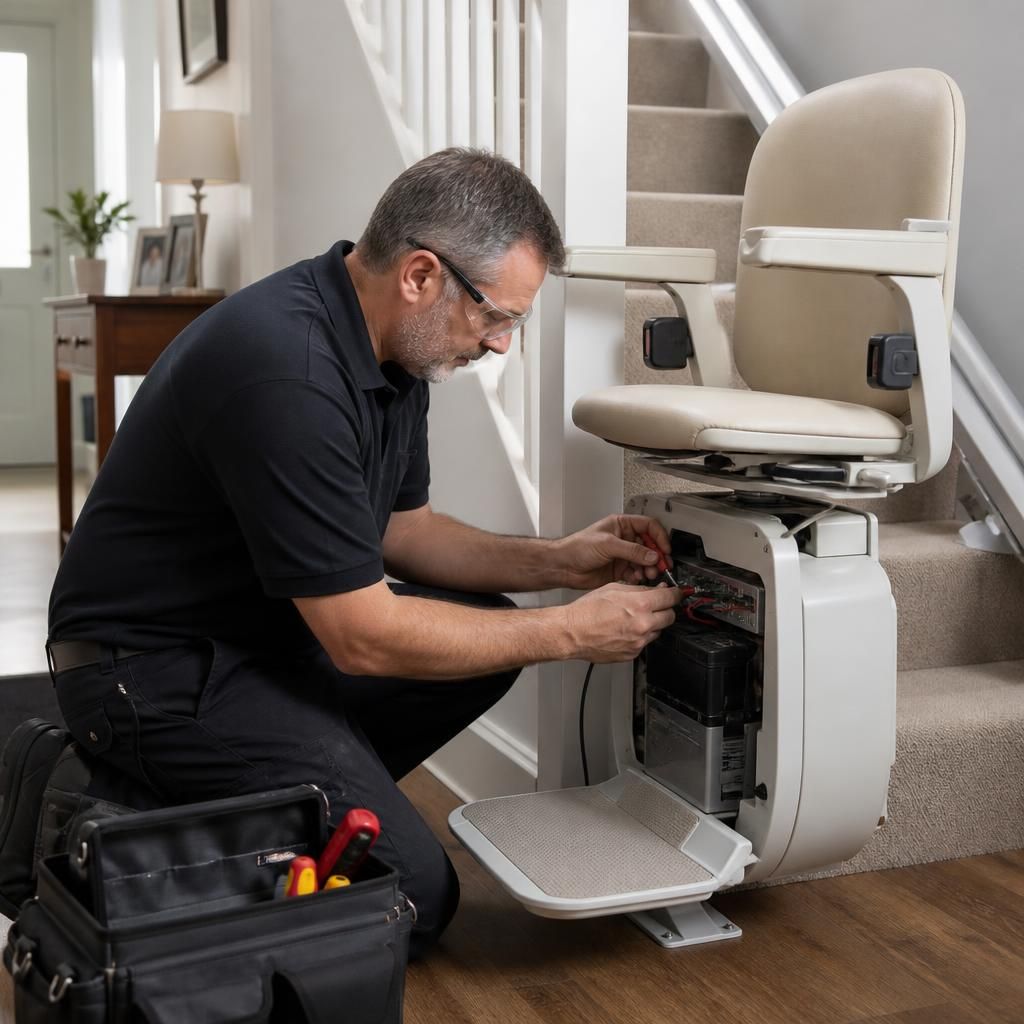
A service is intended to confirm that the stairlift remains safe, dependable and correctly adjusted. An engineer will typically inspect and test the:
- rail, brackets, fixings and joints, including the condition of the track and its alignment;
- motor, gearbox, drive system and charging equipment;
- batteries, battery connections and charging performance;
- seat belt, swivel seat, armrests, footplate and other user-safety features;
- obstacle sensors, limit switches, controls, remote controls and emergency stop functions;
- wiring, connectors and visible electrical components; and
- travel speed, stopping, starting and general operation under normal conditions.
The engineer may clean components, tighten fixings, make approved adjustments and recommend parts that need attention. The service record should identify any work completed and any repairs that are advisable. Servicing frequency should follow the manufacturer’s guidance and the conditions of your warranty or service agreement. A lift used several times a day, installed outdoors or exposed to dust, damp or temperature changes may need closer monitoring than a lightly used indoor lift.
Battery replacement and charging costs
Most modern stairlifts use rechargeable batteries rather than relying directly on household mains power while travelling. Batteries gradually lose capacity through age and use. Warning signs include shorter journeys between charges, slower operation, repeated low-battery alerts or the lift stopping away from its charging point.
Battery replacement is a normal maintenance cost and is usually charged separately unless your warranty or maintenance plan includes it. The price depends on the battery type, model and whether one or more batteries need replacing. Batteries should be fitted by a suitably trained person using compatible parts. Replacing them with an incorrect type, or continuing to use batteries that are leaking or damaged, can create a safety risk.
If a stairlift is not used for a period, ask for advice before switching off its power or leaving it unattended. Some models need to remain connected to charge, while extended storage may require a specific procedure.
Typical costs to plan for
There is no single maintenance price that applies to every stairlift. When budgeting, consider the following cost categories:
- Routine servicing: a scheduled inspection and test, priced according to the provider, model, location and work required.
- Service plans: an agreement may cover scheduled servicing and some call-outs for a recurring fee. Check exactly what is included, as batteries, accidental damage, misuse, major parts and out-of-hours visits may be excluded.
- Repairs: fault-finding, labour and replacement parts may be billed separately. Ask whether a diagnostic or call-out charge applies before authorising work.
- Battery replacement: a periodic cost affected by the model, battery specification and condition of the charging system.
- Wear-related parts: items such as rollers, switches, controls, belts or drive components may eventually need replacement, particularly on an older or heavily used lift.
- Outdoor or complex installations: weather exposure, longer rails, multiple landings and unusual layouts can increase inspection time and the cost of specialist parts or access.
For an accurate figure, request an itemised quotation based on the specific stairlift and its service history. Confirm whether the price includes VAT, labour, travel, testing, parts and any follow-up visit. If the lift is covered by a warranty, check its start date, duration, exclusions and whether servicing must be carried out according to a specified schedule to keep the cover valid.
How to keep long-term costs under control
Keep the stairlift’s model details, installation information and service records together. Report small changes in performance rather than waiting for a complete breakdown, as continued use can worsen a fault and increase repair requirements. Keep the rail clear, avoid carrying loads beyond the manufacturer’s limit and do not use the stairlift if a safety feature is not working correctly.
When comparing a repair with replacement, consider the lift’s age, parts availability, battery and service history, frequency of faults, and whether your mobility or staircase requirements have changed. A professional assessment can help determine whether repair is practical or whether a replacement would provide better reliability and value over time. For a rented or reconditioned stairlift, establish in advance which maintenance, call-outs and replacement parts are included in the agreement.
Good routine care cannot prevent every fault, but it can support safe operation, protect the equipment and make maintenance costs more predictable. If you are unsure whether your stairlift needs a service, battery change or repair, arrange an assessment rather than attempting electrical or mechanical work yourself.
Professional stairlift servicing checks the mechanical, electrical and safety systems that routine cleaning cannot fully assess. An engineer will inspect the rail, drive system, batteries, charging points, seat belt, controls, sensors and emergency functions, then test the lift in operation.
Arrange servicing in line with the manufacturer’s guidance and any warranty or maintenance agreement. The cost can vary according to the stairlift model, its age, usage, location and whether parts or repairs are needed. Before work begins, ask for an itemised price confirming whether labour, travel, testing, VAT and replacement parts are included.
Regular servicing can also identify worn components before they cause a breakdown. Keep the service record with your stairlift documents, and report unusual noise, uneven travel, repeated fault messages or charging problems promptly rather than continuing to use a lift that may be unsafe.
Arrange a Stairlift Maintenance Assessment
Arrange a stairlift maintenance assessment to review its condition, servicing needs, battery performance and any likely repair costs. Independent Stairlifts can advise on the most appropriate next steps for your model and installation.