
What factors should I consider when choosing a compact stairlift for a narrow staircase?
When choosing a compact stairlift for a narrow staircase, consider the available stair width, the lift’s folded dimensions, seat and footrest design, track layout, user weight and transfer needs. A professional assessment should also check bends, landings, parking positions, power supply and whether a bespoke or curved solution would provide safer access without obstructing the stairs.
Choosing a compact stairlift for a narrow staircase depends on more than the stairlift’s overall size. The key considerations are the clear width available when the seat, arms and footrest are folded, the shape of the staircase, the user’s transfer and support needs, and where the stairlift can be parked without obstructing a doorway, landing or corridor. A professional home assessment is essential because a model that appears compact in a brochure may not provide sufficient clearance in the specific staircase.
Start with the staircase measurements
The available stair width should be checked at its narrowest point, including around handrails, dado rails, radiators, window ledges and other fixed features. The survey should also consider the width of the stairs at the top and bottom, as well as the space available for entering and leaving the seat. Measurements should be taken with the stairlift both in use and folded away.
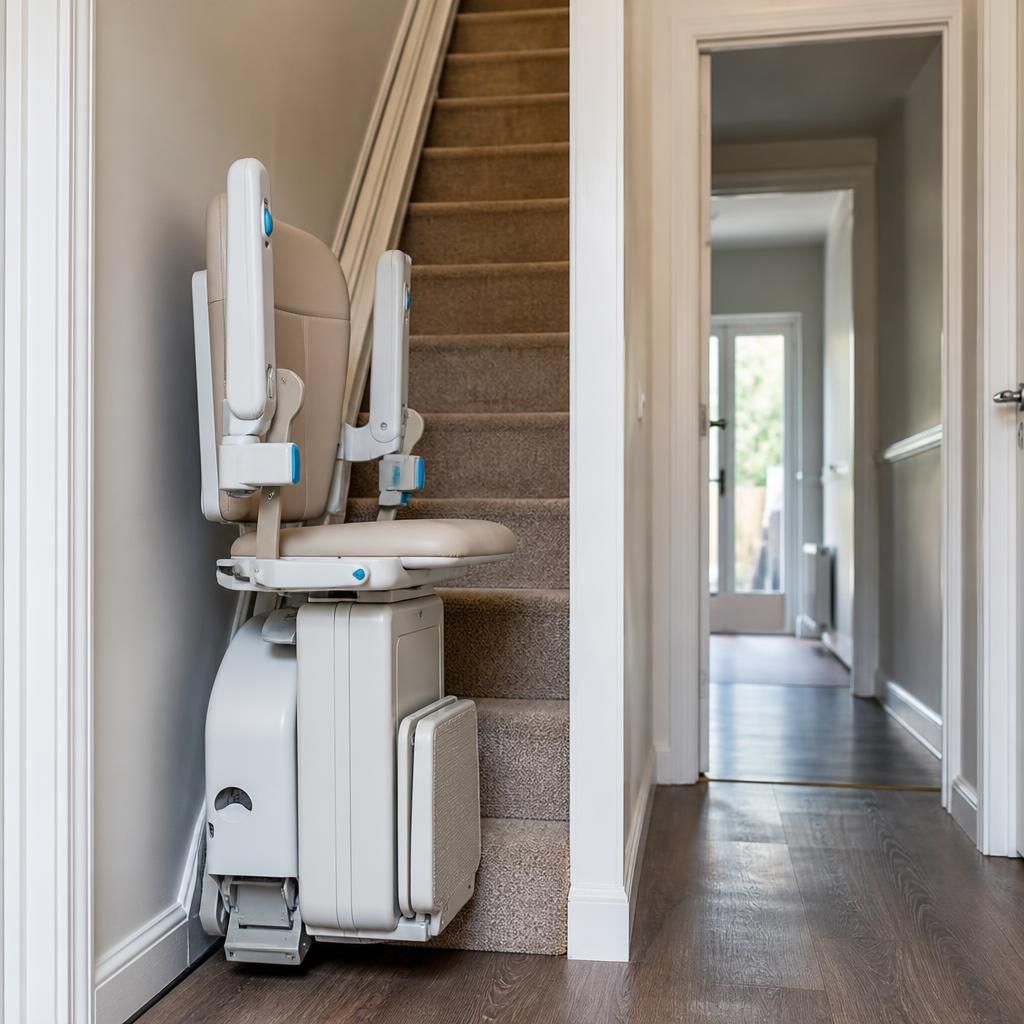
Usable clearance is affected by the complete folded profile, not just the rail. A stairlift with a slim folded seat may still leave limited room if its arms, controls or footrest project into the staircase. Ask for the manufacturer’s folded dimensions and have them assessed against the actual stair width rather than relying on a general description such as “slim” or “compact”.
Consider the seat, arms and footrest design
Space-saving features can include a narrow seat, slimline arms, a folding footrest and a seat that folds close to the wall. These features can make a significant difference on a terraced-house staircase, where other household members may still need to use the stairs. However, the smallest available design is not automatically the safest or most comfortable choice.
The seat should provide adequate support and allow the user to sit down and stand up in a controlled way. Armrests may help with stability when transferring, while a powered swivel seat can make it easier to turn towards the landing before standing. A powered or manually folding footrest may reduce obstruction, but it must still be easy for the user or a carer to operate. The right balance is one that preserves clearance without making transfers awkward.
Check whether the staircase is straight or curved
A straight stairlift may be suitable where the stairs run in one continuous line and there is enough space at both ends for safe boarding and parking. A staircase with a bend, intermediate landing, change of gradient or unusual geometry may require a curved stairlift. Curved systems are made to follow the individual staircase and can often use tighter or more controlled parking arrangements, but their suitability depends on the available space and the proposed rail route.
On a narrow staircase, the position of the rail can be particularly important. The surveyor should assess whether the rail can be installed without interfering with doors, skirting boards, radiators or a second handrail. Where the stairs turn, the design should also allow the user to travel smoothly and arrive in a suitable position at the top or bottom.
Plan the parking positions carefully
A compact stairlift still needs a practical parking position. At the bottom, the seat may need to clear a doorway, hallway or access route. At the top, it may need to park beyond the stair edge so the user can turn and transfer safely without standing on the stairs.
Where space is restricted, options such as a hinged rail or a different parking orientation may help, subject to the staircase layout. A hinged rail can keep the lower section of the track away from a doorway or passage, but it must not create a trip hazard or interfere with other household activities. The survey should consider how the stairlift will be used when it is not travelling and whether family members, visitors or emergency access routes will still have sufficient space.
Match the stairlift to the user
The user’s mobility needs should guide the choice as much as the staircase dimensions. Consider:
- Whether the user can sit down and stand up independently.
- Whether they need powered swivelling, a powered footrest or additional controls.
- Whether the seat, arms and belt provide suitable support and comfort.
- Whether the user can operate the controls and manage the remote control.
- Whether a carer may need to assist with boarding or alighting.
- Whether the user’s height, posture, leg position or weight requires a particular seat specification.
A very narrow seat or reduced armrest width may preserve more stair space but could make transfers less secure. Conversely, a larger seat may be more comfortable but reduce the remaining clearance. The assessment should therefore consider safe, repeatable use rather than focusing only on the smallest equipment dimensions.
Assess the user’s weight and posture requirements
Every stairlift has an approved weight capacity and operating specification. These must be checked against the user’s weight and any likely changes in mobility or posture. The user should also be able to sit centrally, keep their feet supported and use the safety belt correctly throughout the journey.
Some people need extra room because of stiffness, reduced balance, joint pain or difficulty bending their knees. These needs may affect the choice of seat, footrest and armrest configuration. A compact stairlift should never be selected solely because it takes up less room if it compromises the user’s ability to travel securely.
Look at the electrical supply and charging arrangements
Most modern stairlifts use rechargeable batteries and charge at designated points on the track or at parking positions. The installer should confirm that the stairlift can be left in a charging position when not in use and that the power connection is suitable for the property.
Battery-powered operation normally allows the lift to continue for a limited period if the household power supply is interrupted, but the batteries still require regular charging and eventual replacement. The charging points should not force the user to leave the stairlift in an inconvenient or obstructive position. Any required socket or electrical work should be identified during the survey rather than treated as an afterthought.
Check safety and compliance features
The stairlift should include appropriate safety equipment for the user and the layout, such as a seat belt, safety sensors, secure armrests and controls that can be reached easily. Sensors should stop the lift if an obstruction is detected, although the stairs and landing should still be kept clear.
Installation should be carried out in accordance with the relevant manufacturer’s instructions and applicable UK safety requirements. A competent survey should also consider the condition of the stairs, the strength of the fixing points and any features that could affect the rail installation. If the staircase has unusual construction or restricted access, the installer should explain the proposed fixing method before work begins.
Compare a standard compact model with a bespoke solution
A standard compact stairlift can be appropriate for a simple, straight staircase with consistent dimensions. A bespoke solution may be more suitable where the staircase is unusually narrow, includes bends, has limited landing space or requires a specific parking arrangement.
Bespoke does not necessarily mean choosing the largest or most complex system. It means designing the rail, seat configuration and parking positions around the property and the user. In some homes, a curved stairlift may use the available space more effectively than trying to fit a straight model to a difficult layout. In others, a straight model with carefully selected folding features may provide the most practical result.
Ask what will happen during and after installation
Before installation, confirm the expected rail route, fixing points, power arrangements, parking positions and any changes needed around doors or handrails. The installer should explain how the stairlift will be operated and demonstrate boarding, travelling, parking, charging and the use of the safety features.
After installation, keep the track and steps free from objects, follow the operating and charging instructions, and report unusual noises, movement or repeated fault indications promptly. Routine servicing and battery replacement requirements should also be explained so the stairlift remains reliable.
The most suitable compact stairlift is therefore the one that leaves adequate usable clearance while supporting safe transfers and comfortable travel. A home assessment by Independent Stairlifts can establish whether a compact straight model, a curved stairlift or another bespoke arrangement is appropriate for the staircase and the person who will use it.
For a compact stairlift on a narrow staircase, the most important measurement is the remaining usable clearance when the seat, armrests and footrest are folded. A slim rail alone does not guarantee enough room for other people to pass safely.
An assessment should measure the staircase at its narrowest points and check fixed features such as handrails, radiators, dado rails and window ledges. It should also consider where the stairlift will park at the top and bottom, including whether it could obstruct a doorway, landing or hallway. The right design must preserve practical access while still providing enough seat width, support and transfer space for the user.
Book Your Compact Stairlift Assessment
Arrange a home assessment with Independent Stairlifts to check your staircase dimensions, parking space and transfer requirements. We can advise whether a compact straight stairlift, curved model or bespoke solution is the safest fit.