
What are the maintenance requirements for stairlifts in terraced houses?
Stairlifts in terraced houses require the same essential routine servicing as other models, including checks of the battery, drive system, safety sensors, seat, controls and charging points. Narrow staircases and compact installations also need regular checks to ensure the lift, track and surrounding access remain secure, unobstructed and correctly aligned.
Stairlift maintenance in a terraced house involves routine user checks, professional servicing and prompt attention to faults. The main areas are the batteries, charging points, drive system, track, seat, controls and safety sensors. On a narrow or compact staircase, maintenance should also confirm that the lift remains correctly aligned, securely fixed and clear of handrails, doors, landings and everyday household items.
Follow the manufacturer’s servicing recommendations. The required schedule depends on the stairlift model, how frequently it is used, the design of the staircase and whether the lift is new or reconditioned. A qualified stairlift engineer should carry out servicing at the intervals set out in the manufacturer’s instructions or your service agreement. Professional servicing is different from cleaning or carrying out simple daily checks, as it involves inspecting and testing safety-critical components.
Routine checks for the user
- Keep the track clear of shoes, toys, bags, cleaning equipment and other objects that could obstruct the carriage or footrest.
- Check that the stairlift starts, stops and travels smoothly without unusual juddering, grinding or repeated beeping.
- Make sure the seat is locked in its travelling position, and check that the swivel mechanism, armrests, seat belt and footrest operate as intended.
- Test the controls, including the handset if one is supplied, and report controls that are sticking, intermittent or difficult to use.
- Keep the charging points and the area around them clean and unobstructed. The lift should be left at its designated charging position when it is not in use, unless the manufacturer gives different instructions.
- Check that safety features such as the seat belt, obstruction sensors and swivel-seat interlock respond correctly. Do not continue using the lift if a safety feature appears faulty.
These checks should be visual and practical only. Do not remove covers, adjust the rail, bypass a sensor or attempt to repair electrical or mechanical parts yourself. Stairlifts contain moving and electrical components that require appropriate training and model-specific parts.
Battery and charging maintenance
Most domestic stairlifts use rechargeable batteries and charge at one or more points on the rail. Batteries gradually lose capacity, so a lift may begin to travel more slowly, stop before reaching the top or bottom, or give a low-battery warning. A battery fault can also be caused by a charging-point problem, a disconnected supply or an issue with the charger, so the complete charging system should be assessed rather than replacing batteries without diagnosis.
Keep the lift parked on its charging point as instructed and avoid leaving it switched off for extended periods. If the stairlift is not being used because the resident is away, ask for advice on the correct shutdown and charging procedure for that model. Battery replacement should be carried out with suitable parts and safe disposal of the old batteries.
Track, drive system and fixings
During a service, the engineer will inspect the rail for secure fixings, damage, contamination and correct alignment. The drive system, rollers, gears and other moving parts are checked for wear and smooth operation. Lubrication, where required, must be carried out according to the model’s instructions; applying unsuitable lubricant can attract dirt or affect components.
This is particularly important in terraced houses because staircases may be narrow, steep, tightly enclosed or interrupted by bends and limited landing space. A small change in alignment or a loose fixing can affect clearances and the way the carriage approaches the top or bottom of the stairs. Any new flooring, decorating, handrail alteration or building work near the staircase should be reported if it may affect the lift or its track.
Safety and access checks in a narrow home
Maintenance should consider how the stairlift interacts with the whole staircase, not just the motor. The engineer may check that:
- the footrest, armrests and seat do not strike walls, doors, radiators or bannisters;
- the lift can be parked without blocking a doorway, hallway or important escape route;
- folding or swivel components latch securely and leave sufficient room for a safe transfer;
- the track remains firmly attached to the stairs or supporting structure;
- the landing and stair treads remain free from trip hazards; and
- any hinged or overrun section continues to operate safely where the installation uses one.
Do not store items on the stairs or close to the rail, even temporarily. In a compact terraced-house layout, an object that appears to leave adequate room may still trigger an obstruction sensor or restrict the user’s ability to approach and leave the seat safely.
Cleaning and environmental care
Wipe the seat, armrests, controls and accessible surfaces with a lightly damp cloth and a suitable household cleaner, following the manufacturer’s guidance. Keep liquids away from switches, charging contacts and electrical housings. Dust and debris should not be allowed to build up around the rail, carriage or footrest.
Indoor stairlifts are intended for the conditions inside the home. Excessive damp, condensation, decorating dust or building work can affect electrical and moving parts. If the stairlift is installed on an external access route or in an unusually damp area, it may have additional weatherproofing and inspection requirements.
When to arrange a service or report a fault
Contact the service team if the stairlift becomes noisy, jerky or slow; fails to charge; stops unexpectedly; displays a fault indication; or does not respond consistently to the controls. Report damage to the rail, seat, belt, footrest or casing, and any change in the distance between the lift and nearby walls or fittings.
If the lift stops between floors, follow the instructions supplied with the model and use the agreed emergency contact process. Do not try to force the carriage along the rail or climb out on the staircase unless there is an immediate danger and emergency services advise you to do so. Keep the user manual and service contact details accessible to household members or carers.
Records, warranties and reconditioned stairlifts
Keep a record of servicing, repairs, battery changes and any recurring fault. This helps an engineer identify patterns and confirms which parts have been inspected. Warranty conditions may require servicing or repairs to be completed by an appropriately qualified provider, so check the documentation before arranging work independently.
Reconditioned stairlifts need the same safety checks as new installations, with particular attention to the age and condition of batteries, drive components, controls and seat mechanisms. The servicing history and any replacement parts should be recorded so future maintenance can be planned accurately.
In practice, a terraced-house stairlift is maintained through regular cleaning and user checks, correct charging, keeping the narrow staircase unobstructed and arranging professional inspections at the recommended intervals. If the staircase or surrounding fittings change, request a safety review rather than assuming the previous clearances will remain suitable.
Maintenance for a stairlift in a terraced house should include checks that the lift remains safe to use within the available staircase space. Alongside the battery, controls and drive system, a qualified engineer should inspect the rail fixings, alignment, footrest, seat and safety sensors.
This is particularly important where the staircase is narrow, steep or close to doors, walls and bannisters. Report any new obstruction, unusual noise, jerky movement or change in clearance promptly. Do not move the rail, adjust sensors or attempt repairs yourself; model-specific servicing helps prevent a minor alignment or charging issue from becoming a safety problem.
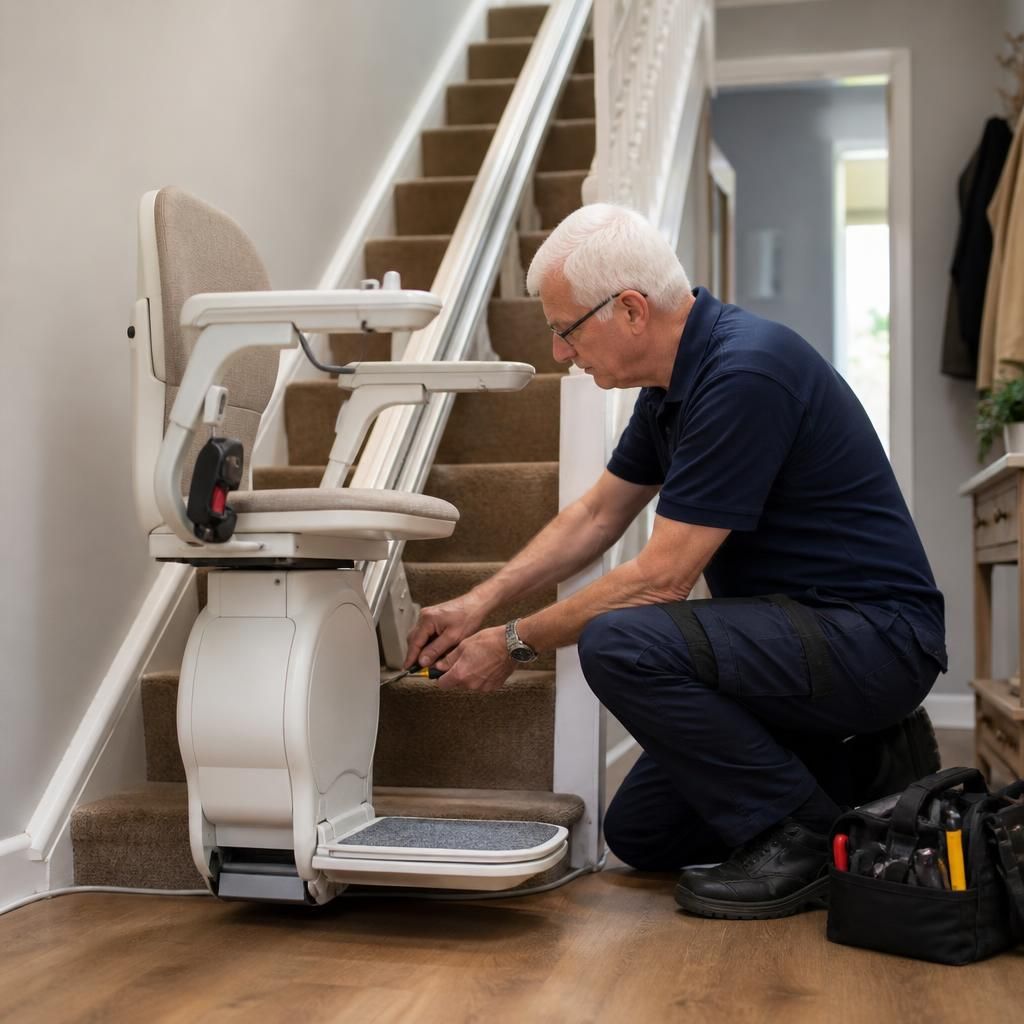
Arrange a Stairlift Maintenance Check
Arrange a professional stairlift maintenance check to confirm that your lift, rail, charging system and safety features remain secure and reliable in your terraced home. Contact Independent Stairlifts to book a service or report any unusual noise, movement, charging issue or change in clearance.