
What types of stair lifts are available for different types of staircases in houses?
Different staircase layouts require different stairlift designs: straight stairlifts suit uninterrupted straight flights, while curved stairlifts are made to follow bends, landings and changes in direction. Narrow staircases, split-level layouts and external steps may require compact, bespoke or outdoor models, selected after an assessment of the staircase and surrounding space.
The main types of stairlift available for houses are straight, curved, narrow-staircase, standing or perch, and outdoor stairlifts. The correct model depends on the shape and length of the staircase, the available space at the top and bottom, the user’s mobility, and whether the lift needs to travel between more than one level. A professional survey is needed to confirm which design will fit safely and whether a standard or bespoke installation is appropriate.
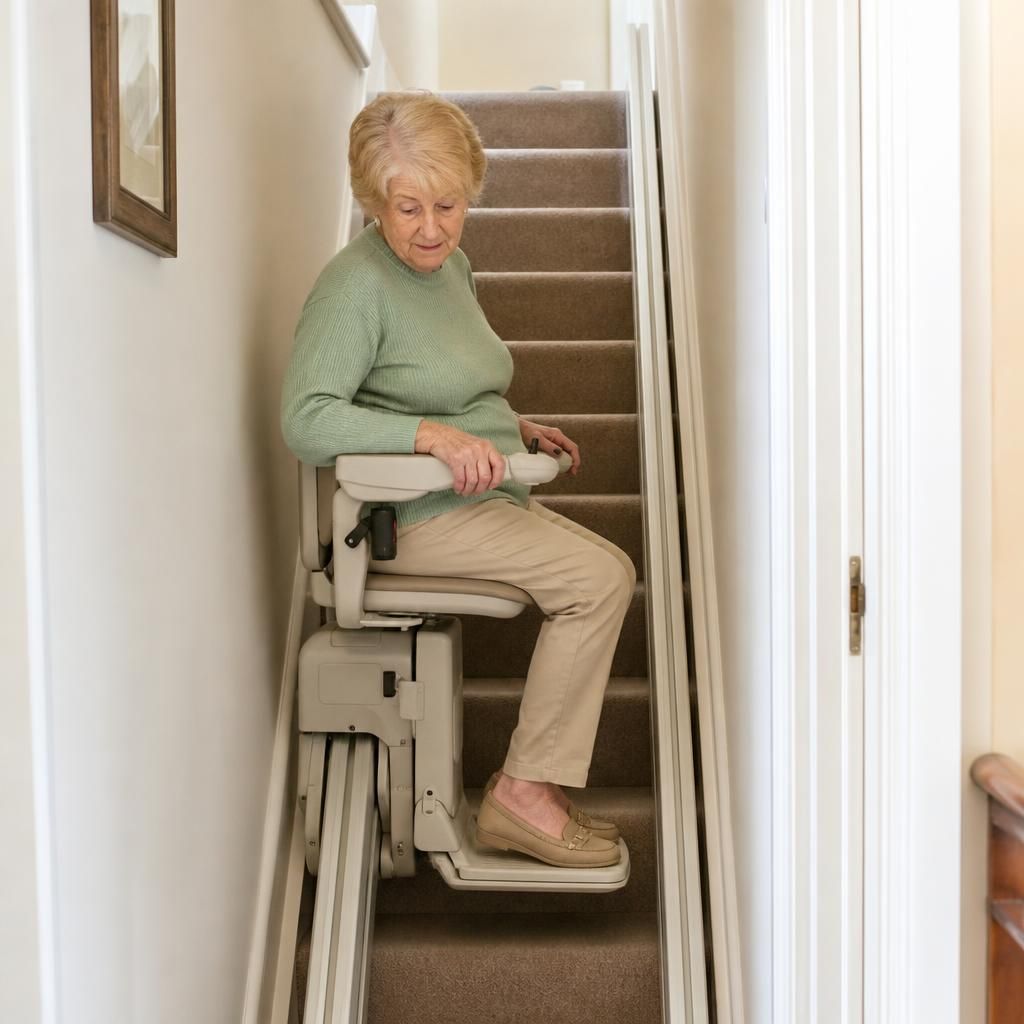
Straight stairlifts are designed for a staircase that runs in one uninterrupted direction without bends, intermediate landings or changes of angle. They are usually fitted to the stair treads rather than the wall, so the staircase normally does not need major structural alteration. A straight model can be suitable for many conventional staircases in houses, including relatively narrow flights, provided there is enough clearance for the user and other people using the stairs.
The rail is generally installed along one side of the staircase and may include a hinged or folding section where the rail could otherwise obstruct a doorway or passage. At the bottom, a swivel seat, folding armrests or a compact parking position can help preserve access to the hall. The available space at the top is also important, particularly where the staircase ends close to a landing, wall or doorway.
Curved stairlifts are made for staircases that include bends, half-landings, intermediate landings, multiple flights or changes in direction. The rail is manufactured to follow the individual route of the stairs, allowing the chair to travel around corners and stop at the required landing. This makes a curved stairlift suitable for layouts such as L-shaped, U-shaped and multi-flight staircases.
Because the rail is made for the specific staircase, a curved stairlift can often serve more than one flight without requiring separate lifts at each level. The design may include carefully planned parking points so that the chair is kept clear of doorways and walking routes when it is not in use. Where two people need to use different floors independently, it may be more practical to consider separate lifts or another access arrangement. This can be discussed during the assessment.
Narrow staircases do not automatically rule out a stairlift. Compact seats, slimline designs, folding components and suitable rail positions may allow a lift to be installed while retaining usable space for other people. However, the width of the stairs is only one consideration. The survey also needs to assess the user’s seated position, the width of the chair and armrests, the position of handrails, obstructions, door openings and the amount of room available at the landings.
On a particularly restricted staircase, a perch or standing stairlift may be worth considering. These models are designed for users who find it difficult to bend their knees or sit comfortably, and they can sometimes provide a more compact travelling position. They are not suitable for everyone, especially anyone who has poor balance or cannot stand securely, so the user’s abilities and clinical needs should be considered before choosing this option.
Staircases with landings or split levels may need either a curved stairlift or a planned combination of lifts. A curved model can follow the complete route where the staircase changes direction. In other situations, a straight lift may be installed on each uninterrupted flight, with the user transferring at the landing. The best arrangement depends on the size of the landing, the user’s ability to transfer safely and whether the route includes doors or other obstructions.
Spiral and helical staircases can be more challenging because the stairs are narrow, continuously curved and often have limited space on the inner side. A conventional stairlift may not be suitable, particularly where the treads taper significantly or the user would be positioned too close to the central column. A bespoke curved design may be possible in some properties, but this can only be confirmed after detailed measurements and a practical assessment of the route.
Outdoor stairlifts are intended for external steps, such as stairs leading to a garden, driveway, entrance or raised patio. They use weather-resistant materials and protective covers, but they still require suitable drainage, a safe landing area and access to an appropriate electrical supply. The installation must take account of rain, frost, dirt, direct sunlight and the risk of slippery surfaces. An outdoor stairlift should not be treated as an ordinary indoor model placed outside, as its components need to be suitable for external conditions.
Stairlifts for split-level and unusual house layouts are often specified around the property rather than selected from a standard category. Examples include staircases that open directly into a room, stairs that finish close to a kitchen or bathroom door, and routes with limited headroom or uneven walls. A rail may need to extend beyond the final step, fold away, or finish in a position that allows the user to get on and off safely. These details affect the design as much as the staircase itself.
When assessing the most suitable type, the installation team should consider:
- the direction, gradient and width of every flight;
- the number and shape of bends, landings and changes in level;
- clearance at the top and bottom of the stairs;
- doorways, radiators, handrails, walls and other obstructions;
- whether other household members need to continue using the stairs;
- the user’s height, weight, balance, knee movement and ability to transfer;
- where the stairlift will park when it is not being used; and
- whether the installation is indoors, outdoors or exposed to damp conditions.
Some stairlifts are available as reconditioned models, which can be suitable for certain straightforward layouts where a compatible unit is available. A reconditioned lift still needs to be checked for condition, correctly installed and matched to the staircase and user. Curved stairlifts are generally more specific to the property because their rails are made to follow the individual route.
The safest way to choose between these options is to arrange a home assessment. Measurements, photographs and a discussion of how the stairs are used will help establish whether a straight, curved, compact, perch or outdoor design is appropriate. The assessment should also identify practical details such as parking positions, controls, charging points and access during installation. If the staircase is unusual or space is limited, ask for the proposed travel route and transfer points to be explained before agreeing to the installation.
A narrow staircase does not automatically rule out a stairlift. A compact seat, folding components and careful rail positioning may preserve useful space for other people using the stairs, but the available width is only one part of the assessment.
The installation team also needs to check the user’s seated position, handrails, doorways, obstructions and the space at both landings. A perch or standing stairlift may suit some people who have difficulty bending their knees, although it is not appropriate for anyone who cannot stand securely or has poor balance. A home survey is therefore essential before choosing the most suitable design.
Arrange a Home Assessment for Your Staircase
Arrange a home assessment with Independent Stairlifts to identify the most suitable stairlift for your staircase, layout and mobility needs. Our team can explain the available options and confirm whether a straight, curved, compact, perch or outdoor model is appropriate.