
Can stair lifts be installed on narrow staircases or in small spaces?
Yes, stair lifts can often be installed on narrow staircases or in small spaces, provided the stairway and surrounding access areas are assessed carefully. Bespoke options such as slimline designs, folding seats or hinged rails may help preserve usable space, with the most suitable arrangement confirmed during a home survey.
Yes. Stair lifts can often be installed on narrow staircases and in homes with limited space, but the available width, shape of the stairs, landing layout and surrounding obstructions all need to be assessed. A suitable design may include a slimline seat, folding armrests and footrest, a compact rail, a hinged rail or a different parking arrangement. The correct solution can only be confirmed during an individual home survey.
A narrow staircase does not automatically prevent installation. The stair lift is fixed to the stair treads rather than relying on the wall, so it can usually be fitted to straight or curved stairs without major structural alterations. However, the lift must leave enough usable space for the passenger and, where required, for other people to pass safely. The surveyor will consider the stair width at different points, as well as the passenger’s height, weight, mobility and ability to sit and transfer safely.
Several design features can help where space is restricted:
- Folding seats, arms and footrests: These reduce the amount of space occupied when the lift is not being used and can make it easier to move around the staircase.
- Swivel seats: A powered or manual swivel seat can help the passenger get on and off at the top or bottom without twisting on the stairs. The available landing space must still be checked.
- Hinged rails: Where a rail would obstruct a doorway, hallway or walkway at the bottom of the stairs, a hinged section may allow it to be folded out of the way. A powered hinge can be useful when reaching down to operate a manual mechanism would be difficult.
- Compact or slimline configurations: Some lifts have a narrower folded profile or can be specified with seating and controls suited to the available space. The narrowest option is not automatically the safest or most comfortable, so the design needs to be matched to the user.
- Alternative parking positions: On a curved staircase, the lift may be able to park around a bend or on a landing rather than stopping directly in front of a door or at the narrowest point.
Curved staircases in small spaces are assessed particularly carefully because the rail is made to follow the stairs and may occupy more room around bends, landings or changes in direction. A bespoke curved stair lift can often be designed around these features, but the survey must account for handrails, radiators, bannisters, doors, cupboards and low ceilings. On a straight staircase, a standard rail may be suitable, although the top and bottom parking areas can still determine whether the installation is practical.
The space at each end of the staircase is as important as the width of the stairs themselves. At the bottom, the surveyor will check whether the lift would restrict a hallway, door or route through the home. At the top, they will consider whether the passenger can turn, stand and transfer safely. If the landing is small, a swivel seat, altered parking position or hinged rail may help. Doors should not open into the lift’s travel path or prevent the passenger from reaching the seat safely.
Installation normally involves securing the rail to suitable stair treads and connecting the lift to its charging supply. In many homes, extensive building work is not needed. Small adjustments may occasionally be required to improve access or protect an obstruction, but any proposed work should be explained before installation. The condition and construction of the stairs also need to be checked, particularly where treads are unusually shaped, damaged or covered with a material that affects secure fixing.
Safety and comfort should not be sacrificed simply to fit a lift into a restricted area. The passenger must be able to sit with adequate support, use the controls, position their feet correctly and transfer at the top and bottom without undue strain. Features such as a seat belt, safety sensors, armrests, a swivel seat and controls positioned for the user may be important. A survey should also consider whether another person needs to use the staircase when the lift is parked.
If a conventional stair lift cannot provide sufficient clearance, the survey may identify another arrangement, such as a different seat style, a changed rail layout or an alternative mobility solution for that part of the home. Do not judge suitability from a catalogue measurement alone: a staircase that appears too narrow may accommodate a carefully specified lift, while a wider staircase may present problems because of a doorway, landing or sharp bend.
During the home assessment, it is useful to explain how the staircase is used throughout the day, where the passenger needs to get on and off, and whether family members, carers or visitors need to pass while the lift is parked. The final recommendation should reflect both the physical measurements and the person’s mobility needs. This approach ensures that the stair lift fits the available space without making everyday movement around the house unnecessarily difficult.
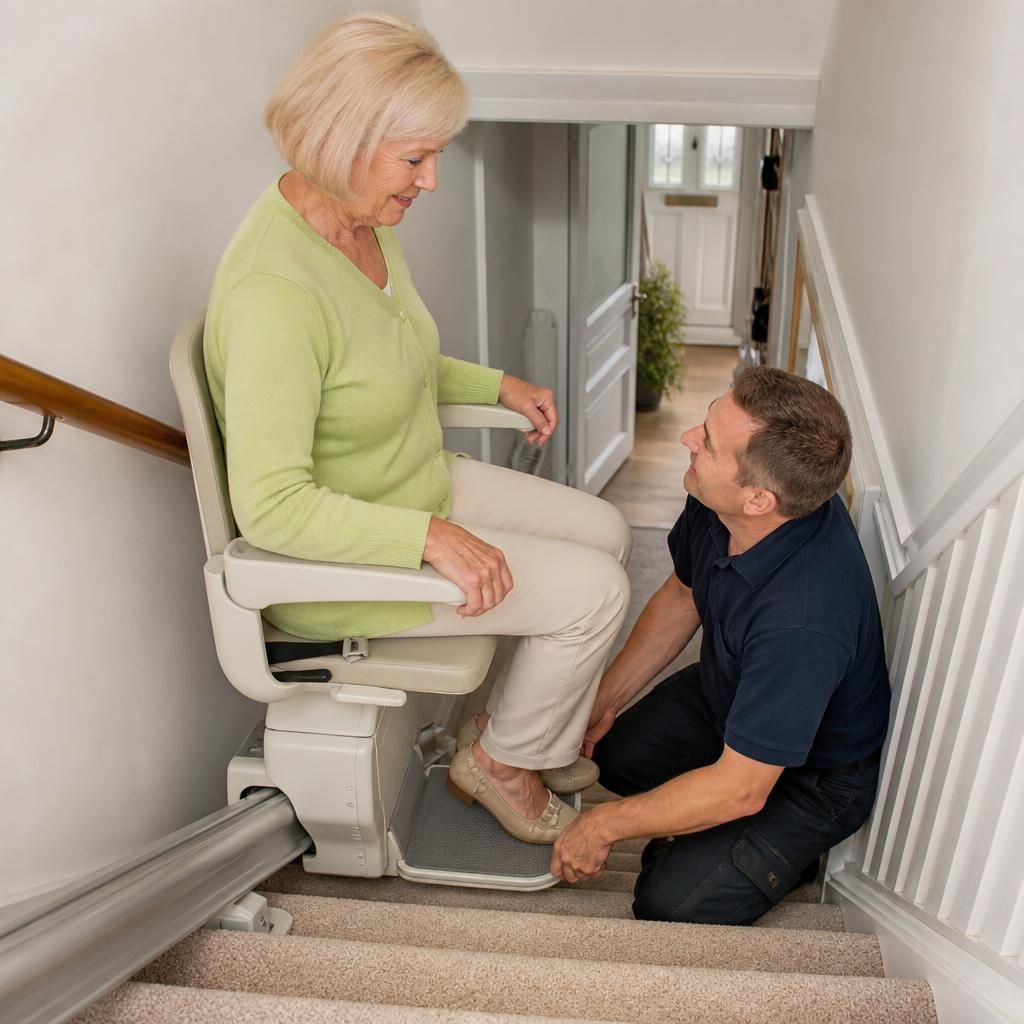
On a narrow staircase, the space at the top and bottom can be just as important as the width of the steps. A stair lift may fit the stairs but still need enough room for the passenger to sit, swivel, transfer safely and keep nearby doors or walkways clear.
During a home survey, the installation team will assess features such as doorways, handrails, radiators, bannisters, cupboards and tight bends. Depending on the layout, a folding seat and footrest, a swivel seat, a hinged rail or a different parking position may help preserve usable space. These features must be selected around the passenger’s mobility and comfort, rather than choosing the narrowest possible design.
A stair lift is normally fixed to the stair treads, so extensive structural work is not usually needed. However, the stairs must be suitable for secure fixing and the final arrangement must leave a safe route through the home. An individual assessment is therefore essential before confirming whether a narrow staircase or small landing can accommodate a stair lift.
Book Your Home Stairlift Survey
Book a home stairlift survey with Independent Stairlifts to assess your narrow staircase, landing and access requirements. We’ll recommend a suitable configuration based on the space available and the passenger’s comfort and safety needs.