
What are the key factors to consider when choosing a compact stairlift for a narrow staircase?
When choosing a compact stairlift for a narrow staircase, consider its folded footprint, seat and armrest dimensions, rail design, weight capacity and whether it leaves enough room for other people to use the stairs. A professional assessment should also check the staircase layout, turning points, landing space, user’s mobility needs and essential safety features before recommending a suitable model.
Choosing a compact stairlift for a narrow staircase involves balancing the lift’s folded size, the available stair width, the user’s physical needs and the layout of the stairs. The most suitable model is not necessarily the smallest one; it must provide a stable, comfortable ride while leaving practical space on the staircase and fitting safely around landings, bends and doorways.
A professional survey is essential before choosing a model. Measurements should be taken at the narrowest points of the staircase, rather than relying on the apparent width at the bottom or top. The assessment should also consider handrails, radiators, skirting boards, door openings, low ceilings, nearby furniture and any obstructions that could affect installation or use.
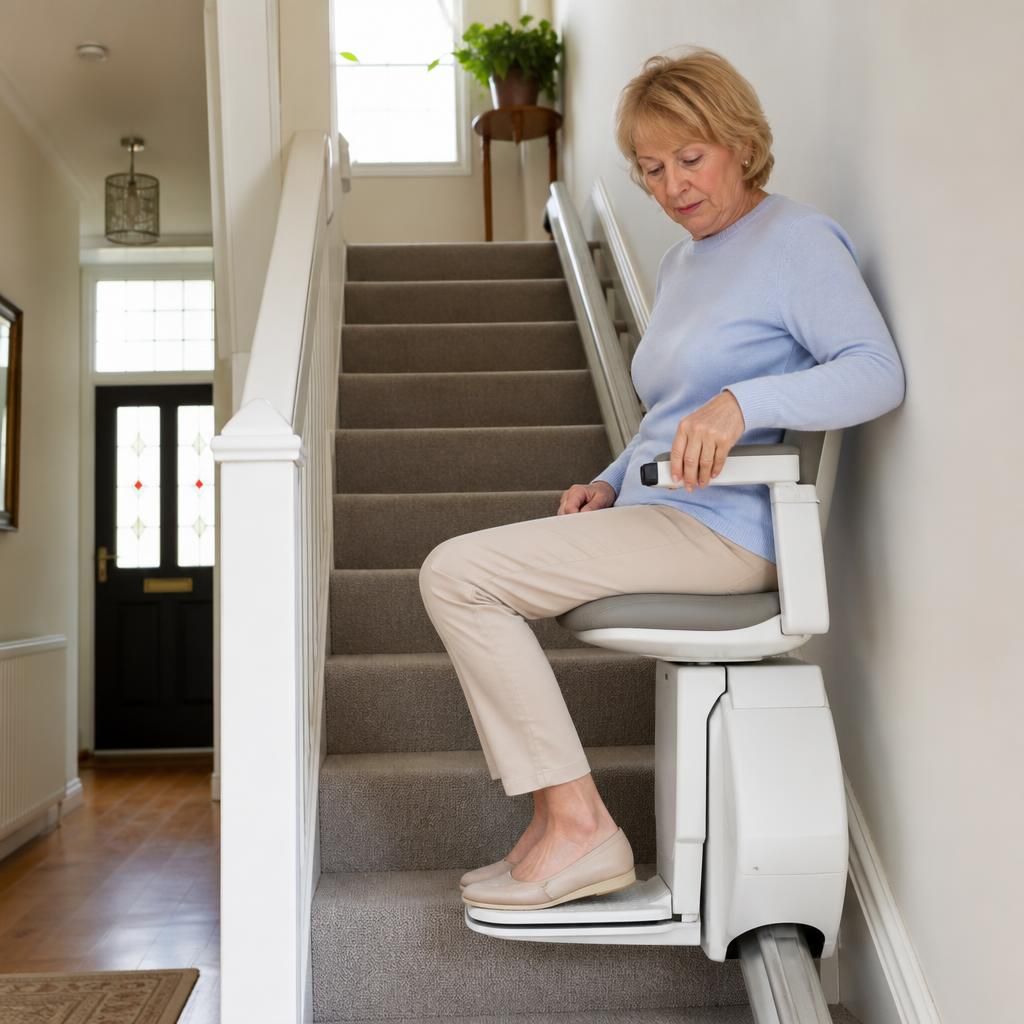
- Folded footprint: Check how far the seat, arms and footrest project into the staircase when the lift is parked or folded. A compact design should reduce obstruction when it is not being used, but the actual folded dimensions vary between models.
- Seat and armrest width: The seat must be narrow enough for the staircase without compromising the user’s posture or making transfers difficult. Armrests should provide useful support while remaining easy to fold if additional clearance is needed.
- Footrest design: A folding or hinged footrest can help preserve space at the bottom of the stairs. It should still give the user adequate support and be simple to operate, particularly if hand or leg movement is limited.
- Rail position and design: The rail is usually fitted close to the steps, but its route affects clearance at bends, landings and the top or bottom of the staircase. On a tight staircase, a tailored rail configuration may be more suitable than a standard layout.
- Staircase shape: Straight staircases are generally more straightforward, while curved or multi-flight stairs require a rail made to follow the individual route. Changes in direction, intermediate landings and unusual step shapes all need to be included in the survey.
- User dimensions and mobility: Consider the user’s height, weight, hip width, leg position, balance and ability to transfer on and off the seat. A lift that is compact but too restrictive can be harder and less safe to use than a slightly wider alternative.
- Weight capacity: Confirm that the chosen model is rated for the user and any clothing or items carried during normal use. The capacity should never be treated as an optional specification.
- Transfer space: There must be enough room to sit down and stand up safely at the parking points. If space is limited, features such as a swivel seat or a suitable parking position may make transfers more manageable.
Safety features are particularly important where the staircase is narrow because the user may have less room to correct their position or avoid an obstruction. Look for a secure seat belt, stable armrests, a supportive seat, reliable controls and sensors that stop the lift if it detects an obstacle. A swivel seat can assist with transfers, provided it locks securely in the intended position before travel.
The controls should match the user’s abilities. A simple control on the armrest is often appropriate, while remote controls can allow another person to bring the lift to a different floor. Controls should be easy to identify and operate without requiring excessive grip strength or fine finger movement.
Consider how the lift will be used by other people in the household. A compact model should leave a usable route for walking where the staircase allows this, but the remaining clearance must be assessed realistically. When the lift is parked, folding the seat, arms and footrest may reduce obstruction. On some staircases, parking the lift away from the main walking route is more important than choosing the smallest seat available.
Power arrangements also need checking. Most domestic stairlifts use rechargeable batteries, allowing the lift to operate during a power interruption, but the charging points must be positioned where the lift can park correctly. The installation survey should identify suitable electrical connections and confirm that the user can access the lift safely when it is parked.
For homes with more than one flight, ask whether a single continuous installation or separate lifts would be more practical. The answer depends on the landings, changes in direction, available parking areas and the user’s ability to transfer between flights. A solution that looks compact on one flight may not be suitable once the full route is considered.
Appearance and finish can also matter, particularly where the staircase is part of a narrow hallway. Seat upholstery, rail placement and folded components should be considered alongside function, but visual compactness should not take priority over safe access, comfort or correct installation.
When comparing options, ask for the following information:
- the folded and operating dimensions of the proposed lift;
- the clear space remaining on the stairs at relevant points;
- the user weight limit and suitability for the intended user;
- how the seat, footrest and controls are operated;
- where the lift will park and charge;
- how bends, landings and doorways will be handled;
- what safety sensors and restraint features are included; and
- what servicing and aftercare arrangements apply.
A suitable compact stairlift should be selected from the measurements of the staircase and the abilities of the person using it, not from appearance alone. Independent Stairlifts can assess the full route, discuss the available space-saving features and explain the practical differences between straight, curved and reconditioned options before installation. This helps ensure that the chosen lift fits the home while remaining comfortable, safe and straightforward to use.
The most important factor when choosing a compact stairlift for a narrow staircase is the space available when the lift is both in use and folded away. A professional survey should measure the narrowest points of the stairs, along with landings, bends, doorways, handrails and other obstructions. This confirms whether the proposed seat, armrests, footrest and rail will leave enough clearance for safe travel and, where possible, for other people to use the stairs.
Compactness should not come at the expense of safe transfers or comfortable support. Check that the seat suits the user’s height, weight and mobility, and consider features such as folding components, a swivel seat, accessible controls, a secure seat belt and obstruction sensors. The survey should also identify a practical parking and charging position. Independent Stairlifts can use these measurements and the user’s needs to recommend a suitable straight or curved configuration, rather than selecting a model based on appearance alone.
Arrange Your Compact Stairlift Assessment
Arrange a compact stairlift assessment with Independent Stairlifts to check your staircase measurements, user requirements, parking space and suitable safety features. Our adviser can recommend an appropriate straight or curved solution for your home.