
How do compact stairlifts accommodate the needs of homes with multiple flights of stairs?
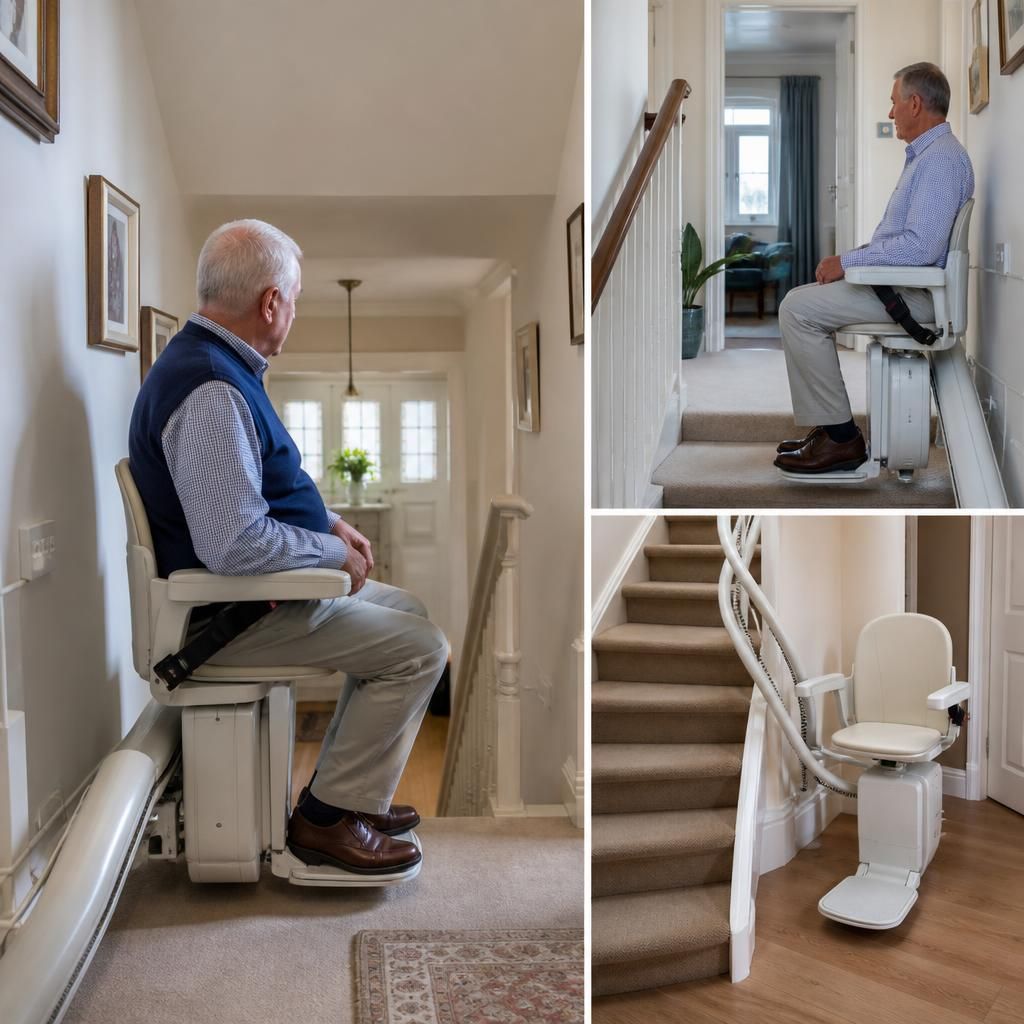
Compact stairlifts can accommodate homes with multiple flights by using separate lifts for each staircase, with safe transfer points on suitable landings, or a bespoke curved system that follows more than one flight where appropriate. A professional assessment determines the most practical arrangement, taking account of staircase shape, landing space, user mobility and the need to keep access routes clear.
Compact stairlifts accommodate homes with multiple flights by using a configuration suited to the layout: separate lifts on individual straight flights, a bespoke curved stairlift that follows changes in direction, or a combination of both. The most suitable arrangement depends on the staircase design, available landing space, the user’s mobility and whether they can safely transfer between flights.
There is no single solution for every multi-flight home. A professional assessment considers the complete route between floors rather than looking at each staircase in isolation. This includes the width and gradient of each flight, bends, intermediate landings, doorways, handrails, radiator positions and any areas where other household members need to pass. The aim is to provide reliable access while keeping stairs and landings usable for everyone.
Separate stairlifts for straight flights
Where the stairs consist of distinct straight flights with a suitable landing between them, fitting a separate compact stairlift to each flight can be a practical option. The user travels to the landing, parks the lift in a safe position and transfers to the next stairlift. This approach can be less intrusive than installing one continuous curved rail, particularly where the flights have different widths or angles.
Transfer points need careful planning. The landing must provide enough clear space for the user to get on and off safely without obstructing a doorway or creating a trip hazard. The direction in which each seat swivels, the position of the controls and the location of the parked lift are also considered. If transferring is difficult, a separate-lift arrangement may not be appropriate, even when the staircase itself could accommodate it.
One curved stairlift across several flights
A bespoke curved stairlift can be designed to follow a staircase that turns at landings or includes more complex changes in direction. Its rail is measured and manufactured to the individual staircase, allowing the lift to travel along a continuous route rather than requiring the user to change seats between flights.
This can be helpful for someone who has limited balance, strength or confidence when standing. It may also reduce the need to leave a lift at an intermediate landing. However, a curved system can require more planning and may occupy some of the landing or stair space when parked. The design therefore needs to balance ease of use with access for people who continue to use the stairs.
Combined layouts for complicated homes
Some properties need a combination of solutions. For example, a compact straight stairlift may serve a lower flight, while a curved lift is used around a tight turn or between upper floors. In another layout, separate lifts may be suitable for the main flights, with carefully selected parking positions to keep corridors and doorways clear.
Combining systems can be useful when the staircase changes significantly from one level to the next. It also allows each section to be matched to its specific surroundings rather than forcing one design to cover an unsuitable route. The assessment should consider how the user will move between lifts, whether assistance is available and what happens if a lift is parked at the opposite end of the staircase.
Landing space and parking positions
Compact equipment is intended to reduce obstruction, but it still needs a safe parking position. A lift may park at the top or bottom of a flight, on a landing or, where the design allows, in a position that keeps a doorway clear. The seat, footrest and armrests must not interfere with essential access routes, and the user should have sufficient room to approach and leave the lift.
On a multi-flight staircase, parking positions are particularly important because a poorly positioned lift can block the route to another flight. The installer may recommend powered or manual folding features, a seat that swivels at the end of the journey, or a rail layout that finishes in a more suitable location. These details should be agreed during the survey rather than treated as an afterthought.
Charging and everyday use
Each stairlift must be able to charge in its designated parking position. This is normally planned at one or both ends of the rail, depending on the model and installation. If a home has more than one lift, each unit needs its own charging arrangement and should be returned to its charging point after use in accordance with the manufacturer’s instructions.
Controls should be straightforward and positioned where the user can reach them comfortably. Remote controls can be useful when a lift has been left on another floor, although the user still needs a safe way to access the lift and transfer onto it. Where family members or carers assist with transfers, their access and working position should also be considered.
Safety between flights
Safety does not depend solely on the lift itself. The whole journey, including transfers, must be assessed. A stairlift should have appropriate safety features such as a secure seat belt, obstruction sensors, controlled starting and stopping, and a swivel seat or other arrangement that supports safe dismounting where required. The user should receive clear instructions on using the controls, belt, footrest and emergency features.
For homes with separate lifts, the transfer between flights is the main additional consideration. If the user cannot stand securely, turn, or move from one seat to another, a continuous curved system or a different access arrangement may be safer. The assessment should also identify potential hazards such as loose mats, narrow landing edges, poor lighting and doors opening into the transfer area.
When a multi-flight solution may need further consideration
A compact stairlift may not be the right answer if the staircase is exceptionally narrow, the landings cannot provide a safe transfer area, or the user’s condition makes transfers unsuitable. In these circumstances, the assessment may consider whether a different stairlift design, a powered transfer aid or an alternative route within the home would provide better access. The decision should be based on safe, consistent use rather than simply whether equipment can be physically installed.
As mobility needs can change, it is sensible to explain how the proposed arrangement would work on a difficult day, not only when the user is feeling well. Independent Stairlifts can assess the full staircase route and discuss whether separate compact lifts, a bespoke curved system or a combined layout is most appropriate. A properly planned installation can make several flights manageable without unnecessarily restricting the rest of the household’s use of the stairs.
In a home with multiple flights, compact stairlifts are usually arranged as separate lifts for straight sections, a continuous curved lift, or a combination of both. The right arrangement depends on the staircase layout and whether the user can transfer safely between flights.
Where separate lifts are used, each landing becomes an important transfer point. It must provide enough clear space to approach the next lift without blocking a doorway, narrowing the route or creating a trip hazard. Seat position, swivel direction, controls and parking locations should all be assessed together.
A continuous curved stairlift can avoid transfers by following bends and intermediate landings. This may be more suitable when standing, turning or moving between seats is difficult, although the rail and parked seat still need to leave essential access routes usable. A full survey of every flight helps identify the safest and most practical configuration.
Arrange a Multi-Flight Stairlift Assessment
Arrange a full multi-flight stairlift assessment with Independent Stairlifts to compare separate, curved or combined solutions for your home. We will review the complete route, transfer points and available space before recommending a practical configuration.