
Are compact stairlifts suitable for both straight and curved staircases?
Compact stairlifts can be suitable for both straight and curved staircases, but they use different rail systems. Straight models are generally more standardised, while curved stairlifts require a bespoke rail designed around each bend, landing and change of direction, so a home assessment is essential to confirm the most space-efficient option.
Compact stairlifts can be suitable for both straight and curved staircases, but they are not the same type of installation. A straight compact stairlift runs along a continuous rail, while a curved compact stairlift uses a made-to-measure rail shaped around bends, landings and changes in direction. The most suitable option depends on the staircase layout, available clearance and the user’s mobility needs.
Compact stairlifts for straight staircases
A straight stairlift is normally the simplest and most space-efficient choice where the stairs run in one uninterrupted line. Its rail is installed parallel to the steps and is usually designed to keep the stairway usable for other household members. A compact model may have a slim seat, narrow chassis and folding armrests, footrest and seat, helping to reduce its parked footprint.
Straight stairlifts can work well in homes where the staircase is narrow, provided there is enough room for the user, the moving chair and safe access at the top and bottom. The position of the rail, the width of the steps and the available space at each end all need to be considered. A stairlift may need to park at the top or bottom, or use a hinged or alternative rail arrangement, where a doorway, radiator or narrow landing affects access.
A staircase with a bend, intermediate landing or change in direction usually cannot be served by a standard straight rail throughout. In these situations, a curved stairlift or a combination of stairlift arrangements may be considered. The exact solution depends on whether the separate flights can be used safely and conveniently without creating a difficult transfer between them.
Compact stairlifts for curved staircases
Curved stairlifts are made for staircases with corners, half-landings, bends, multiple flights or unusual geometry. The rail is measured and manufactured to follow the actual route of the stairs. This allows the stairlift to travel continuously around the curve rather than stopping at a landing and requiring the user to change seats.
A curved stairlift can be compact, but its space-saving performance depends on the design of the rail and the position of the parked stairlift. The rail may be routed close to the inside or outside of a bend, depending on the staircase and the clearance required. A powered swivel seat, folding components or a suitable parking position can also help with transfers and keep access routes clearer when the stairlift is not in use.
Curved systems are generally more individually designed than straight systems. The assessment needs to account for the shape and width of every section of the staircase, the position of handrails and doors, headroom, landing space and any obstructions. The installer should also check where the user will get on and off, as a technically suitable rail is not sufficient if the transfer points are awkward or unsafe.
What determines whether a compact model will fit?
- Staircase width: The available width must accommodate the stairlift while leaving a practical route for other people where possible.
- Clearance around bends: Curves and landings need sufficient space for the chair, footrest and user’s knees to pass safely.
- Landing space: The top and bottom of the stairs must provide a stable area for boarding and leaving the stairlift.
- Obstructions: Doors, radiators, newel posts, bannisters and wall features can influence the rail route and parking position.
- User requirements: Seat width, weight capacity, armrest position, swivel operation and control type should match the user’s abilities.
- Everyday access: The installation should preserve access to rooms, cupboards and doorways rather than simply fitting within the stairwell.
A compact stairlift is not necessarily the smallest possible chair in every home. A narrower design may save space but could be less comfortable or harder to use for someone who needs more support when sitting down or standing up. The correct balance is between the physical dimensions of the equipment and the user’s ability to transfer, sit securely and operate the controls.
Why a home assessment is important
Photographs or general measurements can indicate whether a staircase may be suitable, but they cannot confirm the best rail route. An in-home assessment allows the installer to examine the complete staircase, measure clearances and discuss how the stairlift will be used. It should also identify whether the user needs a powered swivel, a different control arrangement, a specific parking position or additional support when boarding.
The assessment is particularly important for curved staircases because small changes in the angle or position of the rail can affect clearance, comfort and access. For straight staircases, it helps confirm whether a standard rail is appropriate or whether the landing, door position or another obstruction calls for a different configuration.
In summary, compact stairlifts can serve both straight and curved staircases. Straight models are usually appropriate for a continuous flight and offer a relatively straightforward, space-conscious installation. Curved models are suitable for more complex layouts and use a bespoke rail to follow the staircase. The best choice should be based on the staircase measurements, the available parking and transfer space, and the individual user’s mobility rather than on the stairlift’s compact dimensions alone.
Whether a compact stairlift is suitable depends on the staircase layout, not simply the available stair width. Straight staircases usually allow a slimmer, standard rail, while curved staircases require a bespoke rail that follows each bend, landing and change of direction.
A home assessment checks whether the stairlift can travel safely while preserving practical access for other household members. It also considers:
- clearance around bends, handrails and obstructions;
- space for safe boarding and leaving at the top and bottom;
- the most suitable parking position when the stairlift is not in use; and
- whether the user needs features such as a powered swivel seat or folding components.
This assessment is particularly important on curved stairs, where a small change in rail position can affect knee clearance, comfort and access. A compact design should reduce the stairlift’s footprint without compromising the user’s ability to sit, transfer and travel securely.
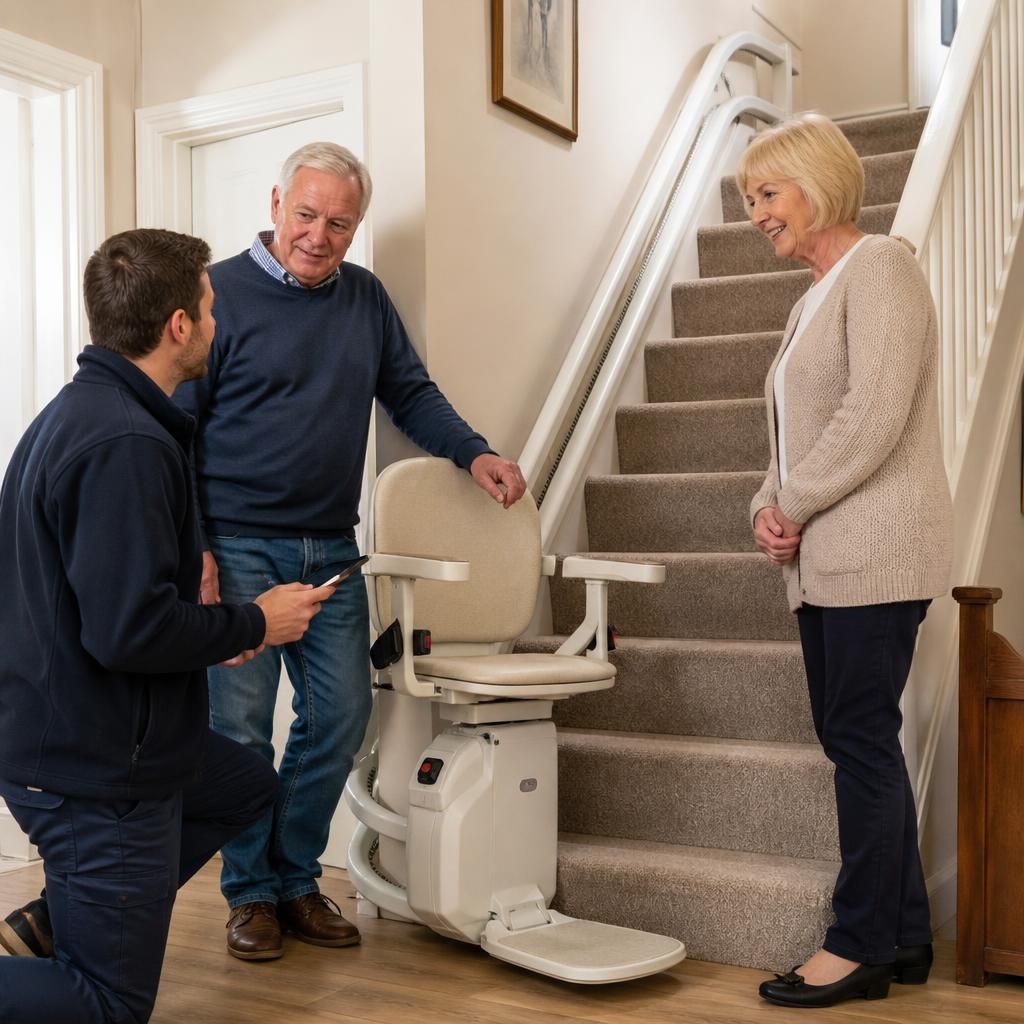
Arrange a home assessment for your staircase
Arrange a home assessment for your staircase so we can confirm whether a compact straight or curved stairlift is suitable and identify the safest, most practical configuration.