
What specific features should I look for in a stairlift designed for spiral or complex staircases?
Look for a stairlift with a bespoke rail accurately shaped to the spiral or complex staircase, together with a compact carriage, powered swivel seat and adjustable controls that suit the available space and the user. Essential safety features include obstruction sensors, secure seat-belt systems, reliable braking, battery backup and easy-to-use emergency controls, all confirmed through an individual home assessment.
The most important features for a stairlift on a spiral or complex staircase are a bespoke rail, a compact carriage and controls that allow safe movement through every change of direction. The lift should also provide a secure seating position, dependable obstruction detection, effective braking, battery backup and suitable access at the top and bottom of the stairs. These features must be selected after an accurate survey, because a standard straight or conventional curved stairlift may not suit the staircase geometry.
Bespoke rail design
A complex staircase rarely follows a simple curve. It may include tight turns, changing gradients, narrow treads, intermediate landings, unusual wall lines or limited headroom. The rail should therefore be measured and manufactured to follow the actual staircase rather than adapted from a standard layout. A well-designed rail keeps the carriage stable through bends and positions the user safely at the correct approach and exit points.
Ask how the proposed rail will deal with:
- Spiral or changing-radius turns
- Transitions between straight sections and curves
- Restricted space beside the stairs
- Low ceilings, doorways and landings
- Safe parking without blocking circulation or access routes
In some homes, the rail may need to sit close to the treads, wall or balustrade. The installer should explain the clearance requirements and confirm that the design will not interfere with doors, handrails or other household activities.
Compact carriage and suitable seat position
A compact carriage is particularly useful where the staircase is narrow or turns into a confined landing. The lift should occupy as little usable space as possible while still providing a stable riding position. A slimline design may help preserve access for other people, but it must not compromise the user’s support or the safe operation of the footrest.
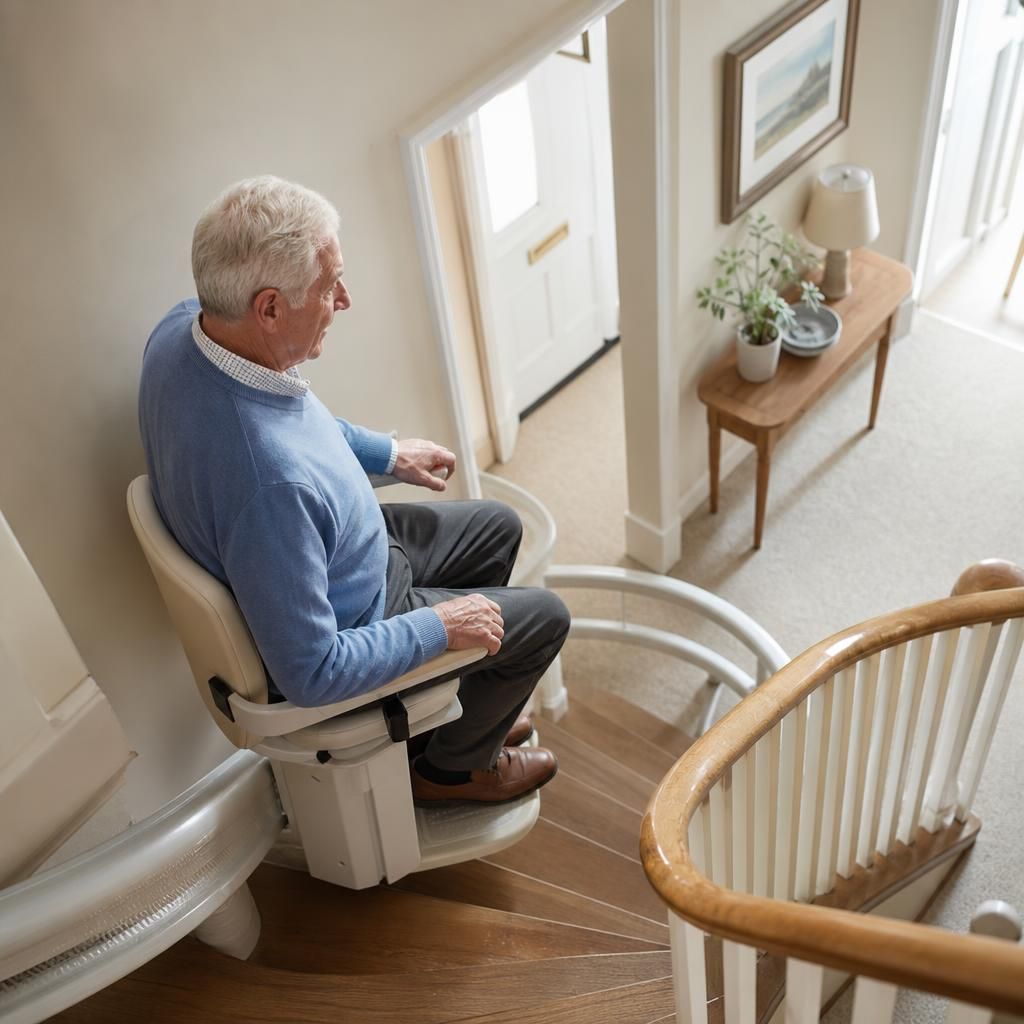
Look for a seat that can be adjusted to suit the user’s height and posture. A powered swivel seat is often valuable on a complex staircase because it turns the user towards the landing before getting off, reducing the need to twist while stepping away from the lift. Where space is restricted, a powered or manually folding seat, armrests and footrest can help the lift park neatly when it is not in use.
Safe entry and exit arrangements
The entry and exit position should be considered as carefully as the journey itself. Depending on the staircase, the most suitable arrangement may involve a straight-on exit, a swivel towards the landing or a different parking position. The seat should lock securely during travel and remain stable while the user is getting on or off.
Check whether the design provides:
- A level or practical boarding position
- Clearly defined armrests and a supportive backrest
- A seat belt that is easy to fasten and release
- Controls that can be reached without leaning or twisting
- A footrest that supports the feet throughout the journey
If the user has limited strength, balance or dexterity, these details can be more important than the appearance of the lift. They should be tested during the home assessment rather than judged from photographs or specifications alone.
Controls suited to the user and the staircase
The operating control should be simple, clearly marked and positioned where the user can use it comfortably. A control on the armrest is commonly convenient, while remote controls can allow the lift to be called to another level when more than one person uses the staircase. Controls should not require excessive pressure or complicated sequences.
For a spiral or complex installation, the user should be shown how to start, stop and resume the lift safely, how to use the swivel mechanism and what to do if the lift stops unexpectedly. If more than one control is supplied, each should be clearly identified and kept in an accessible location.
Obstruction detection and braking
Obstruction sensors should stop the lift if the carriage, footrest or another protected part of the system encounters an object on the rail or stairs. This is especially important on complicated layouts, where a bend or landing can make hazards less visible to the person using the lift. Sensors should be checked during the demonstration, and the user should understand that the stairs must still be kept clear.
The stairlift should also have a controlled braking system that brings the carriage to a smooth stop if the control is released or a fault is detected. It should remain stable when parked and should not move until the relevant safety conditions have been met, such as the seat and swivel being correctly positioned.
Battery backup and charging
A rechargeable battery system allows the lift to continue operating for a period during a mains power interruption, provided it has been adequately charged. Charging points should be positioned where the lift can park reliably at the top or bottom of the staircase. On a complex rail, it is important to confirm that the carriage can reach its charging position and that routine parking is convenient for the user.
Ask how the lift indicates a low battery, what happens if it is parked away from a charging point and how charging contacts are maintained. Battery backup is a safety and reliability feature, but it does not remove the need for regular servicing or for keeping the lift connected to its power supply as instructed.
Emergency features and fault information
Useful emergency features can include an accessible stop control, an audible or visual fault indication, manual release arrangements and a telephone or communication option where appropriate. The exact equipment varies by model and installation. The user and anyone providing care should receive clear instructions for responding to a stopped lift, including when to remain seated, when it is safe to leave the carriage and whom to contact.
Ask whether the system records or displays fault information. Clear diagnostics can help a service engineer identify a problem without unnecessary delay. The installer should also explain the arrangements for routine maintenance, battery checks and call-outs.
Weight capacity, comfort and adaptability
The lift must be rated for the user’s weight and any clothing or items carried during normal use. The seat, belt, armrests and footrest should provide support without making boarding or leaving difficult. If the user’s mobility may change, discuss whether the seat, controls or transfer arrangement can be adjusted later.
Other useful options may include a powered footrest, a higher or more supportive seat, weather protection for an outdoor section, or controls that can be operated with reduced hand strength. Features should be selected for a clear practical reason; adding equipment that the user cannot comfortably operate may make the lift less suitable.
What to confirm during the assessment
Before approving a design, ask the surveyor to demonstrate the proposed route or explain it using the measurements and layout of the staircase. Confirm the rail route, parking positions, clearances, seat orientation, control locations, charging points and emergency procedure. The assessment should also consider other household users, pets, doors, handrails and any future changes to the surrounding space.
For a spiral or complex staircase, the best specification is the one that combines accurate rail geometry with safe, comfortable operation for the individual user. A bespoke assessment should establish which features are necessary, which are optional and how the completed installation will be used and maintained in the home.
For a spiral or complex staircase, the most important feature is a bespoke rail that follows the staircase accurately through every curve, change of gradient and restricted section. This keeps the carriage stable and places the seat in a predictable position throughout the journey.
A powered swivel seat can then turn towards the landing before the user gets off, reducing twisting where space is limited. The design should also provide a secure seat belt, supportive armrests, an accessible control and a footrest that folds or parks without obstructing the stairs. These features should be confirmed during an individual assessment, as the safest arrangement depends on the staircase layout and the user’s mobility.
Arrange a Bespoke Stairlift Assessment
Arrange a bespoke stairlift assessment with Independent Stairlifts to confirm which rail, seating and safety features suit your spiral or complex staircase.