
What features should I look for in a stairlift for spiral staircases?
For a spiral staircase, look for a stairlift with a bespoke rail shaped to the exact curves, gradients and landing positions of your stairs. Essential features include reliable safety sensors, a secure swivel seat and seat belt, compact folding components, easy-to-use controls and suitable battery backup, all confirmed through a professional assessment.
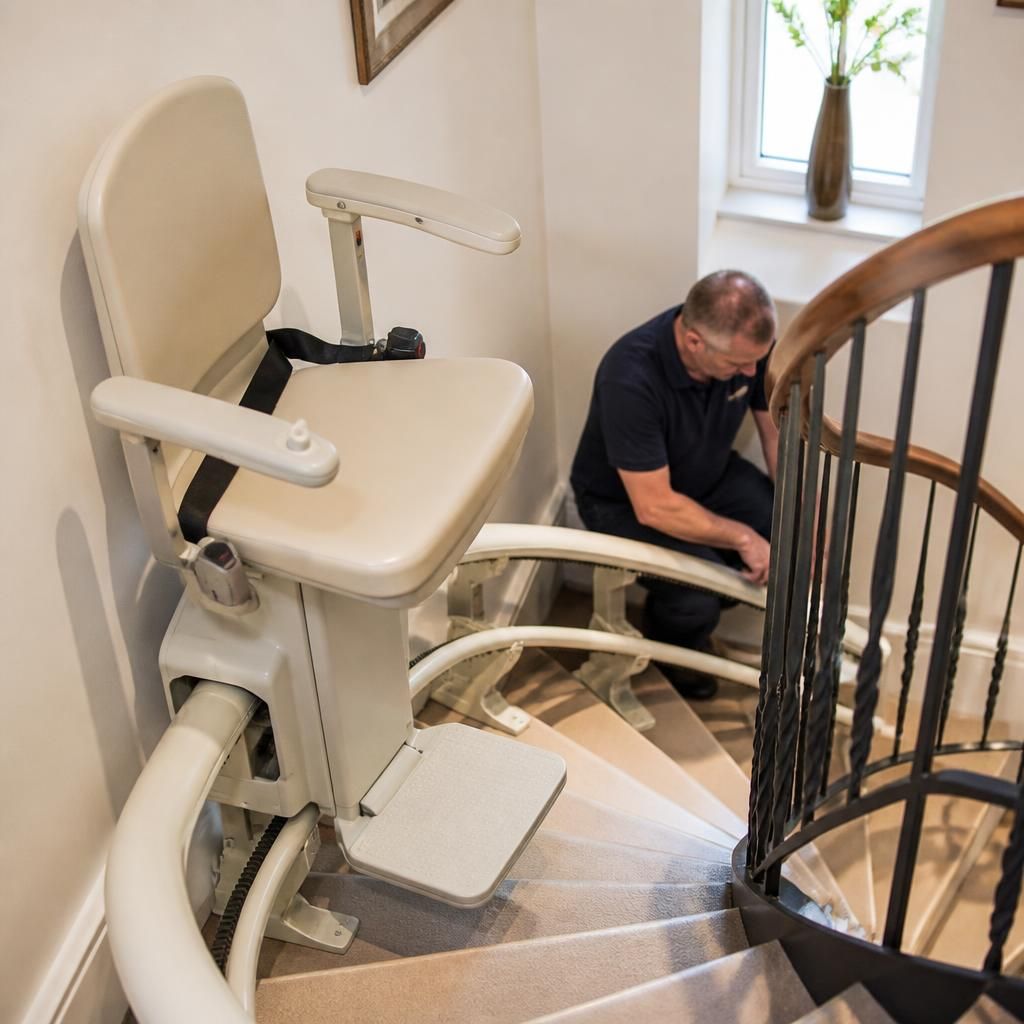
The most important feature of a stairlift for a spiral staircase is a bespoke rail manufactured to follow the staircase accurately. Unlike a standard straight stairlift, it must accommodate changing gradients, tight curves, variable tread widths, landings and the available clearance around the stairs. The rail design, together with appropriate safety, seating, control and charging features, should be confirmed during a professional home assessment.
When comparing options, look for the following features:
- A made-to-measure curved rail: The rail should be designed around the precise shape of your staircase rather than selected from a standard length. On a spiral or complex staircase, this may involve several curves, changes in inclination and carefully planned parking positions. Accurate measurement helps the lift travel smoothly while preserving usable access on the stairs and at the landings.
- A compact folded profile: Space is often restricted on spiral staircases, particularly where the stairs are narrow or located close to a wall, doorway or another flight. A seat, footrest and armrests that fold away can reduce obstruction when the lift is parked. The folded dimensions should be checked at the narrowest points of the staircase, not just at the top and bottom.
- Safety sensors and obstruction detection: Sensors beneath the footrest and around the carriage should stop the stairlift if it encounters an object on the rail or stairs. This is particularly important on a spiral staircase, where visibility can be limited around bends. Ask how the sensors operate and whether the lift stops smoothly when an obstruction is detected.
- A secure swivel seat: A powered or manually operated swivel seat can help you turn towards the landing before getting off. This reduces the need to twist on a confined step. The seat should lock securely in the travel position and provide suitable support for your posture and mobility needs.
- An adjustable seat and armrests: Look for a seat height, width and armrest arrangement that can be adapted to the user. A correctly positioned seat helps maintain balance during travel and makes getting on and off easier. The footrest should also provide stable support without creating unnecessary obstruction on the staircase.
- A reliable seat belt: A comfortable, easy-to-operate belt should hold the user securely throughout the journey. If dexterity is limited, the buckle and release mechanism need to be simple to use without requiring excessive hand strength.
- Simple, accessible controls: Controls on the armrest should be clearly marked and usable with limited grip or movement. A remote control can allow a family member to call or send the stairlift when appropriate, although it should not replace the user’s own ability to operate it safely. Controls should be positioned so they cannot be pressed accidentally during transfer.
- Appropriate speed control: The stairlift should maintain a controlled, comfortable speed through bends and changes in gradient. Smooth acceleration, deceleration and cornering are more important than travelling quickly, particularly on a staircase where the user may feel movement more noticeably.
- Battery operation with dependable charging: Battery-powered operation allows the lift to complete a journey during a mains power interruption, provided the batteries are adequately charged and maintained. Charging points should be positioned at practical parking locations, and the user should understand how to leave the lift charging after use. Ask what warning is given when the battery needs attention and how emergency operation is managed.
- Emergency safety functions: Useful safeguards can include an emergency stop control, diagnostic indicators, manual lowering or recovery procedures and an alarm or communication option, depending on the design. Your installer should explain what to do if the lift stops between floors and provide clear instructions for contacting support.
- Suitable weight rating and construction: The stairlift must be rated for the intended user’s weight and supplied with components appropriate to the rail design. This should be assessed alongside posture, transfers and any equipment the user may carry, rather than considered as a separate specification alone.
Comfort and practicality also depend on the parking arrangement. The lift may need to park at the top or bottom, or on a landing, without blocking a doorway or reducing access to another room. A hinged rail, powered swivel or other space-saving arrangement may be worth considering where the rail could interfere with a door or walkway. These options are only suitable when the staircase and surrounding layout provide enough clearance.
For an outdoor or partly exposed spiral staircase, materials, covers, seals and charging arrangements should be suitable for the environment. An indoor lift should not be assumed to be appropriate outside. The installer should also consider lighting, damp, temperature and safe access to the charging point.
Finally, check the maintenance requirements before choosing a system. Ask how often the rail, drive unit, batteries, sensors and safety belt should be inspected, what signs indicate a fault, and what support is available if the lift stops operating. A detailed assessment should confirm whether the staircase can safely accommodate a stairlift, which features are genuinely needed and how the proposed rail will affect everyday access. Bespoke design is important, but the best solution is the one that combines accurate fitting with safe transfers, straightforward controls and practical use of the whole staircase.
A bespoke rail is the most important feature of a stairlift for a spiral staircase. It is measured and manufactured to follow the staircase’s curves, changing gradients, tread widths and landing positions, rather than relying on a standard straight section.
Accurate rail design helps the stairlift travel smoothly while keeping the staircase usable for other people. During the assessment, the installer should also identify a practical parking position and check clearances around doorways, landings and narrow sections. A compact folded seat, footrest and armrests can reduce obstruction when the lift is not in use.
Ask to see how the proposed rail will fit at the tightest points, not just at the top and bottom. The final design should balance smooth movement, safe transfers and everyday access throughout the staircase.
Arrange a Professional Spiral Stairlift Assessment
Arrange a professional spiral stairlift assessment with Independent Stairlifts to confirm which features your staircase and mobility needs require. We will assess the available space, rail design, parking position and safe operation before recommending a suitable solution.