
What factors should I consider regarding the maintenance requirements of spiral stairlifts?
Spiral stairlifts require regular professional servicing because their bespoke curved rails, drive systems and safety components must remain correctly aligned and adjusted. Follow the manufacturer’s maintenance schedule, arrange safety checks, keep the rail and sensors clear, monitor battery performance, and report unusual noises, movement or stopping without delay.
Maintenance for a spiral stairlift centres on keeping its bespoke curved rail, drive system, batteries and safety components correctly aligned, adjusted and clean. Because every spiral staircase has its own radius, gradients and clearances, the lift should be serviced in line with the manufacturer’s instructions and checked by a suitably qualified stairlift engineer rather than treated like a standard straight-rail model.
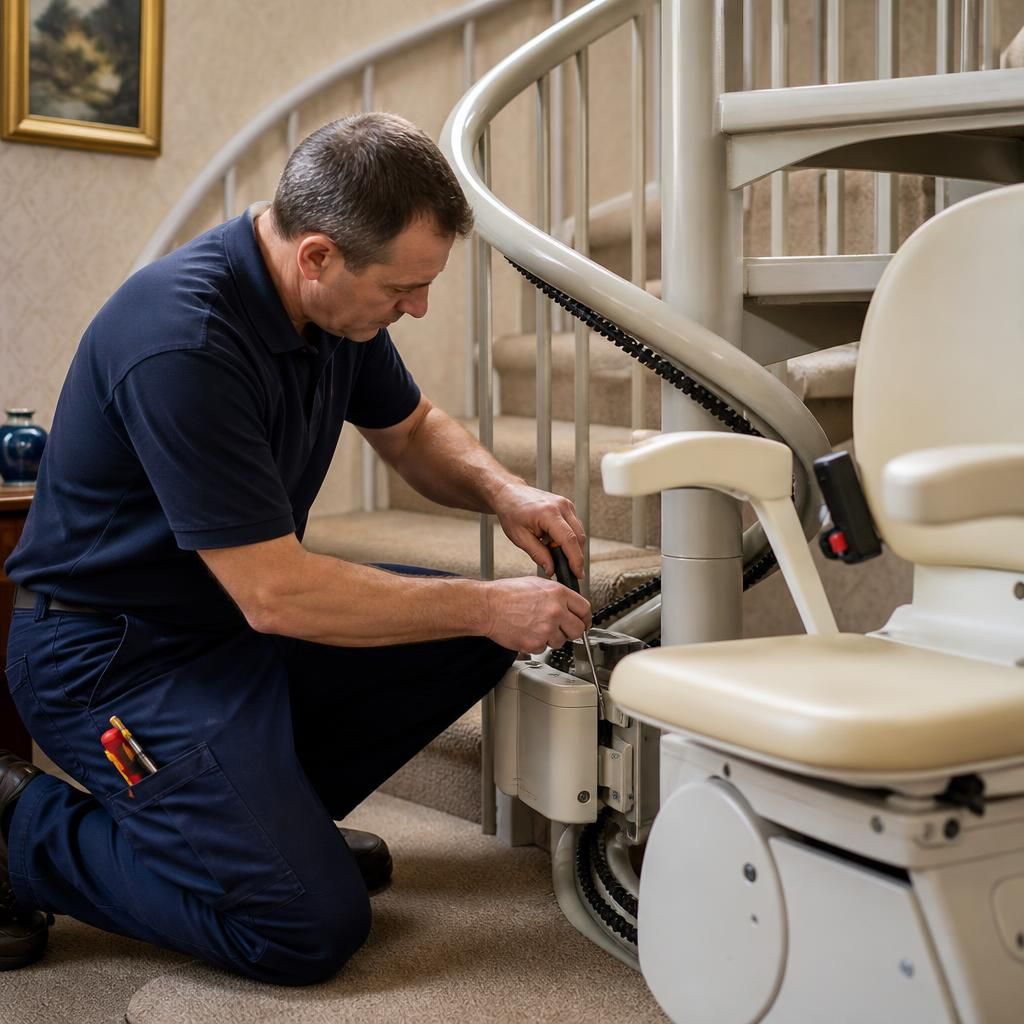
A professional service should normally include an inspection of the complete installation. The engineer will check the rail fixings, joints, brackets and movement of the carriage around each curve, as well as the drive mechanism, rollers and other moving parts. They may make adjustments or apply the specified lubrication where appropriate. Not every component should be lubricated by the user, since unsuitable products can attract dirt or affect the drive system.
Safety equipment requires particular attention on a spiral stairlift. Checks may include the seat swivel and locking mechanism, armrests, footrest, seat belt, safety edges, sensors, control switches and the emergency stop or lowering controls. The lift should stop when a safety edge detects an obstruction, and the seat should remain secure while travelling and when it is positioned for mounting or dismounting. Any change in these functions should be reported promptly.
Battery condition is another important maintenance consideration. Most indoor stairlifts use rechargeable batteries and remain on their charging points when parked. Keep the charging contacts and parking area clear, and follow the manufacturer’s instructions if the lift is not going to be used for an extended period. A service engineer can test battery performance and charging output. A lift that travels more slowly, stops before reaching the top or bottom, or repeatedly reports a low battery may need attention rather than simply a battery replacement.
There are several simple checks you can make between services:
- Keep the rail, steps, sensors and charging points free from dust, clothing, pet hair and other obstructions.
- Check that the seat, belt, armrests and footrest operate normally before use.
- Make sure the lift follows its usual route smoothly, without hesitation, jolting or unusual vibration.
- Listen for new grinding, squeaking, clicking or straining noises.
- Check that the carriage stops correctly at the charging points and that the controls respond as expected.
Do not attempt to dismantle the carriage, alter the rail, bypass a safety sensor or investigate electrical components yourself. Spiral stairlift installations have carefully set clearances, and an adjustment that appears minor can affect alignment, braking or obstruction detection. If the lift stops unexpectedly, isolate it according to the user instructions, keep the staircase clear and contact the service team for advice. Do not force the carriage to move.
Usage and the position of the lift can affect the maintenance needed. Frequent journeys, heavy household traffic around the staircase, dust and pet hair may increase cleaning and inspection requirements. An outdoor spiral stairlift is exposed to rain, damp, temperature changes and dirt, so its covers, seals, charging equipment, rail and corrosion protection need specific checks. Outdoor equipment should be maintained with the products and methods approved for that installation.
Keep the service records, installation information and operating instructions available. Tell the engineer about any previous fault, unusual noise, missed charge, emergency stop or change in the way the lift travels. This information can help identify a developing issue before it causes a breakdown. If the stairlift is shared by several people, make sure everyone knows the basic operating and safety instructions and understands that the seat belt and other safety features must not be overridden.
The correct servicing interval depends on the stairlift model, installation, level of use and manufacturer’s recommendations. A bespoke spiral rail should not be adjusted by an engineer who has not assessed its design and fixing arrangement. At each service, ask what has been checked, whether any wear has been identified, when the next service is due and whether any parts need planned replacement.
Prompt reporting is particularly important if the lift does not start reliably, loses power, stops on a curve, moves unevenly, fails to charge, produces a new noise or shows a warning indication. Early attention can help protect the rail and drive components, maintain the operation of the safety systems and reduce the risk of being left without access between floors.
Professional servicing is the most important maintenance requirement for a spiral stairlift because its curved rail and drive system are made to follow the specific shape of the staircase. During a service, a qualified engineer can inspect the rail fixings, carriage, rollers, drive mechanism, seat and safety controls, while checking that the lift travels smoothly around every curve.
Do not adjust the rail, bypass a sensor or apply lubricant unless the manufacturer’s instructions specifically allow it. Keep to the recommended servicing schedule and tell the engineer about any new noise, hesitation, uneven movement, charging problem or unexpected stop. Early reporting can help identify wear or an alignment issue before it affects the stairlift’s safe operation.
Need Advice on Spiral Stairlift Maintenance?
If you need advice about servicing, fault symptoms or the maintenance requirements of your spiral stairlift, contact our team for practical guidance based on your installation.