
What are the main differences between spiral stairlifts and standard stairlifts?
Spiral stairlifts are bespoke systems designed to follow curved, winding or unusually narrow staircases, while standard stairlifts usually run along a straight rail on a conventional staircase. The main differences are the rail design, space requirements, installation process, travel comfort and cost, with spiral models requiring a detailed survey and more individualised fitting.
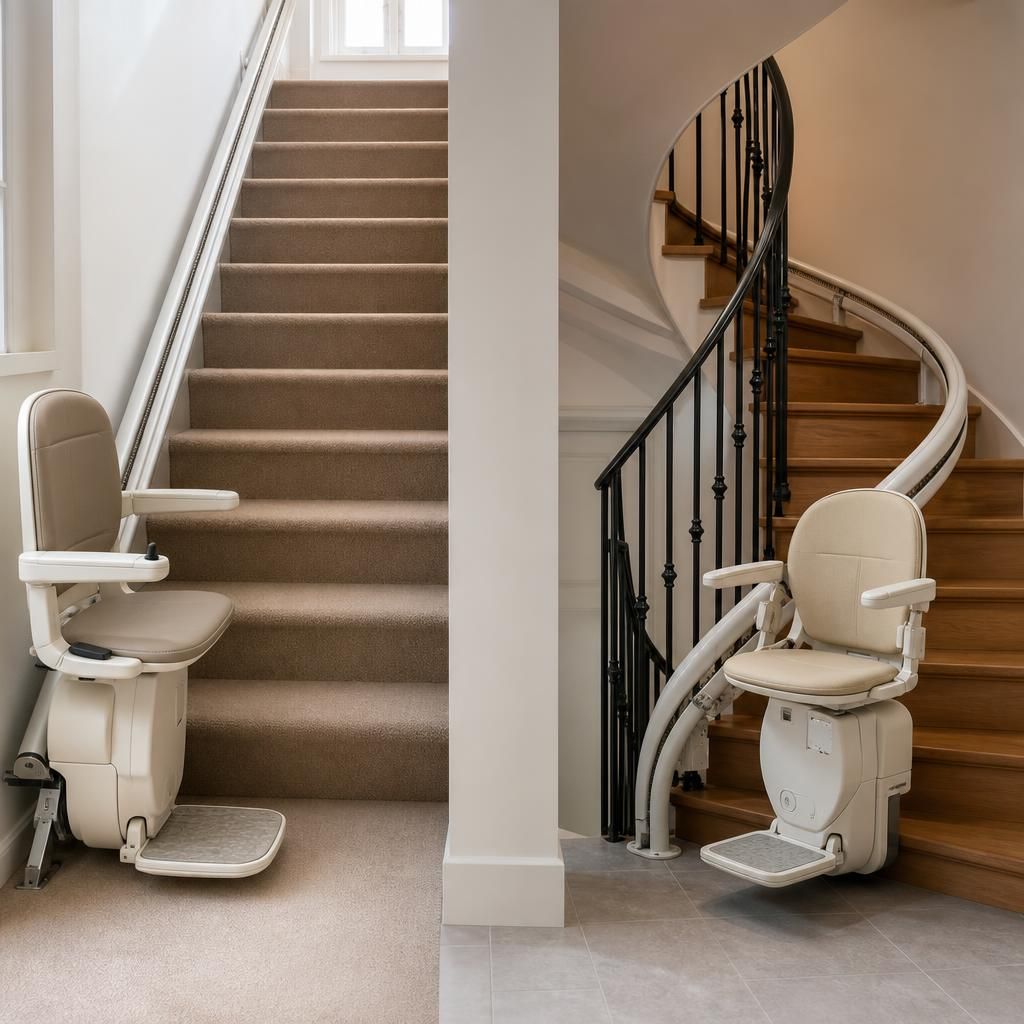
The main difference is that a standard stairlift is usually built for a straight staircase with a simple, continuous rail, whereas a spiral stairlift is designed around a curved, winding or otherwise complex staircase. A spiral system normally requires a bespoke rail, a more detailed survey and more involved installation. These differences affect the space available, the way the lift travels, the fitting process, cost and the range of suitable safety features.
Rail design and staircase shape
A standard stairlift generally travels along a straight rail fixed to the stair treads. It is suitable where the staircase has a consistent line and does not include landings, bends or changes of direction. Depending on the layout, a straight stairlift may be installed relatively quickly once the stairway has been assessed.
A spiral or complex stairlift uses a rail manufactured to follow the individual staircase. The rail may need to curve around a central newel, follow a tight bend, pass a landing or accommodate changes in gradient. On some staircases, the route is not a true spiral but is still too narrow, steep, irregular or multi-directional for a standard system. In these cases, the design must take account of the full route rather than treating the stairs as a single straight flight.
Survey and design requirements
A straight staircase is usually easier to assess because the installer mainly needs to consider the stair width, available headroom, the position of the top and bottom landings and the location of nearby doors or obstacles. A complex staircase needs a more detailed survey. The surveyor will assess each curve, the width of the stairs, clearances at bends, the position of handrails and radiators, landing space, overhead obstructions and how the user will get on and off the lift.
Measurements are particularly important on spiral stairs because a small change in the rail position can affect the space available for the user, other people using the stairs and anyone assisting them. The proposed travel path should also be checked with the user’s posture, mobility and likely chair dimensions in mind.
Space and access
Standard stairlifts are often suitable for conventional domestic staircases, but the stairway still needs enough room for the chair and the user. A narrow staircase may require a slimline seat, a folding design or careful positioning of the rail. The lift should not be assessed only when the chair is parked; clearances need to be considered throughout the journey.
Spiral staircases can be more restrictive. Their inner edge may be tight, the outer edge may curve away from the landing and the available space can change continuously as the lift moves. A bespoke rail and suitable seat configuration can help use the available space, but not every spiral staircase can accommodate a stairlift. In some properties, an alternative access arrangement or a different mobility solution may need to be considered.
Travel comfort and operation
On a straight staircase, the lift normally follows a predictable path at a consistent orientation. This can make it straightforward for the user to board, travel and leave the chair at the upper or lower landing.
On a spiral or curved staircase, the chair may need to rotate as it follows the rail. The direction and degree of rotation depend on the staircase and the design of the lift. A swivel seat, adjustable footrest, supportive armrests and a suitable seat belt can be important, particularly where the user has reduced balance or difficulty turning at the top or bottom of the stairs. Controls should be positioned so they can be operated comfortably without leaning or twisting.
Comfort is not determined by the rail alone. The user’s height, weight, hip and knee movement, ability to transfer and preferred seating position should all be considered. A practical assessment is the best way to confirm whether the proposed seat and travel position are suitable.
Installation process
A standard stairlift normally involves installing the rail to the stair treads, assembling the chair, connecting the charging points and testing the system. The installation team will also check that the lift travels correctly and that the user can operate it safely.
A spiral stairlift involves more individualised preparation. The rail may be produced from detailed measurements or digital information gathered during the survey, then checked against the staircase during fitting. Installation can involve more careful alignment, additional sections or joints and closer attention to clearances at curves and landings. The exact duration depends on the complexity of the staircase, the rail design and any preparatory work required. The installer should explain the process and any practical arrangements before work begins.
Cost
Standard stairlifts are generally less expensive because the rail design is simpler and more easily adapted to a straight flight. A spiral stairlift usually costs more because its rail is bespoke and the survey, design, manufacture and installation require additional work. The final price will depend on the staircase layout, the number and tightness of curves, the chosen seat and controls, installation conditions and any optional features.
A quotation should be based on a proper assessment rather than on the staircase description alone. Asking for a clear breakdown can help you understand which elements relate to the bespoke rail, the equipment and the installation.
Safety considerations
Both types of stairlift should include essential safety systems such as obstruction sensors, a seat belt, braking control, secure armrests and a reliable charging system. The lift should stop if an obstruction is detected and should be tested at the points where the user boards and leaves the chair.
Spiral installations require additional attention to movement around bends. The rail position, chair rotation, footrest clearance and stopping points must be checked so that the user remains stable and does not come into contact with the stairs, walls or nearby fixtures. Folding components can help preserve access when the lift is not in use, but they must be easy for the user or carer to operate.
Safety also includes the people sharing the staircase. The fitted lift should leave a practical route for others where possible, and the user should be shown how to park the chair, use the controls, respond to an obstruction and deal with a power interruption.
Maintenance and long-term use
Both standard and spiral stairlifts need routine care, including keeping the rail and sensors clear, charging the batteries correctly and arranging servicing when recommended. A spiral stairlift has more individualised rail geometry, so its condition and alignment should be checked carefully during maintenance. Any unusual noise, hesitation, changes in speed or difficulty at a bend should be reported rather than ignored.
Future needs are also relevant. If the user’s mobility changes, features such as powered swivelling, a powered footrest, different control positions or a more supportive seat may become useful. A bespoke design can be adapted to the staircase, but the available options depend on the original installation and the space around it.
Which type is suitable?
A standard stairlift is usually the appropriate option for a straight, accessible staircase where the user can comfortably board and leave the chair at the landings. A spiral stairlift may be appropriate where the staircase curves, winds around a central point, changes direction or includes other features that prevent a straight rail from following the route.
The correct choice cannot be confirmed from photographs or the staircase name alone. A professional survey should consider:
- the complete shape, width and gradient of the staircase;
- clearance around bends, landings, doors and other fixtures;
- where the chair can be parked without obstructing access;
- the user’s balance, posture, transfer ability and likely future needs;
- the seat, controls and safety features required; and
- the practical requirements for installation, servicing and emergency use.
In summary, a standard stairlift is a simpler solution for a straight flight, while a spiral stairlift is a tailored system for a more demanding route. The additional design and installation work can provide access where a standard lift would not fit, but suitability, comfort and safety should always be confirmed through an individual assessment of the staircase and the person using it.
The main difference between a spiral stairlift and a standard stairlift is how the rail fits the staircase. A standard stairlift normally follows a straight line, while a spiral stairlift uses a bespoke rail shaped to follow curves, changes in direction and variations in width.
This makes the survey particularly important. The installer must assess the complete route, including:
- clearance around the inner and outer edges of the staircase;
- the position of handrails, walls, doors and other fixtures;
- where the chair can park safely at the top and bottom; and
- whether the user can board, travel and leave the seat comfortably.
A bespoke rail can make use of difficult stair space, but it cannot make every staircase suitable. The proposed design should be checked with the user seated in the lift, so that comfort, stability and access for other people using the stairs are considered before installation.
Arrange a survey for your staircase
Arrange a professional survey to confirm whether your spiral or complex staircase can accommodate a stairlift and identify the most suitable design. Our assessment will consider the staircase layout, available clearances and your individual access needs.