
What types of stairlifts are compatible with spiral and awkward staircases?
Spiral and awkward staircases are generally compatible with bespoke curved stairlifts, which use a made-to-measure rail shaped around bends, landings and unusual angles. Depending on the setting, an outdoor-rated model or a carefully configured modular curved system may also be suitable, following an on-site assessment.
Spiral and awkward staircases are usually compatible with a bespoke curved stairlift rather than a standard straight model. A curved stairlift has a made-to-measure rail that follows the staircase’s bends, curves, landings and changes in angle. Depending on the staircase and its location, a compact seated model, standing or perch stairlift, outdoor-rated system or specially configured modular solution may also be suitable.
The correct type depends on more than the overall shape of the stairs. The available width, direction and tightness of each curve, headroom, landing space, fixing surfaces and the user’s mobility all affect the design. An on-site assessment is therefore needed before confirming which stairlift can be installed safely and comfortably.
Bespoke curved stairlifts
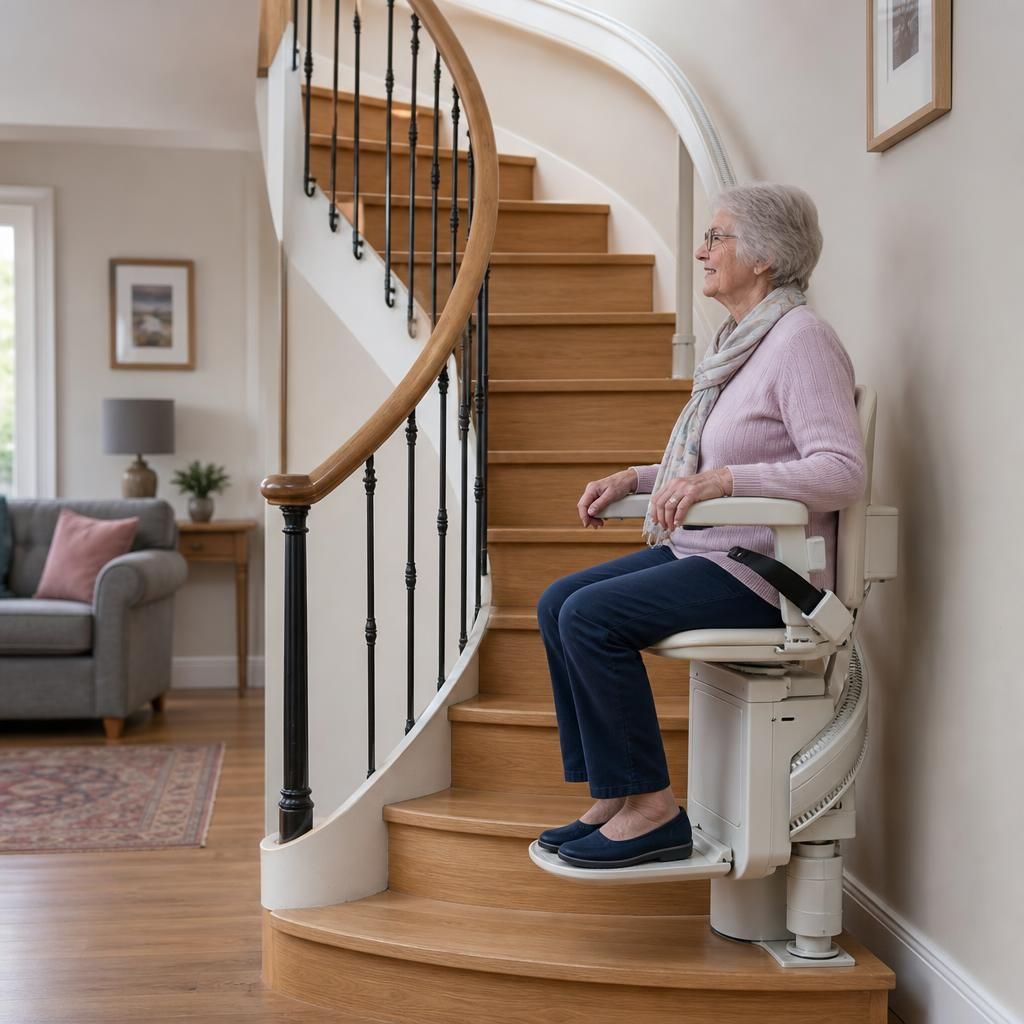
A bespoke curved stairlift is generally the most appropriate option for a spiral or unusually shaped staircase. Its rail is measured and manufactured to follow the individual staircase, rather than being selected from a standard straight length. This allows the stairlift to travel around:
- Continuous spiral curves
- Tight internal or external corners
- Intermediate landings
- Changes in gradient or stair direction
- Uneven, narrow or non-standard stair layouts
The rail can often be designed to park at the top, bottom or another suitable position, helping to keep access clear. Where space is restricted, the installer may also consider a close-fitting rail, a compact seat and folding components to reduce obstruction when the stairlift is not in use.
Compact or perch stairlifts
A seated curved stairlift is not suitable for everyone or every staircase. If the stairs are particularly narrow, a standing or perch stairlift may provide a better solution. These models allow the user to travel in a more upright position, reducing the amount of space needed for the seat. They may be considered where bending the knees or lowering into a conventional seat is difficult, although the user must be able to stand securely or lean against the support provided.
Perch models are not appropriate for every mobility condition. Balance, leg strength, posture and the ability to transfer safely at the top and bottom of the stairs must all be assessed before this type is recommended.
Curved stairlifts with powered features
Awkward staircases often require more than a curved rail. A stairlift may be configured with features such as a powered swivel seat, powered folding footrest, powered hinge rail or powered swivel mechanism. These can reduce the need to twist, reach or manually move parts of the stairlift, which is useful where a landing is small or the user has limited strength.
For a tight spiral staircase, the seat and carriage may also need to be positioned carefully as the stairlift moves through the curve. The final configuration should provide adequate clearance from the wall, banister and other obstructions throughout the journey, not only when the stairlift is parked.
Outdoor stairlifts for external spiral or awkward stairs
If the staircase is outside, an outdoor-rated curved stairlift may be suitable. It needs protection against rain, damp, temperature changes and sunlight, as well as suitable electrical installation and safe parking arrangements. Outdoor systems should not simply be treated as indoor stairlifts placed outside; the equipment, controls and charging arrangements must be selected for the environment.
Exposure to salt air, persistent damp, leaves or grit can also affect maintenance requirements. The assessment should consider whether the stairlift will remain adequately protected when parked and whether the surrounding surface provides safe access in poor weather.
Modular curved systems
Some curved stairlifts use modular rail sections that are configured to suit a particular layout. These may be practical for staircases with less complicated bends or repeatable sections, but a genuinely tight spiral or highly irregular staircase may need a fully bespoke rail. A modular system is only suitable where its available sections can reproduce the required route without compromising clearance, ride quality or safe access at the landings.
Are straight or reconditioned stairlifts suitable?
A standard straight stairlift is normally unsuitable for a spiral staircase because it cannot follow a continuous curve or change direction. It may be considered only for a separate, genuinely straight section of stairs, subject to the layout and the user’s needs.
A reconditioned stairlift can sometimes be a cost-conscious option where a suitable straight staircase is involved. However, a used curved rail is rarely a direct fit for another property because curved rails are made for the original staircase. A reconditioned carriage may be usable as part of a new installation, but the rail and configuration still need to be assessed and made to suit the current staircase. Availability, compatibility, warranty and future servicing should all be confirmed before proceeding.
Other accessibility options
A platform or wheelchair stairlift may be considered for some unusual staircases, but spiral stairs frequently have insufficient width, turning space or load-bearing capacity for this type of equipment. Where a stairlift cannot provide a safe route, alternative access arrangements may need to be discussed. This could include adapting the ground floor, improving transfers or considering a different access route, depending on the property and the user’s circumstances.
The most suitable solution is confirmed by checking the staircase in person and discussing how the user will approach, sit on, travel in and leave the stairlift. The assessment should also cover power supply, fixing points, obstruction clearance, parking positions, emergency operation and any requirements arising from a listed or unusual building. For most spiral and awkward staircases, the practical starting point is a bespoke curved stairlift, with the seat style, controls and powered options selected around the user and the available space.
Bespoke curved stairlifts are usually the most suitable type for spiral and awkward staircases. Their rails are measured and shaped to follow the staircase’s curves, changes of direction, landings and unusual angles, unlike standard straight stairlifts, which cannot travel around a continuous spiral.
The design can also be adapted to the available space and the user’s mobility. Options may include a compact seat, perch configuration, powered swivel seat or folding components, provided the user can use them safely. An on-site assessment is essential to check clearances, fixing points, parking positions and safe transfers before the stairlift type is confirmed.
Book your bespoke stairlift assessment
Book your bespoke stairlift assessment to confirm which solution is suitable for your spiral or awkward staircase. Our specialist team will assess the layout, available space and your mobility needs before recommending the safest configuration.