
What are the maintenance requirements for stairlifts installed on spiral or awkward staircases?
Stairlifts installed on spiral or awkward staircases require regular cleaning, battery and safety checks, plus professional servicing to ensure the customised rail, drive system and safety sensors continue to operate correctly. Because these installations have tighter curves and more complex components than standard straight stairlifts, arrange servicing in line with the manufacturer’s guidance and report unusual noise, movement or stopping without delay.
Stairlifts installed on spiral or awkward staircases need routine user checks, careful cleaning and servicing by a qualified stairlift engineer. The customised rail, drive system, sensors and charging equipment must be inspected in line with the manufacturer’s guidance, because tight curves, unusual angles and restricted clearances can place greater demands on the installation than a standard straight stairlift.
Routine checks you can carry out
- Keep the rail, steps and landing area clear of clothing, toys, furniture and other items that could obstruct the stairlift or its sensors.
- Wipe the seat, armrests, footrest and accessible parts of the rail with a soft, slightly damp cloth. Use only cleaning products recommended for the model, and keep liquid away from electrical connections, controls and the charging points.
- Check that the seat swivels, folds and locks correctly, and that the footrest, armrests and seat belt are secure and undamaged.
- Test the controls and remote controls for a consistent response. If the stairlift stops, hesitates or moves unevenly, do not continue using it until the cause has been checked.
- Make sure the stairlift is returned to its designated charging position when it is not in use. This helps the batteries remain charged and ready for use.
- Look, without removing covers, for loose trim, visible damage, unusual wear or anything that has changed around the rail and its fixing points. Do not attempt to tighten or realign components yourself.
Battery and charging maintenance
Most stairlifts use rechargeable batteries, including when the lift is powered from a domestic electrical supply. On a spiral or awkward staircase, a weak battery may become more noticeable if the lift has a longer or more complex travel route. Reduced travel, slower movement, repeated low-battery warnings or failure to leave the charging point should be reported promptly. Batteries are replaceable service components, but they should be tested and changed by an engineer using the correct specification.
Check that the charger is connected as intended and that the charging contacts are clean and unobstructed. Do not use an extension lead or attempt electrical repairs unless this has been specifically approved for the installation. If there is a power cut, follow the operating instructions supplied with the stairlift and contact us if the lift does not resume normal charging afterwards.
Why the customised rail needs professional inspection
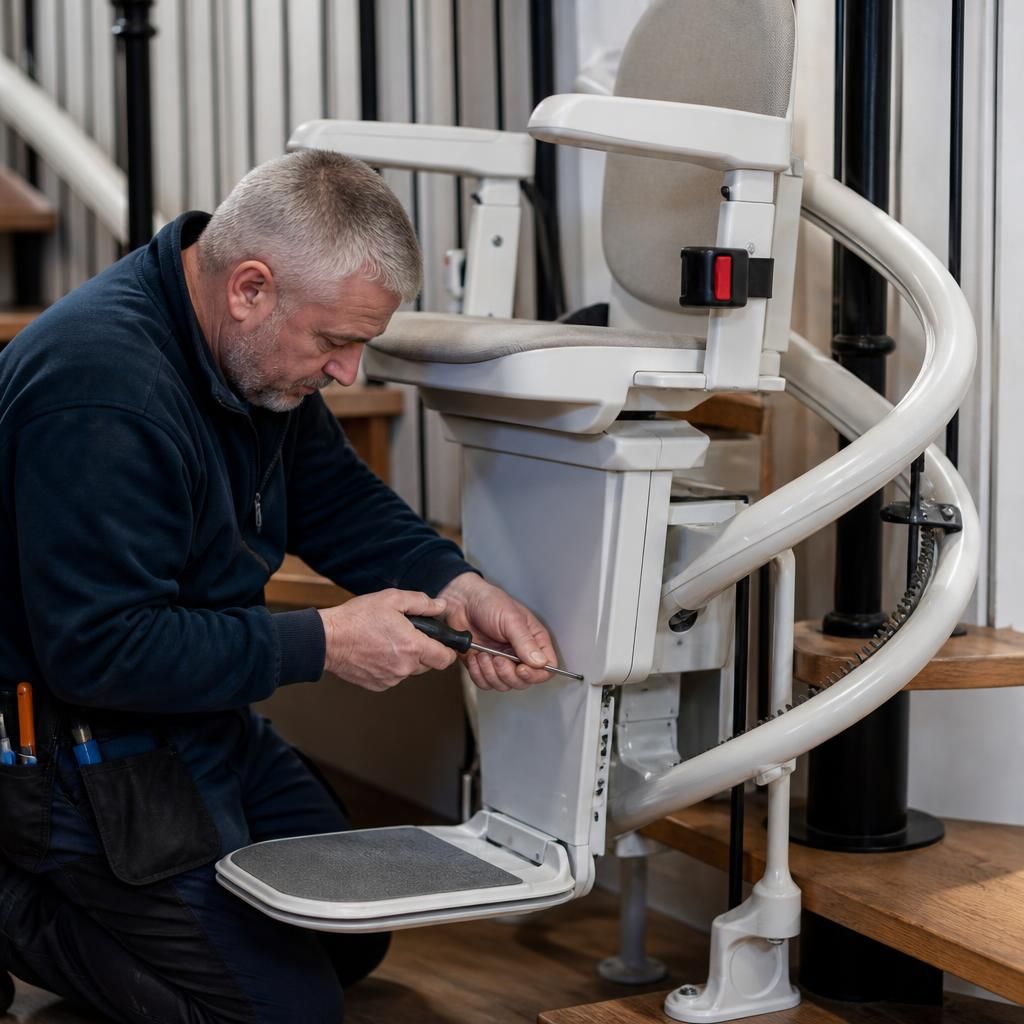
A bespoke rail follows the exact geometry of the staircase. Its curves, joins, brackets and clearances must remain correctly aligned so that the carriage travels smoothly and safely. During a service, an engineer can inspect the rail and fixings, drive components, rollers, gears, sensors, switches, seat mechanisms, braking systems and charging equipment. They can also check that the stairlift stops at the correct positions and that safety edges respond as intended.
Do not apply oil or grease to the rail, rollers or drive mechanism unless the manufacturer’s instructions specifically require it. Some systems are designed to operate without user-applied lubrication, and an unsuitable product can attract dust, affect sensors or damage components. Removing covers, adjusting the rail or bypassing a safety switch can create a serious hazard and may affect the warranty.
Recommended servicing arrangements
Arrange professional servicing at the interval stated in the installation and maintenance documentation. The appropriate interval depends on the model, how often it is used, the environment and the complexity of the installation. A stairlift exposed to damp, dust, temperature changes or outdoor conditions may need particular attention to weather protection, seals, corrosion, drainage and electrical connections.
Keep the service record and report any changes in use or the staircase environment. For example, redecorating, fitting new flooring, moving furniture, adding a handrail or altering a doorway can reduce the clearance that was available during installation. An engineer should check the stairlift if its route or surroundings have been changed.
Signs that the stairlift needs attention
- Grinding, clicking, squeaking or other new noises, particularly around a curve.
- Jerky starts, uneven speed, stopping between floors or difficulty completing the route.
- The carriage contacting the rail, wall, banister or other part of the staircase.
- Repeated fault messages, warning tones or a safety sensor activating without an obvious obstruction.
- A seat, swivel, footrest, armrest or seat belt that does not lock securely.
- Reduced battery performance, failure to charge or visible heat, damage or corrosion around electrical parts.
Stop using the stairlift if it behaves unpredictably, gives a burning smell, shows exposed wiring or has suffered impact or water damage. If it stops on the staircase, follow the emergency procedure in the user guide, keep the steps clear and contact the service team. Do not try to move the carriage manually or dismantle the system.
With regular cleaning, sensible daily checks and servicing by an appropriately trained engineer, a stairlift for a spiral or awkward staircase can remain smooth and dependable. The most important requirement is to treat unusual movement or noise as an early warning, rather than waiting for the stairlift to fail completely.
Professional servicing is especially important for stairlifts fitted to spiral or awkward staircases because the customised rail must remain correctly aligned throughout its curves, joins and changes in angle. An engineer can check the rail fixings, carriage, drive system, rollers, safety sensors, seat mechanisms, braking system and charging equipment for safe, smooth operation.
Arrange servicing according to the manufacturer’s guidance and the maintenance information supplied with your installation. Between visits, keep the rail and steps clear, return the stairlift to its charging position and report new noises, jerky movement, unusual stopping, repeated warning tones or changes in battery performance. Do not adjust the rail, remove covers or apply lubricant unless the manufacturer specifically instructs you to do so.
Arrange Your Stairlift Service
If your stairlift needs routine servicing or is showing unusual noise, movement or charging problems, contact Independent Stairlifts to arrange an inspection by a qualified engineer.