
How do you ensure the safety and reliability of stairlifts on spiral and awkward stairs?
Safety and reliability are ensured through a detailed site assessment, a rail and seat designed to follow the staircase accurately, and installation by trained stairlift specialists. Safety features such as obstruction sensors, secure seat belts, swivel seats, reliable braking systems and thorough testing help the lift operate safely around tight curves, uneven steps and unusual angles.
Safety and reliability on spiral and awkward stairs depend on accurate surveying, a rail engineered for the staircase, suitable safety features and careful installation. Unlike a standard straight stairlift, a bespoke system must be designed around tight curves, changing gradients, narrow steps, unusual landings and the available clearance at the top and bottom.
Detailed assessment before any recommendation
A specialist survey is the starting point. The installer assesses the full staircase rather than relying on a few measurements. This includes the width and depth of the treads, the position of handrails, doors and radiators, headroom, landing space, changes in gradient, the direction and tightness of curves, and any areas where the staircase narrows.
The survey also considers how the user approaches, sits on and leaves the stairlift. A lift may need to stop in a particular position, use a powered or manual swivel seat, or include a hinged rail to keep a doorway or passage clear. For an outdoor installation, the condition of the steps, exposure to rain and frost, drainage and the availability of a suitable power supply also form part of the assessment.
This information is used to determine whether the staircase can accommodate a stairlift safely and which configuration is appropriate. If the space or geometry presents a restriction, it should be identified before installation rather than resolved by making assumptions on site.
A rail designed to follow the staircase
On a spiral or awkward staircase, the rail is normally made or configured to follow the individual route of the stairs. Its alignment must maintain the correct relationship between the lift, the steps and surrounding walls or balustrades throughout the journey. The design accounts for changes in angle and gradient so that the carriage travels in a controlled way rather than placing unnecessary strain on the drive system or creating avoidable contact with the staircase.
Clearance is checked at bends and narrow points. The seat, footrest and armrests must pass safely without striking walls, posts, handrails or other obstructions. Where the staircase has a particularly tight corner, the rail may require a carefully engineered curve, a different parking position or a compact seat and footrest arrangement. The final design should also leave adequate space for the user to transfer on and off the stairlift safely.
Safety features suited to the staircase and user
A suitable stairlift includes safety features that help protect the user during travel and when boarding or leaving the seat. Depending on the model and assessment, these may include:
- Obstruction sensors that stop the lift if an object is detected on the rail or steps.
- A seat belt or safety harness to help keep the user securely positioned.
- A swivel seat, often with an interlock, so the lift cannot travel unless the seat is correctly aligned.
- Armrests and a stable footrest to support the user through curves and changes in direction.
- Braking and speed-control systems designed to bring the carriage to a controlled stop.
- Safety edges or sensors around the footrest and carriage where appropriate.
- Controls positioned so they can be used without excessive reaching or twisting.
- Battery backup on applicable systems, allowing the lift to reach a safe position during a power interruption.
Not every feature is suitable or necessary for every staircase. The important point is that the equipment, controls and seating arrangement are selected for the user as well as the physical route.
Installation and testing by trained specialists
Reliable performance depends on the rail being fixed securely to the staircase or an appropriate supporting structure. Installers check the fixing points, alignment and clearances as the rail is fitted, particularly around curves and transitions. The carriage, seat and footrest are then adjusted so that the lift travels smoothly without catching, excessive vibration or unexpected movement.
After installation, the stairlift is tested along its complete route rather than only at the top and bottom. Checks include starting and stopping, travel around bends, obstruction detection, seat-swivel interlocks, belt operation, controls, charging, battery performance where fitted, and the operation of any hinged or powered rail. The installer should also confirm that the lift parks safely and that doors, walkways and emergency access remain usable.
The user or their carer should receive a practical demonstration covering the controls, belt, swivel mechanism, charging position, manual lowering or emergency procedures where applicable, and what to do if the lift stops unexpectedly. This is particularly important on a spiral staircase, where the correct seating position and keeping hands and feet within the seat area are essential.
Ongoing reliability and maintenance
Regular maintenance helps identify wear before it affects safe operation. Keep the rail and steps clear, avoid placing objects in the lift’s path, and follow the cleaning and charging instructions provided for the model. Do not apply unapproved lubricant or attempt to alter the rail, sensors or electrical components.
Arrange servicing at the recommended intervals and report changes such as unusual noise, jolting, slowing, repeated stops, a belt that does not latch correctly, sensor warnings or a battery that is not holding its charge. A stairlift that behaves differently from normal should be taken out of use until it has been checked by a qualified technician.
For outdoor stairlifts, inspect the cover, charging connection and exposed components for damage, water ingress or debris, while avoiding pressure washing electrical parts. Indoor systems on awkward stairs also benefit from periodic checks of fixings, rail condition, seat mechanisms and the travel path.
In practice, the safest and most dependable solution is one that is measured specifically for the staircase, matched to the user’s mobility needs, installed correctly and maintained in line with the manufacturer’s guidance. A thorough assessment and documented testing process provide the basis for confident daily use, even where the stairs include tight spiral corners or several unusual angles.
Safety on spiral and awkward stairs starts with a detailed survey of the complete route. The installer checks the staircase width, changing gradients, tight corners, headroom, landings, handrails and nearby doors to ensure the stairlift can travel without contacting surrounding surfaces.
The bespoke rail is then designed to follow the staircase accurately, with the seat, footrest and controls positioned for safe use. After fitting, the stairlift is tested along its entire route, including bends, stopping points, obstruction sensors, seat-swivel interlocks, belt operation and charging. Any unusual movement, contact or restricted clearance should be resolved before the stairlift is put into regular use.
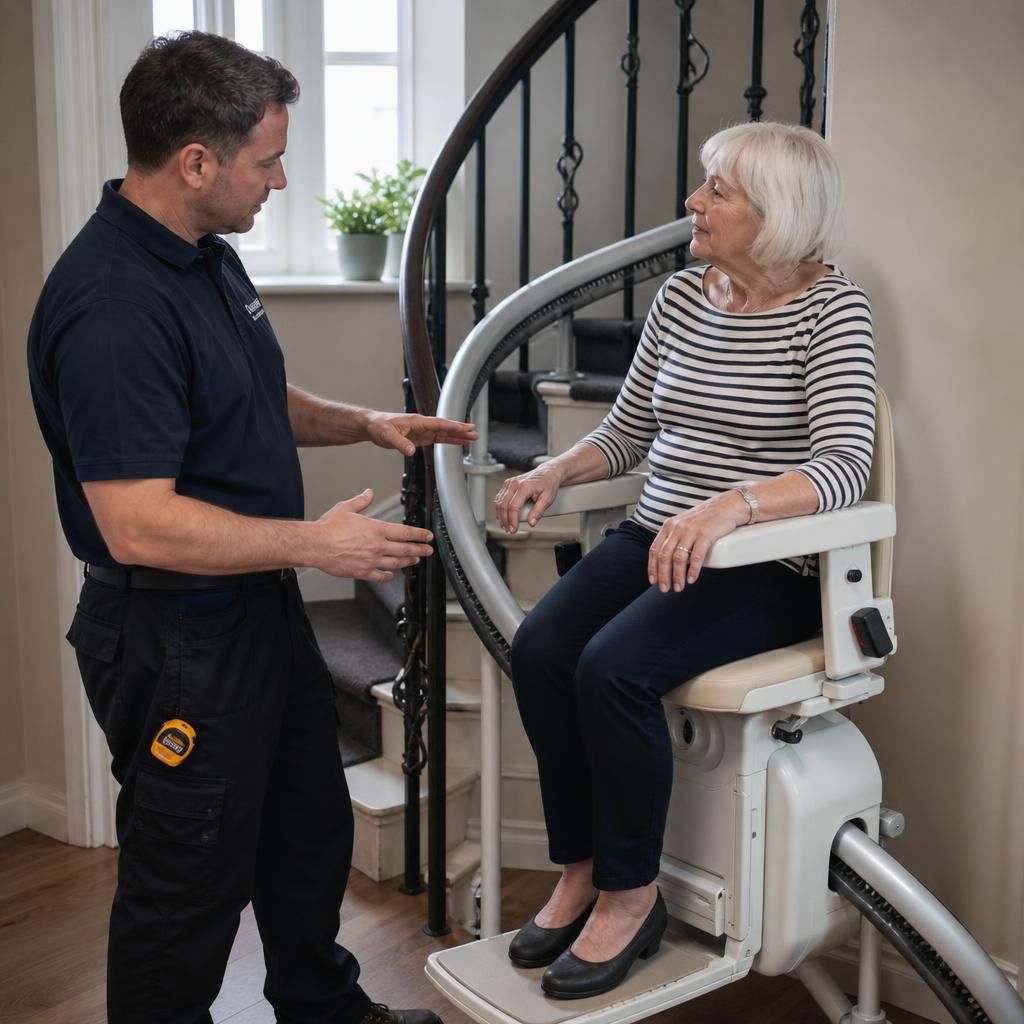
Arrange a professional assessment for your staircase
Arrange a professional assessment of your spiral or awkward staircase so the route, clearances and user requirements can be checked accurately. Independent Stairlifts can then recommend a safe, reliable configuration suited to your home.