
Are customised stairlifts for spiral staircases more expensive than standard stairlifts?
Yes, customised stairlifts for spiral staircases usually cost more than standard straight-stairlift models because the rail must be measured, designed and manufactured to follow the staircase’s curves, angles and limited space. The final price depends on the staircase layout, installation requirements, chosen features and whether a new or reconditioned solution is suitable.
Yes. Customised stairlifts for spiral staircases usually cost more than standard straight-stairlift models because the rail has to be measured, designed and manufactured to follow the staircase’s curves, angles and restricted space. The final price is not determined by the word “spiral” alone: it depends on the staircase layout, the equipment selected, installation requirements and whether a new or reconditioned solution is appropriate.
A standard straight stairlift normally uses a comparatively simple rail fitted along a straight flight. By contrast, a stairlift for a spiral or unusually shaped staircase may require a bespoke rail with carefully calculated bends, changes in gradient and clearances around landings, doorways and handrails. The design must also allow the seat, footrest and armrests to travel safely without striking walls, balustrades or other obstructions. This additional design and manufacturing work is the main reason for the higher initial cost.
There is no single price that applies to every spiral staircase. Two staircases that look similar may require different solutions because of differences in width, radius, headroom, access at the top and bottom, or the position of nearby doors and furniture. A proper survey is therefore essential before a reliable quotation can be given.
What can increase the cost?
- The complexity of the rail: A staircase with several curves, tight corners or changing angles generally requires more detailed design than one with a broad, consistent curve.
- Limited space: Narrow treads, restricted landings and low headroom can require careful positioning or additional adjustments to keep the stairlift practical and safe to use.
- Structural and installation requirements: The rail must be securely fixed to suitable points on the staircase or adjacent structure. Extra preparation may be needed where surfaces are uneven, access is difficult or the fixing position is unusual.
- Additional stops or access points: A stairlift designed to serve more than one level or to stop in a particular position may need a more complex rail and control arrangement.
- Seat and safety options: Swivel seats, powered swivels, powered footrests, folding or compact components and alternative upholstery can affect the overall quotation. On a tight spiral staircase, the most suitable option may be chosen for safe transfers rather than simply for appearance.
- Electrical work or other adaptations: Some installations may require a suitable charging point, repositioning of obstacles or minor changes to the surrounding area. These requirements should be identified during the survey.
- Outdoor exposure: A stairlift fitted outside needs weather-resistant equipment and suitable protection from moisture, temperature changes and direct exposure. This can make an outdoor installation different in cost from an indoor equivalent.
How does the cost compare with a standard stairlift?
A straight stairlift is generally the simplest and most economical type because its rail follows one direct flight. A curved or bespoke stairlift is usually more expensive at the outset, but it may be the only practical option where a straight model cannot follow the staircase or would leave the user unable to reach the required floor. Comparing only the purchase price can therefore be misleading. The relevant comparison is between a suitable, safely installed solution and the limitations or building work associated with alternatives.
For some spiral staircases, a curved stairlift may not be necessary. If the staircase includes a genuinely straight section with suitable access, a straight model might be considered for that section, although this depends on the layout and whether it provides useful access. A survey will establish whether a standard rail, a combination of arrangements or a fully bespoke design is appropriate. Installing a standard stairlift where it does not properly suit the staircase is not a sensible way to reduce costs.
Can a reconditioned stairlift reduce the price?
A reconditioned stairlift may offer a lower-cost route in some circumstances, but bespoke curved rails are made for the individual staircase. The rail is not normally interchangeable between properties in the way a standard straight rail can be. A reconditioned solution may therefore involve a suitable existing stairlift unit combined with a newly manufactured rail, or it may not be suitable at all. Availability, compatibility, warranty cover and the condition of the equipment should all be checked before choosing this option.
The lower initial cost of a reconditioned system should not be the only consideration. The equipment must have the correct weight capacity, seat dimensions, control layout and safety features for the intended user. It must also be compatible with the staircase and supported by appropriate servicing and maintenance arrangements.
What should be included in a quotation?
A clear quotation should explain whether the price includes the home assessment, bespoke rail design, manufacture, delivery, installation, testing, user instruction and warranty cover. It should also identify any optional features and state whether electrical work, alterations or follow-up visits are included. Ask about ongoing servicing, battery replacement and call-out arrangements as these can affect the longer-term cost of ownership.
Where the staircase is in a listed or otherwise protected building, the quotation process may also need to account for restrictions on fixings or visible alterations. Permission may be required before work begins, depending on the building and local requirements. These matters should be identified early rather than after the design has been finalised.
How to keep the cost proportionate
- Arrange a detailed assessment rather than relying on a guide price based on photographs alone.
- Explain how the stairlift will be used, including whether the user needs to access one or both ends of the staircase independently.
- Prioritise features that support safe transfers, comfortable posture and reliable operation.
- Ask whether the design can use the available space without unnecessary building alterations.
- Compare like-for-like quotations, including installation, warranty and aftercare rather than comparing equipment prices alone.
- Discuss new and reconditioned possibilities if the layout and user’s requirements allow both.
The most accurate way to establish the cost is to arrange a stair survey. Measurements, photographs and an assessment of the user’s mobility needs allow the rail and seating position to be specified correctly. You can then receive a quotation based on the actual staircase rather than an assumption about a typical spiral layout. Although a customised stairlift normally has a higher upfront cost than a standard straight model, the right design can provide dependable access without compromising clearance, safety or ease of use.
The main cost difference is the rail. A standard stairlift uses a straight, comparatively simple rail, while a spiral staircase usually needs a bespoke rail measured and manufactured to follow its curves, changing angles and restricted clearances. This additional design and manufacturing work is why customised stairlifts generally cost more.
The final quotation can only be confirmed after a stair survey. The survey checks the staircase shape, available headroom, landing access, fixing points and the user’s seating and transfer needs. It also identifies whether a curved, partially bespoke or reconditioned solution is suitable, helping ensure that the quoted equipment is safe, practical and properly matched to the home.
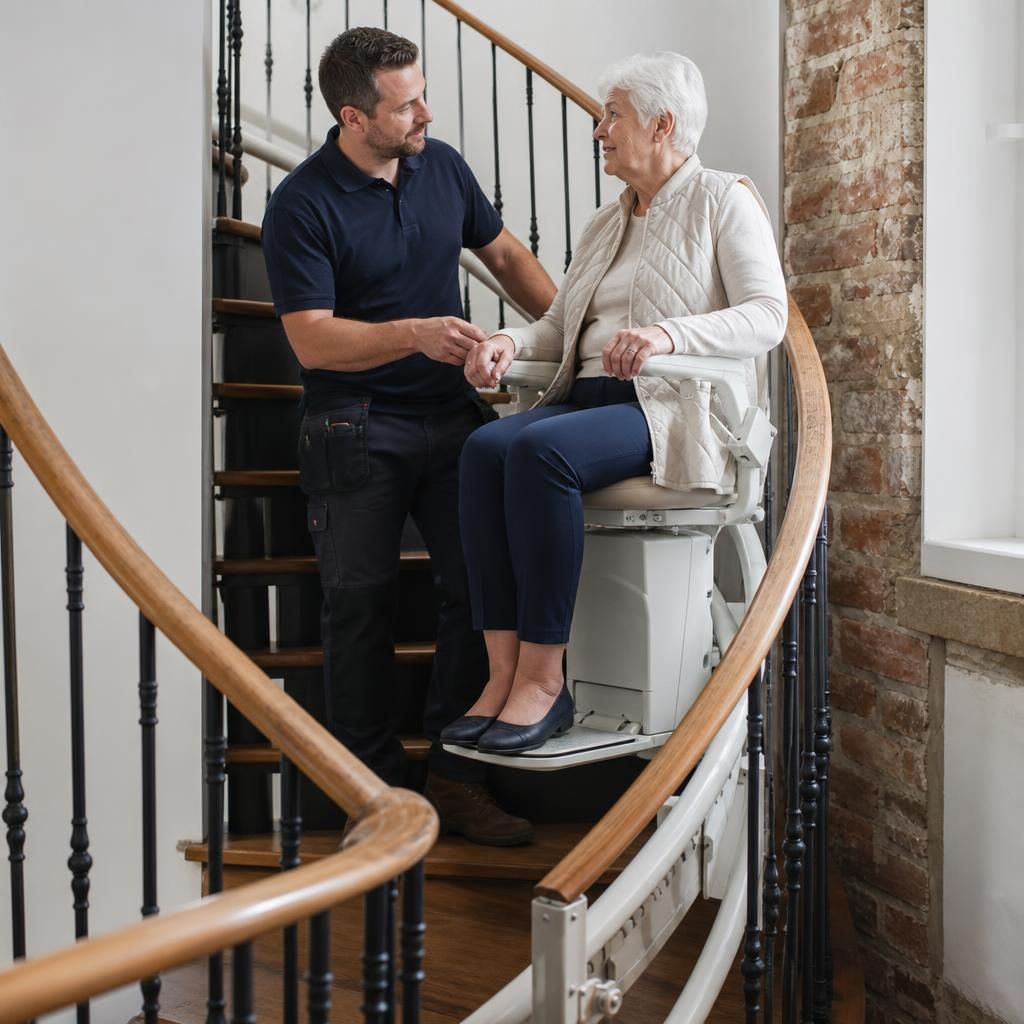
Arrange Your Stair Survey for a Bespoke Quote
Arrange a stair survey to assess your spiral staircase, discuss your requirements and receive a bespoke quotation based on a suitable stairlift solution.