
What should I consider before choosing a spiral stairlift for my home?
Before choosing a spiral stairlift, consider the staircase’s shape and available space, the user’s mobility needs, seating and access requirements, and how the lift can be safely installed and supported. A professional assessment is essential to confirm suitability, identify any structural or access constraints, and specify the right bespoke solution.
A spiral stairlift is a bespoke curved lift designed to follow the changing direction and gradient of a spiral staircase. Before choosing one, the main considerations are the staircase’s geometry, the space available at the top and bottom, the user’s mobility and transfer needs, how the rail will be supported, and whether the finished installation allows safe, convenient access throughout the day. A professional survey is essential because a spiral staircase cannot usually be assessed from photographs or treated like a standard straight flight.
Start with the staircase itself
The shape of the staircase determines whether a suitable rail can be designed. The survey will consider the radius of the spiral, the direction and tightness of each turn, the width and depth of the treads, the headroom, the gradient and the position of any intermediate landings. The surveyor will also check whether the staircase changes direction consistently or includes unusual curves, transitions or restricted sections.
Unlike a straight stairlift, a spiral model normally needs a made-to-measure rail. The rail may be fitted close to the staircase, depending on the design and the safest available line of travel. It must provide sufficient clearance for the user, seat, footrest and any mobility equipment without creating a hazard for other people using the stairs.
Check the space at the top and bottom
The lift needs suitable parking positions at both ends, unless a different arrangement has been agreed during the assessment. Consider where the user will transfer on to and off the seat, whether a landing is level, and whether a door, corridor, furniture or another staircase restricts access. At the top of a spiral staircase, the available turning space can be particularly important.
- There should be a clear area for approaching the seat and completing the transfer.
- The user should not have to lean across an open stairwell or negotiate an awkward turn after leaving the lift.
- Doors and walkways should remain usable when the stairlift is parked.
- The lift should be parkable without blocking the staircase more than necessary.
If space is limited, the design may include a powered or manually operated swivel seat, a hinged or removable rail section, or a different parking position. These options depend on the staircase and the user’s ability to operate them safely.
Match the lift to the user’s mobility
The right model is determined by how the person transfers, sits and controls the lift, not just by the staircase. Discuss whether the user can walk to the seat, turn and sit down reliably, and stand up safely at the destination. If they have reduced balance, weakness, restricted hip or knee movement, or difficulty bending, these factors should influence the seat and transfer arrangement.
Important features may include a powered swivel seat, adjustable seat height, supportive armrests, a secure seat belt and controls that can be operated with limited grip or dexterity. A powered footrest or other powered features may be useful where bending down is difficult. The controls should be positioned so the user can start, stop and manage the lift without stretching or twisting.
Where more than one person may use the stairlift, the assessment should account for the needs of each user. A configuration that suits one person’s height, weight, balance and transfer technique may not be suitable for another.
Consider safety on a tight staircase
Spiral staircases have changing angles and narrower areas, so safety features and correct positioning are especially important. A suitable installation should include obstruction sensors, a reliable braking system, a seat belt and controls that stop the lift when necessary. The seat, footrest and rail must be positioned to maintain safe clearance from the treads, central column, balustrade, walls and surrounding fixtures.
Ask how the stairlift behaves if it encounters an obstruction, if the power supply fails, or if the user needs to stop between floors. Battery-powered systems generally allow controlled operation during a power cut, but the exact procedure and expected use should be explained at handover. The user and anyone who may assist them should know how to use the emergency stop, release the seat belt and contact the appropriate support service.
Confirm how the rail will be supported
A spiral stairlift does not necessarily need a load-bearing wall alongside the staircase. Depending on the design, the rail may be supported by the stair treads, floor structure, a wall or another suitable structural arrangement. The installer must establish what can safely carry the loads created by the rail and moving chair. This may involve inspecting the condition and construction of the stairs, flooring, fixings and surrounding structure.
Do not assume that a visible wall, balustrade or central post is suitable for support. The proposed fixing method should be explained during the survey, particularly where the staircase is open-sided, made from unusual materials, or located in an older property. Any concerns about the structure should be resolved before an installation date is agreed.
Think about electrical supply and the home environment
The installer will need to identify a suitable charging point and route for the electrical supply. The location should be practical, secure and accessible for servicing. The condition of the staircase and nearby surfaces also matters: damp, dust, extreme temperatures or exposure to water may affect equipment and materials.
For an external spiral staircase, the lift must be specifically designed and protected for outdoor conditions. Drainage, weather exposure, corrosion, temperature changes, lighting and safe access in wet or icy conditions all need to be considered. An indoor model should not be assumed to be suitable for outdoor installation.
Understand the effect on other people using the stairs
A stairlift should improve access without creating avoidable restrictions for other household members, visitors or carers. On a narrow spiral staircase, the parked chair and rail may reduce the remaining usable width. The survey should consider how people will pass the lift, whether the seat and footrest can be folded or moved, and whether the proposed route affects fire escape arrangements.
Any household member who may use or assist with the stairlift should be shown the controls and safe operating procedure. Keep the staircase clear of loose items, trailing cables and furniture, particularly around the parking positions and transfer areas.
Compare the practical and financial implications
A spiral stairlift is normally more complex than a straight model because its rail is individually designed and manufactured. The overall quotation may reflect the survey, rail design, structural fixings, seat specification, access conditions, electrical work and installation requirements. If the staircase is unusually tight or access to the property is restricted, these details may affect the work involved.
Ask what is included in the quotation, whether removal of an existing lift or alterations to the staircase are required, and what aftercare is available. If a reconditioned option is being considered, confirm that it is suitable for the specific staircase and user, and establish what warranty, servicing and replacement-part support applies.
Use the survey to make the final decision
A home assessment should leave you with a clear understanding of the proposed travel route, parking positions, transfer method, support and fixing arrangements, safety features, power supply, installation requirements and ongoing servicing. The user should be able to try the seat and controls where possible and explain any concerns about comfort, confidence or access.
The best choice is not simply the smallest or most powerful lift. It is the configuration that follows the staircase safely, fits the available space, supports the user’s actual mobility and remains practical for everyone in the home. If the assessment identifies a limitation, it may be possible to adjust the seat, controls, parking position or rail design; where it is not, alternative access arrangements should be discussed before proceeding.
The most important step before choosing a spiral stairlift is a detailed home survey. A spiral staircase must be measured and assessed in place, including its curves, gradient, tread width, headroom, landing areas and available space around the central column or balustrade.
The assessment should also consider how the user will transfer on and off the seat, where the lift will park, and whether doors, furniture or other people using the staircase could be obstructed. The surveyor can then recommend suitable features, such as a powered swivel seat, adjustable controls or a folding footrest, and confirm how the rail will be safely supported.
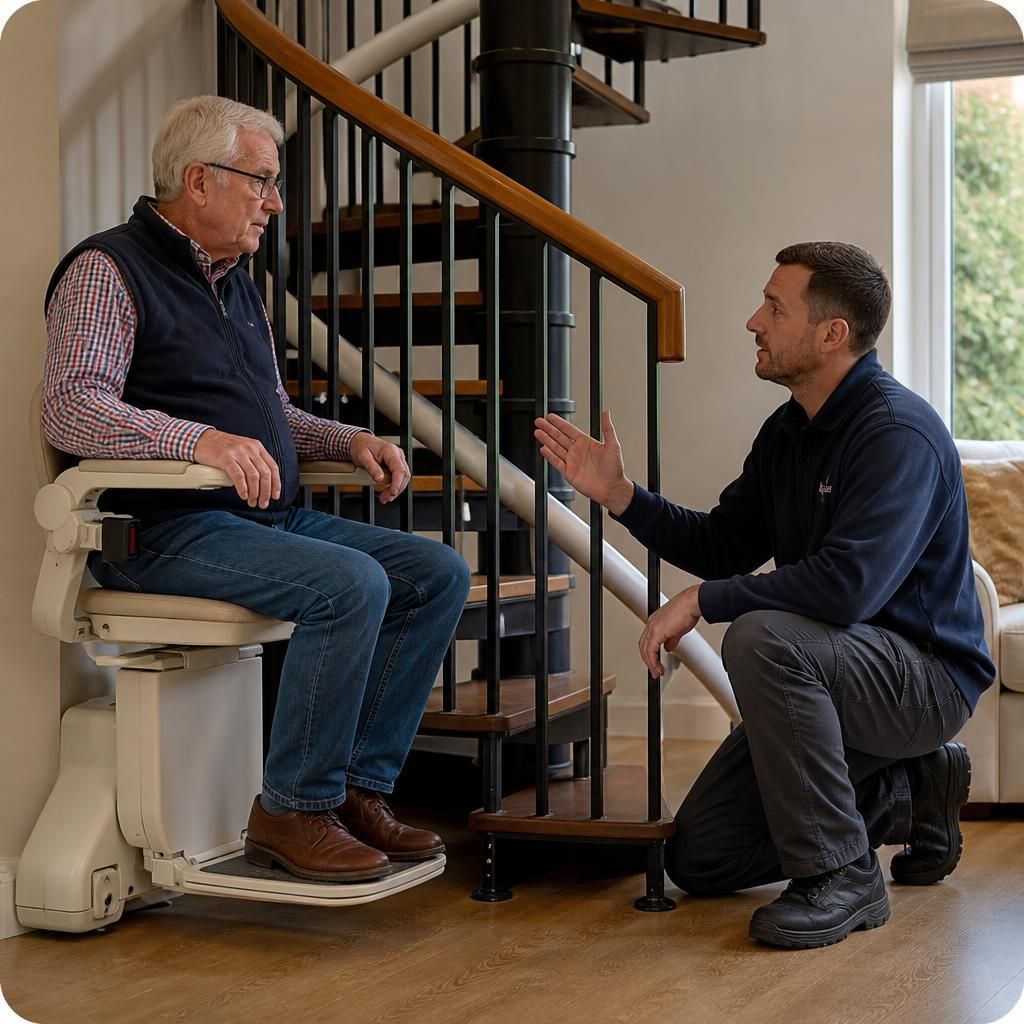
Arrange Your Spiral Stairlift Assessment
Arrange a home assessment to confirm whether a spiral stairlift is suitable for your staircase, user and available space. We can assess the rail route, transfer areas, support requirements and features needed for safe, practical use.