
What factors should I consider when choosing a spiral stairlift for my home?
When choosing a spiral stairlift, consider the staircase’s shape and width, available fixing points, the user’s mobility needs, safety and comfort features, installation requirements, and the total cost of ownership. A professional home assessment is essential because a bespoke solution may be needed to follow the tight turns and changing angles of the staircase safely.
Choosing a spiral stairlift depends on whether the staircase can accommodate a safely engineered rail, whether the user can transfer and travel comfortably, and whether the total solution is practical for the home. The main factors are the staircase’s geometry, available fixing points, the user’s mobility and posture, safety features, power arrangements, installation requirements, ongoing support and the overall cost.
- Staircase shape and dimensions: A spiral staircase may change direction continuously, have tight internal curves, narrow treads, variable widths and limited headroom. These features affect the rail design, seat position and the amount of usable stair width left for other people. A detailed survey is needed to measure the angle, radius, tread depth, clearance and landing arrangements rather than relying on standard straight-stairlift measurements.
- Available fixing points: The rail must be secured to a suitable structure. Depending on the staircase, it may be fixed to the treads, floor, landings or other appropriately reinforced points. A load-bearing wall is not always required, but the installer must confirm that the proposed fixing method can support the equipment and user safely without damaging the staircase.
- The user’s mobility: Consider how easily the user can sit down, stand up, turn at the top and bottom, and remain seated during the journey. If the user has reduced balance, painful joints, weakness on one side, limited hip or knee movement, or difficulty bending, the seat height, swivel mechanism, armrests and controls become particularly important. The person who will use the stairlift should be involved in the assessment wherever possible.
- Seat and operating position: A suitable seat should provide stable support without making transfers unnecessarily difficult. Options may include a powered swivel seat, adjustable seat height, supportive arms and a seat belt or harness where appropriate. The controls need to be reachable and simple to operate, including from the top and bottom of the staircase if required. A remote control can help other household members call or park the lift, but it should not replace accessible controls on the unit.
- Safety and clearance: The stairlift should maintain safe clearance from walls, balustrades, ceilings, doors and nearby furniture throughout its route. Safety sensors can stop the lift if an obstruction is detected, while secure footrests, armrests and a correctly adjusted restraint help keep the user stable. The installer should also consider whether the lift needs to park away from a doorway or whether a folding rail is necessary to protect access at the bottom.
- How the lift will be used: Think about whether the stairlift will be used occasionally or several times a day, and whether more than one person may use it. If the staircase is shared, the parked lift should leave as much of the stairway usable as possible. If the user is likely to need the stairlift for a long period, comfort, ease of transfer and serviceability may be more important than choosing the lowest initial price.
- Electrical supply and power cuts: Most stairlifts use rechargeable batteries so that they can continue to operate for a limited period if the mains power fails. The assessment should identify where charging points can be positioned and whether the lift can charge at its usual parking positions. Ask how the system indicates a low battery and what procedure should be followed if the lift stops away from a charging point.
- Indoor conditions and staircase materials: Moisture, condensation, dust and temperature changes can affect equipment, particularly near external doors or in unheated areas. A spiral stairlift intended for an outdoor or semi-outdoor staircase requires equipment and installation methods suitable for those conditions. Indoor models should not automatically be assumed to be suitable outside. The condition and construction of the staircase also need checking, especially where treads, fixings or finishes are fragile.
- Installation disruption: Spiral stairlift installation is more individualised than fitting a standard straight rail. The work may involve careful positioning, multiple fixings, adjustments to the rail and testing along the full route. Ask what preparation is needed, whether furniture or handrails must be moved, how long the work is expected to take following the survey and how the staircase will be left afterwards. A competent installation should include safety checks and user instruction before handover.
- Cost and total ownership: The price can be affected by the complexity and length of the staircase, the number of curves, the fixing method, seat and control options, electrical work and any alterations needed at the landings. Compare the complete quotation rather than the equipment price alone. Check what is included for the survey, installation, warranty, servicing, call-outs, removal or relocation and any future replacement batteries or parts. A reconditioned option may be suitable in some circumstances, but it must be assessed for compatibility with the staircase and the user’s needs.
- Future changes: Consider whether the user’s mobility is likely to change. A model that is manageable now may become difficult if standing transfers, bending or manual controls become harder. Discuss whether the seat, controls or restraint can be adjusted and whether the design allows the lift to be serviced or modified later. If the home may be sold or the stairlift may no longer be needed, ask whether it can be removed without disproportionate alteration to the staircase.
A professional assessment is especially important for a spiral staircase because small differences in curvature, tread width and landing layout can change the safe position of the rail. The survey should include measurements, photographs or drawings where needed, a review of the fixing structure, a discussion with the user and a practical check of transfers and controls. It should also identify any risks caused by doors, radiators, low ceilings, bannisters or restricted access at the top and bottom.
Before agreeing to a solution, ask the installer to explain where the lift will park, how much stair width will remain available, how the user will board and leave the seat, what happens during a power cut and which parts are covered by the warranty. You should also receive clear information about safe operation, cleaning, charging and arranging service support.
In some homes, a spiral stairlift is the most practical way to connect floors without major building work. In others, the staircase may be too narrow or structurally unsuitable, or the user may find the transfers difficult. A survey can establish whether a bespoke spiral solution is appropriate and, where it is not, whether an alternative arrangement would provide safer and more comfortable access.
A professional survey is essential when choosing a spiral stairlift because the staircase’s changing angles, narrow treads and available fixing points determine whether a safe rail can be installed. The assessment should measure the full route, check clearances around walls and balustrades, and identify how the lift will be secured without compromising the staircase.
The survey should also consider the user’s ability to transfer, sit comfortably and operate the controls. Ask the installer to explain:
- where the stairlift will park at the top and bottom;
- how much stairway width will remain available;
- whether a swivel seat, adjustable seat height or folding rail is needed;
- how the lift will charge and operate during a power cut; and
- what installation, warranty and servicing arrangements are included.
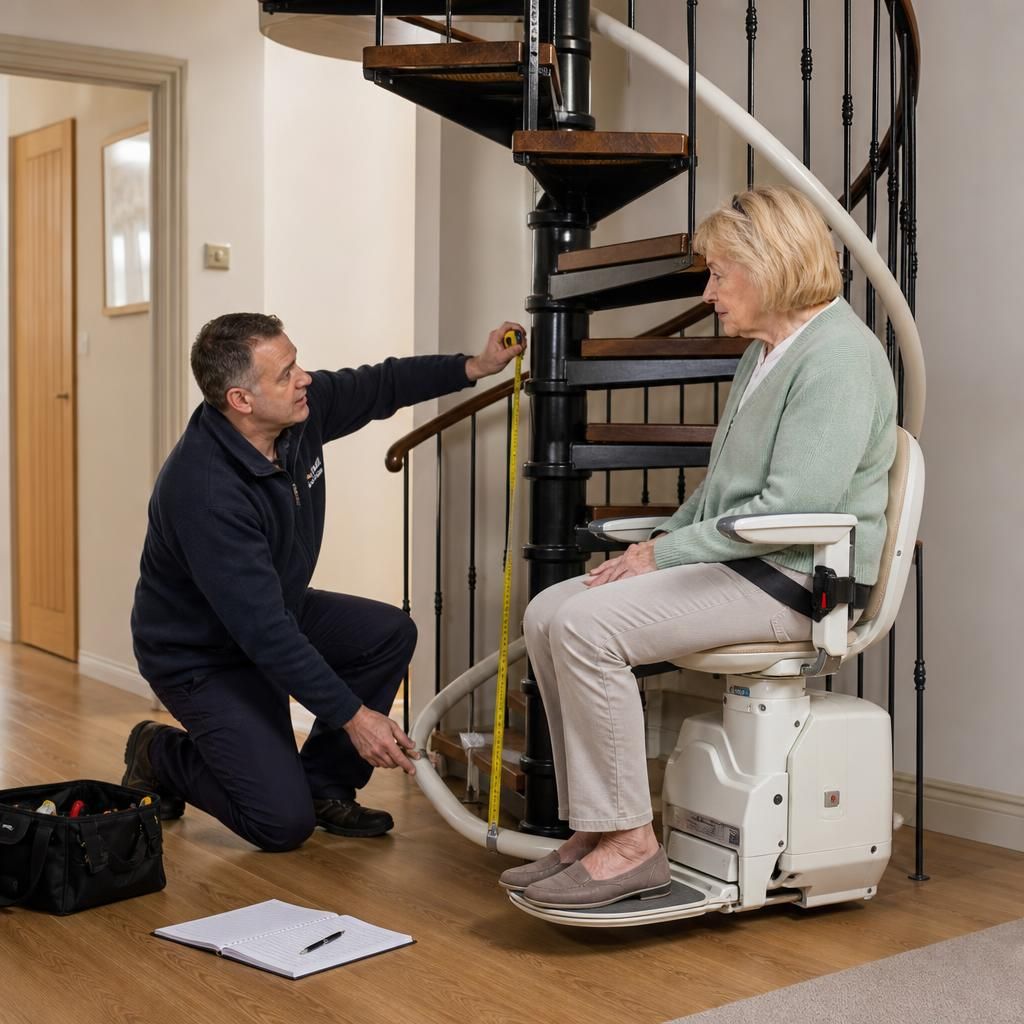
Arrange your professional spiral stairlift assessment
Arrange your professional spiral stairlift assessment to confirm whether your staircase, fixing points and mobility needs are suitable for a safe, comfortable installation.