
What are the maintenance requirements for a spiral stairlift?
A spiral stairlift requires regular servicing in line with the manufacturer’s schedule, together with routine checks of the battery, charging points, drive system, rail and safety features. Keep the lift and staircase clear, report unusual noises or movement promptly, and arrange repairs or adjustments through a qualified stairlift engineer rather than attempting them yourself.
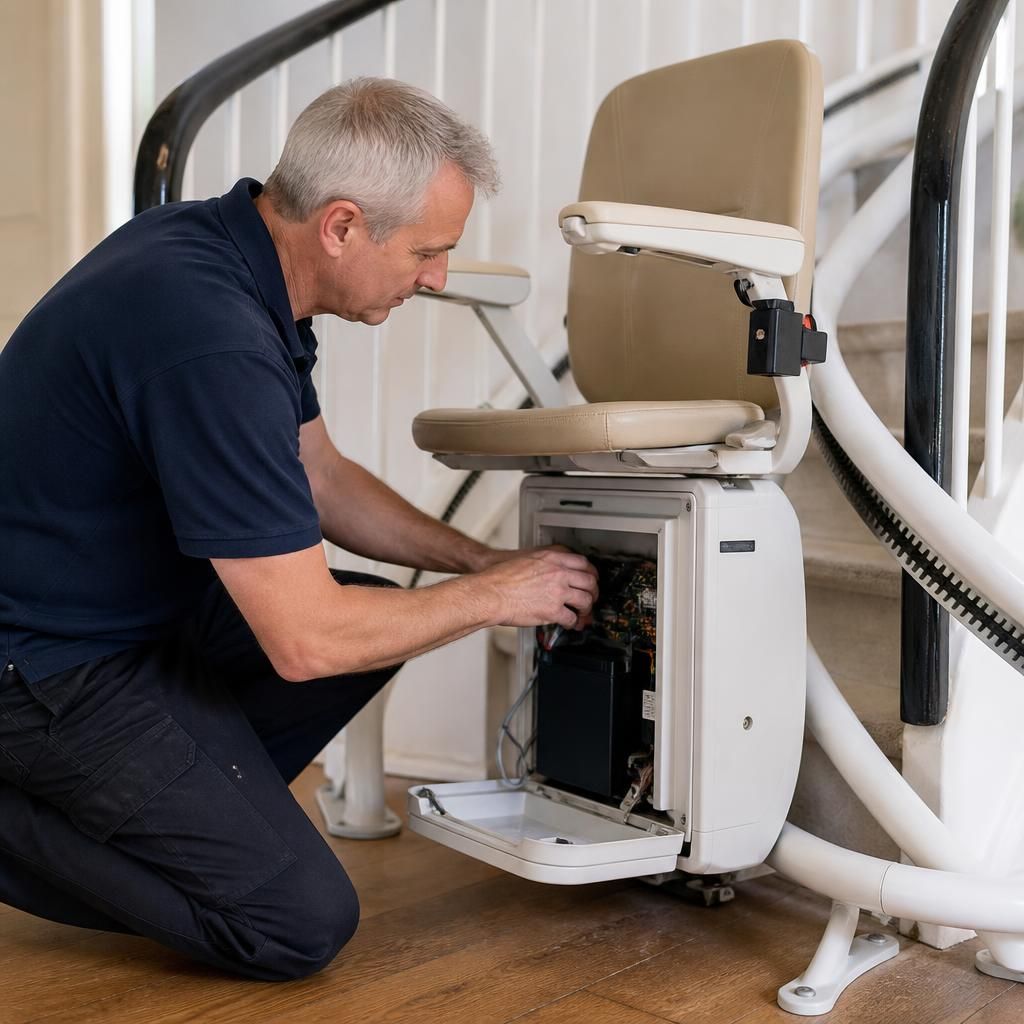
A spiral stairlift should be maintained in accordance with the manufacturer’s servicing schedule, with routine checks of its batteries, charging points, drive system, rail and safety features. Because the lift operates through tight curves and changing angles, servicing should be carried out by a qualified stairlift engineer who can check alignment, clearances and smooth travel throughout the complete route.
Routine checks you can carry out
- Keep the rail, steps, landing areas and charging points clear of dust, objects and obstructions.
- Check that the stairlift reaches its charging position correctly and that the charging indicator behaves as expected.
- Look for obvious damage, loose trim, changes in the seat position or anything that appears out of alignment.
- Listen for new or unusual noises, such as grinding, knocking or repeated clicking, and note whether the lift hesitates or travels less smoothly than usual.
- Check that the seat belt, armrests, footrest, swivel mechanism and safety sensors operate as they should. Do not continue using the lift if a safety feature does not work correctly.
These checks do not replace professional servicing. Do not lubricate the rail, adjust drive components or remove covers unless the manufacturer’s instructions specifically permit it. Using the wrong lubricant can attract dirt or affect the drive system, while unauthorised adjustments can compromise the lift’s safety and may affect warranty cover.
What a service usually includes
During a professional service, the engineer will inspect and test the stairlift rather than simply looking for visible wear. The exact procedure varies by model, but it will normally include:
- testing the batteries, charger, charging contacts and electrical connections;
- checking the motor, gearbox, drive mechanism and associated wear;
- examining the rail, fixings, joints and brackets for movement, damage or alignment issues;
- checking travel through every curve, including the approach to landings and any parking points;
- testing the seat belt, swivel seat, armrests, footrest, sensors, controls, safety edges and emergency stop functions;
- checking that the stairlift maintains safe clearances from the staircase, walls, handrails, doors and other features; and
- cleaning, tightening, adjusting or replacing approved components where necessary.
Battery maintenance
Most domestic stairlifts use rechargeable batteries and are designed to charge when parked at a designated charging point. Leaving the lift connected to its charger as instructed is usually important, including when the stairlift is not being used regularly. A lift that is left away from its charging point may have insufficient power when needed, and batteries can deteriorate if they are repeatedly allowed to discharge fully.
Battery performance can be affected by age, temperature, frequency of use and the condition of the charging system. Signs that batteries may need attention include slower travel, reduced operating time, a low-battery warning, failure to start after charging or the need to recharge more often. Batteries are replaceable components, but they should be tested and changed by an engineer using the correct specification for the stairlift.
Additional considerations for spiral staircases
The curved or helical route makes accurate adjustment particularly important. A small change in rail alignment, fixing security or drive adjustment can affect how the carriage negotiates a bend, how close it comes to the staircase and how it stops at the top or bottom. Servicing should therefore cover the whole rail rather than only the section where a problem has been noticed.
Where a spiral stairlift has been installed outdoors or in a partially exposed area, the service should also consider moisture, dirt, temperature changes, corrosion and the condition of weather protection. Outdoor equipment may need more frequent inspection if it is exposed to rain, salt air, frost or heavy contamination. Keep covers, controls and charging areas as dry and clean as the installation allows, and report any water ingress or corrosion promptly.
When to arrange a repair
Stop using the stairlift and arrange professional advice if it moves unexpectedly, stops short, fails to charge, makes a new mechanical noise, jolts on a bend, shows a fault warning or does not operate one of its safety controls. Do not try to bypass a sensor, reset a fault repeatedly or carry a passenger while the stairlift is behaving abnormally. If someone becomes stranded on the staircase, follow the manufacturer’s instructions and contact the appropriate service team rather than attempting to force the lift to move.
Keep the service and repair records with the stairlift information. They help an engineer identify recurring faults, confirm which parts have been fitted and establish when the next inspection is due. If the stairlift is reconditioned, recently relocated or used by more than one person, ask for its service history and confirm that the current installation has been checked for the present staircase and user.
There is no single maintenance interval that applies to every spiral stairlift. Follow the model-specific handbook and the schedule provided at installation, and arrange an earlier inspection if the lift is used heavily, installed outdoors, exposed to difficult conditions or showing any change in performance. Regular user checks combined with qualified servicing will help maintain safe operation, reliable charging and smooth movement around the staircase’s tight turns.
Routine battery and charging checks are essential to keeping a spiral stairlift dependable. Park the lift at its designated charging point whenever it is not in use, as instructed by the manufacturer, and check that the charging indicator shows normal operation.
Arrange a professional inspection if the lift travels more slowly, runs for less time, fails to charge or displays a low-battery warning. An engineer can test the batteries, charger and charging contacts, and replace batteries with the correct specification when required. Do not remove covers or attempt electrical repairs yourself.
Arrange a professional spiral stairlift service
If your spiral stairlift is due for a service or showing changes in performance, contact Independent Stairlifts to arrange a professional inspection by a qualified engineer. We can check the complete system, including the rail, drive mechanism, batteries and safety features.