
How is the installation process of a spiral stairlift different from other types of stairlifts?
Installing a spiral stairlift is more bespoke than fitting a straight or standard curved model because the staircase’s tight turns, changing angles and limited space require detailed measurements and a purpose-built track. The installation usually involves an expert survey, careful planning around the staircase structure and a precise fitting process to ensure the lift travels safely without obstructing access.
Installing a spiral stairlift is more bespoke than installing a straight or standard curved stairlift. The staircase has continuously changing angles, tighter bends, restricted headroom and less usable space around the steps, so the lift usually requires a detailed site survey, a purpose-designed track and more precise fitting. The installation must account for both the stairlift’s movement and the safe use of the staircase by people on foot.
A straight stairlift normally follows a single flight with a consistent gradient. Its rail can often be manufactured to a standard design and fitted relatively directly to the stair treads. A conventional curved stairlift is also made to suit the staircase, but many curved staircases have broader landings or more predictable turns. A spiral staircase is different because the track must follow a continuous curve around a central column or open void, with the angle and available width changing throughout the journey.
For this reason, a spiral stairlift cannot usually be selected from standard measurements alone. The installation begins with an assessment of the complete staircase and its surrounding area. During the survey, the installer considers:
- the width, depth and shape of each tread;
- the direction and radius of the spiral;
- the height and position of the central newel, column or supporting structure;
- headroom at the tightest points;
- the position of landings, doorways and adjacent rooms;
- where the user will get on and off the stairlift safely;
- the location of suitable electrical supplies; and
- how the stairlift will affect access for other people using the staircase.
Measurements are taken along the intended route rather than simply from the bottom to the top of the stairs. The survey may also need to record the relationship between the stair edges, the central support and nearby walls or balustrades. Small differences in the staircase shape can affect the track’s clearance, the seat position and the way the stairlift approaches the top and bottom landing.
The track is one of the main differences. A straight stairlift usually uses a rail with a consistent direction, while a spiral installation needs a rail engineered to follow the staircase’s changing curve. Depending on the staircase design, the track may be positioned close to the inner or outer edge of the steps, or supported by a structure beside the staircase. The chosen position must leave sufficient clearance for the chair, the user’s feet and any moving parts without creating an obstruction.
A spiral stairlift may also need specially designed parking arrangements. The chair must be able to stop at a suitable position at the top or bottom, and in some homes it may need to swivel or fold to make access easier. The installer will assess whether the seat can be positioned so that the user can transfer on and off safely, particularly where the staircase opens directly into a hallway or another room.
Fixing the track requires careful consideration of the staircase structure. Unlike a wall-supported installation, the rail may need to be fixed to the treads, a central support or another suitable load-bearing point. The installer checks that the proposed fixings are appropriate for the construction and condition of the staircase. Decorative finishes, unusually narrow treads or a staircase that is not designed to carry additional loads may require an alternative solution or further structural advice.
The installation itself is generally more involved than fitting a straight model. Components may be prepared specifically for the measured staircase, then assembled and aligned on site. The installer checks the track position repeatedly as it follows the spiral, making sure that the chair travels smoothly through each change of direction. Any joins, supports or brackets must be secure and accurately positioned so that they do not interfere with the moving carriage or reduce usable stair width unnecessarily.
Electrical work is also planned around the staircase layout. A stairlift needs a reliable charging arrangement, and the charging point must be positioned where the lift can reach it without creating an avoidable obstruction. The installer will explain how the charging system works and check that the stairlift returns to its designated charging position correctly. Any electrical work required as part of the installation should be completed in accordance with applicable safety requirements.
After the track and chair have been fitted, the stairlift is tested throughout its full route. This includes checking acceleration, stopping, the safety sensors, the swivel or folding mechanisms, the seat belt and the operation of the controls. Particular attention is paid to the tightest sections of the spiral, where clearance and alignment are most critical. The installer should also demonstrate how to use the stairlift, charge it, position the seat and respond if it stops unexpectedly.
The installation may take longer to plan and fit than a straightforward stairlift because the track is made to suit the individual staircase and access can be restricted during the work. The exact timescale depends on the staircase design, the required track arrangement, the availability of suitable fixing points and whether any additional preparation is needed. A proper survey should identify these issues before installation rather than relying on assumptions made from photographs or general dimensions.
In practical terms, the key difference is the level of customisation. A straight stairlift is usually based on a simple linear route, whereas a spiral stairlift combines complex measurements, structural assessment, bespoke track design and careful positioning of the chair. Once installed, it should provide a controlled route around the staircase while preserving safe access as far as the layout allows. If the staircase has particularly tight turns, limited headroom or no obvious load-bearing support, these points should be discussed during the survey so that the proposed design is suitable for both the user and the building.
A spiral stairlift installation differs mainly because its track must follow a continuously changing curve rather than a single straight flight or a conventional bend. The installer therefore measures the staircase throughout its route, taking account of the tread shape, central support, headroom, balustrades and available clearance.
These measurements determine where the track can be positioned and how the chair will move around the tightest turns. The fixing method also needs careful planning: depending on the staircase, the rail may be secured to the treads, a central support or another suitable load-bearing structure. This is assessed during the survey rather than assumed from photographs or standard dimensions.
The installer also checks the safest positions for getting on and off, parking the chair and maintaining access for people using the stairs on foot. Once fitted, the stairlift is tested across the entire route, with particular attention to turning points, moving clearances, controls and safety features.
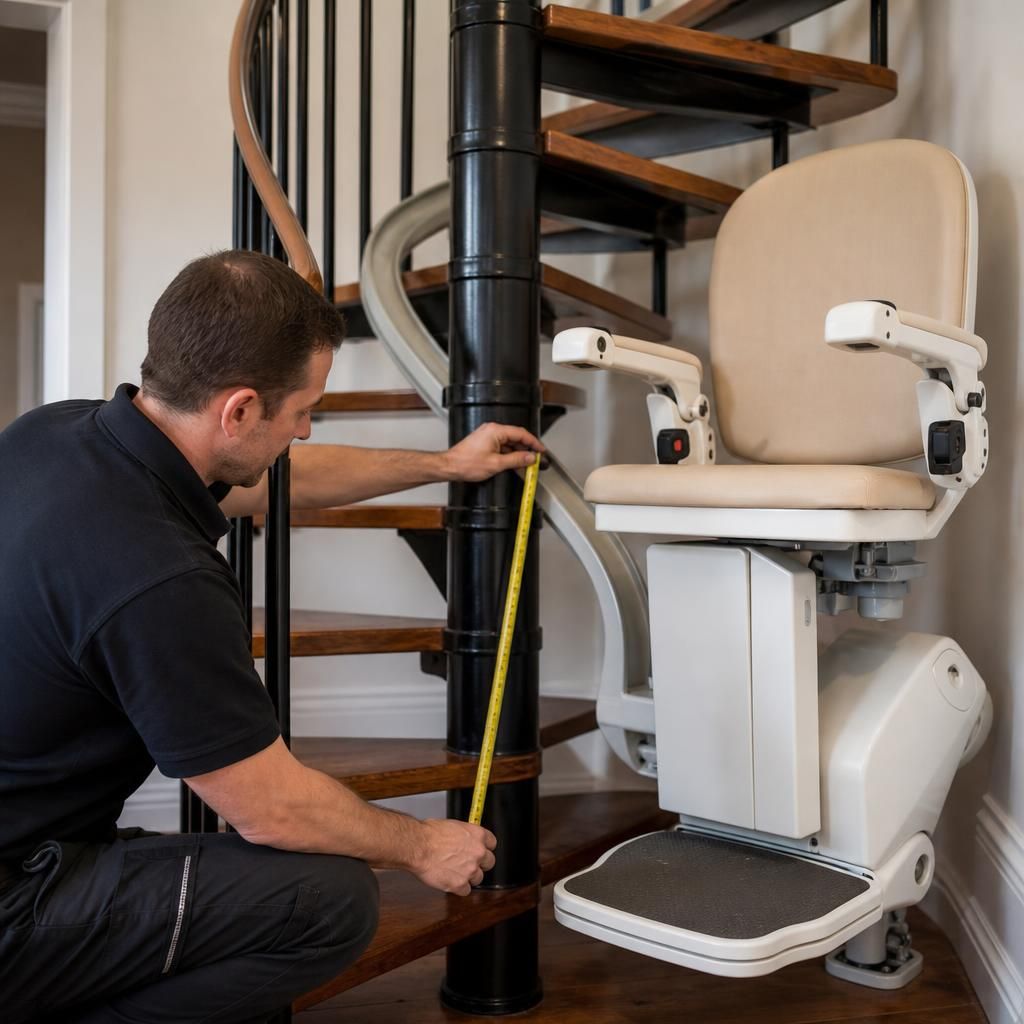
Arrange a bespoke spiral stairlift assessment
Arrange a bespoke spiral stairlift assessment with Independent Stairlifts to confirm the track design, fixing points and safest boarding positions for your staircase.