
How do spiral stairlifts manage the tight turns and narrow spaces of spiral staircases?
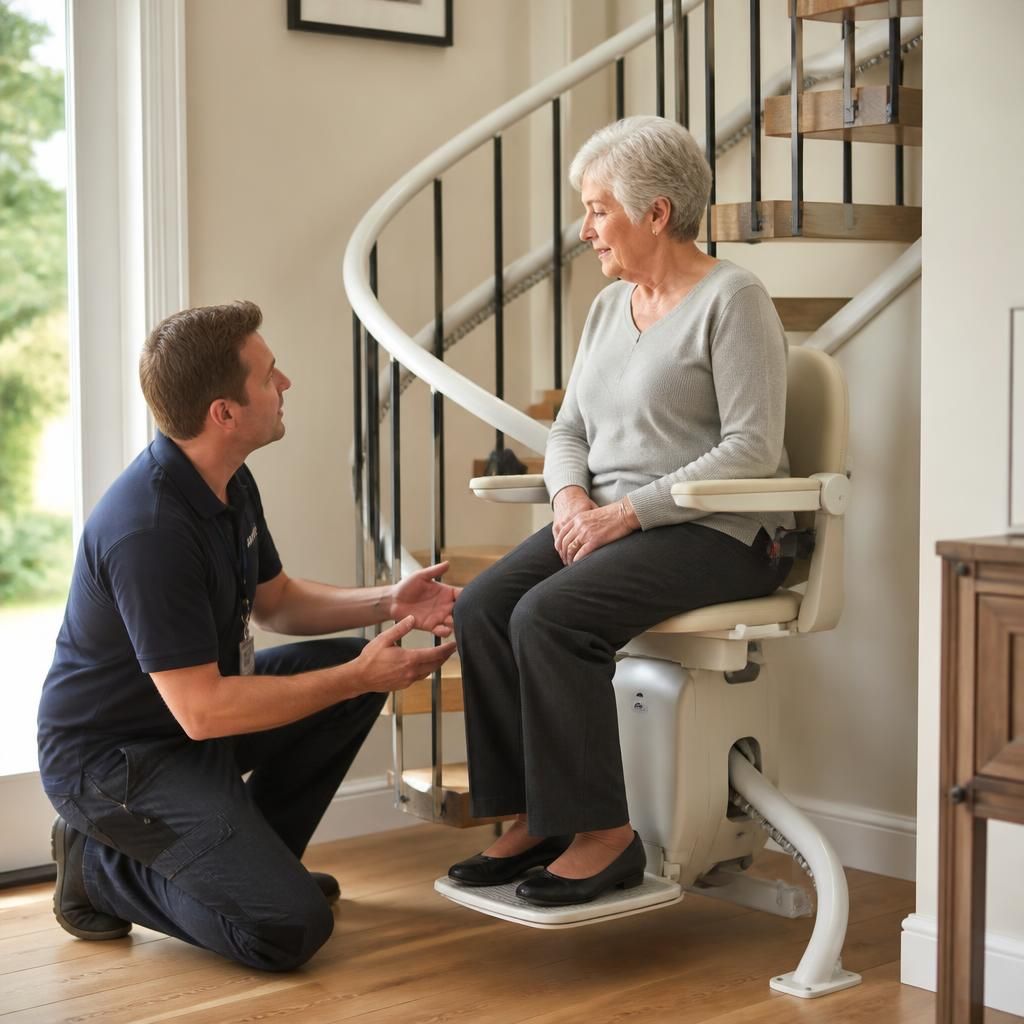
Spiral stairlifts manage tight turns by using a bespoke curved rail designed from a detailed survey of the staircase, allowing the carriage to follow its changing direction and gradient while maintaining a safe position. Compact seating, folding components and suitable swivel or safety features help the lift operate within narrow spaces, subject to the staircase’s width, shape and available clearance.
Spiral stairlifts manage tight turns and narrow spaces through a bespoke curved rail, a compact carriage and safety features that allow the lift to follow the staircase’s changing direction and gradient. The rail is designed from a detailed survey rather than selected from a standard straight section, so its route can be tailored to the staircase, landings, entry points and available clearance.
Unlike a straight stairlift, a spiral model must travel continuously around a curve. The rail is measured and manufactured to follow the staircase’s individual geometry, including its radius, number and shape of turns, tread arrangement and gradient. This creates a smooth, guided route for the carriage while keeping it positioned consistently over the steps.
Several design features help the stairlift operate in a confined space:
- Curved, made-to-measure rail: The rail follows the actual line of the staircase and can accommodate changing curves, rather than forcing the lift to travel along a fixed straight path.
- Compact carriage: The seat, drive mechanism and footrest are selected and positioned to reduce obstruction on the staircase and maintain suitable clearance from walls, balustrades and adjacent features.
- Automatic levelling: The seat is designed to remain level as the carriage travels around the spiral, helping the user stay in a stable and comfortable position.
- Swivel and safety functions: A swivel seat can help the user turn towards the landing when getting on or off. Seat belts, armrests and obstruction sensors provide additional protection during travel, subject to the equipment specification.
- Folding components: Folding arms, footrests and seats can reduce the amount of space occupied when the stairlift is parked and not being used.
- Carefully planned parking points: The rail may be arranged so that the stairlift can be parked clear of a doorway, at the top or bottom of the staircase, or in another practical position where space allows.
The narrowest part of a spiral staircase is usually close to the central newel or inner edge of the curve. This is one of the most important areas assessed during the survey. The installer needs to establish whether the carriage, seat and footrest can pass safely without striking the centre post, handrail, balustrade, wall or other obstruction. Clearance is also considered when the user is seated, as the required space is affected by the seat width, armrests, posture and any mobility equipment used when approaching the lift.
A suitable installation depends on more than the staircase width alone. The survey will normally consider the staircase’s construction, the strength and condition of the treads, the position of supporting walls or alternative fixing points, headroom, landing space, doorways and the route needed to enter and leave the seat. It will also identify whether skirting boards, radiators, windows or furniture could interfere with the rail or carriage.
On a tight spiral staircase, the rail is generally fixed to the steps or another suitable structural surface rather than relying solely on a wall. Where there is no convenient load-bearing wall, this does not automatically rule out a stairlift, but the fixing method must be assessed carefully. The proposed supports must be able to carry the operating loads without damaging the staircase or surrounding structure.
The user’s needs are considered alongside the staircase geometry. A compact seat may improve clearance, but it must still provide adequate support and allow the user to transfer safely. If the user has restricted hip or knee movement, difficulty turning, or needs help from a carer, the position of the seat, swivel action and landing access become particularly important. A stairlift should not be specified solely because the carriage can physically negotiate the curve.
Spiral staircases can present practical limitations. Very narrow steps, abrupt changes in direction, restricted headroom, unsuitable construction or insufficient space at the top and bottom may make a particular design unsuitable. In some homes, the best solution may involve altering the parking position, using a different seat configuration or considering another access arrangement. These decisions should be made after an on-site assessment, not from photographs or staircase measurements taken by the customer.
During installation, the bespoke rail is assembled and secured along the surveyed route, then the carriage and controls are fitted and tested through every section of the staircase. The installer checks movement around the tightest turns, stopping positions, safety sensors, seat levelling, clearances and access at both landings. The user should receive instruction on operating the controls, using the swivel seat and parking the lift safely.
A spiral stairlift therefore does not make a narrow staircase wider. It works by using precise rail design, a suitably compact configuration and careful planning of clearances and access. A detailed survey is essential to confirm whether the staircase can accommodate the equipment safely and to identify the configuration that offers the best balance between space, comfort and everyday usability.
A bespoke curved rail allows a spiral stairlift to follow the staircase around its tight turns while keeping the carriage positioned safely over the steps. The rail is designed from an on-site survey, taking account of the central newel, inner edge of the curve, balustrade, handrail and available headroom.
Clearance is checked with the user seated, not just with the stairlift empty. The seat, armrests and footrest must pass without contact, while still providing adequate support and a safe transfer position at the landing. Folding components and a suitable parking position can help reduce obstruction when the lift is not in use.
Book your spiral stairlift assessment
Book a bespoke spiral stairlift assessment to check the staircase’s curves, clearances, fixing points and landing access. Our survey will help confirm which configuration is suitable for your home and mobility needs.